Choosing the best heat sink depends on the heat load, available space, airflow conditions, thermal resistance target, material requirements, and production cost.
There is no single heat sink type that is best for every application. An extruded heat sink may be ideal for cost-effective electronic cooling, while a Skived Fin Heat Sink is better suited for compact systems requiring higher fin density. For more demanding applications, a heat pipe heat sink or liquid cold plate may provide better thermal performance.
Understanding the differences between common heat sink types can help engineers select the most suitable thermal management solution.
What Factors Determine the Best Heat Sink?
Before selecting a heat sink, several thermal and mechanical factors should be considered.
Heat Load
The total amount of heat generated by the electronic component is one of the most important factors.
Low- to medium-power systems can often use passive or forced-air heat sinks, while high-power systems may require heat pipes or liquid cooling.
Thermal Resistance
Thermal resistance, usually expressed in °C/W or K/W, indicates how effectively the heat sink transfers heat from the heat source to the surrounding environment.
A lower thermal resistance generally means better cooling performance.
Heat Flux
Heat flux describes the amount of heat concentrated over a specific surface area.
A small, high-power semiconductor may create much higher heat flux than a larger component with the same total power.
High heat flux applications often require more advanced cooling structures.
Airflow
A heat sink used under natural convection has different design requirements from one used with fans or blowers.
Forced-air cooling can significantly improve heat transfer, but fin spacing and pressure drop must be optimized.
Installation Space
The available height, width, and length determine which fin structures and cooling technologies can be used.
Compact systems usually require higher fin density or more efficient heat transport.
Extruded Heat Sink
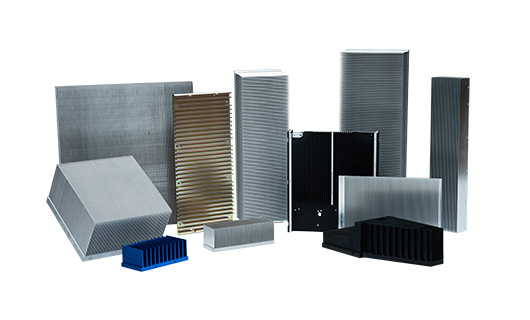
An extruded heat sink is one of the most widely used cooling solutions for electronic equipment.
It is manufactured by forcing heated aluminum through an extrusion die to form a continuous profile with a base and straight fins.
Advantages
Limitations
Extrusion has practical limitations on:
Fin thickness
Fin spacing
Fin height
Fin aspect ratio
Because of these restrictions, extruded heat sinks may not be suitable for extremely high heat flux applications.
Best Applications
An extruded aluminum heat sink is often a good choice for:
Power supplies
LED lighting
Industrial electronics
Motor controllers
Telecom equipment
Inverters
Power amplifiers
For general electronic cooling, an aluminum extruded heat sink often provides the best balance between performance and cost.
A skived fin heat sink is produced by slicing thin layers from a solid block of aluminum or copper and bending them upward to create fins.
Because the fins and base are made from one continuous piece of metal, there is no additional thermal interface between them.
Advantages
Skiving can achieve:
These characteristics make skived fin heat sinks suitable for compact, high-performance thermal management.
Best Applications
A skived fin heat sink is commonly used in:
When space is limited but high cooling surface area is required, a skived heat sink may provide better performance than conventional extrusion.
Cold Forged Heat Sink
A cold forged heat sink is manufactured by shaping aluminum or copper under high pressure.
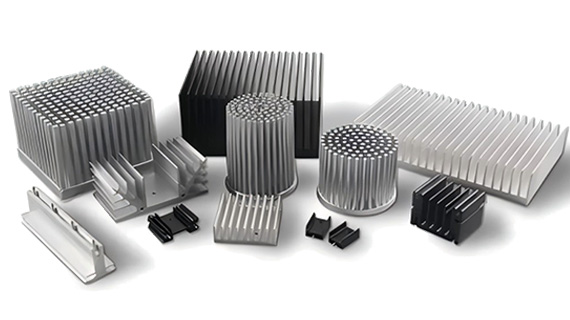
Cold forging can produce dense pin-fin structures, radial fins, and other three-dimensional geometries.
Advantages
Pin-fin structures allow air to flow through the heat sink from multiple directions, which can be useful when airflow direction is not fixed.
Best Applications
Cold forged heat sinks are commonly used in:
LED lighting
Automotive electronics
IGBT modules
Power electronics
Industrial systems
Telecom equipment
For systems requiring compact pin fin heat sink designs, cold forging can be a strong choice.
Heat Pipe Heat Sink
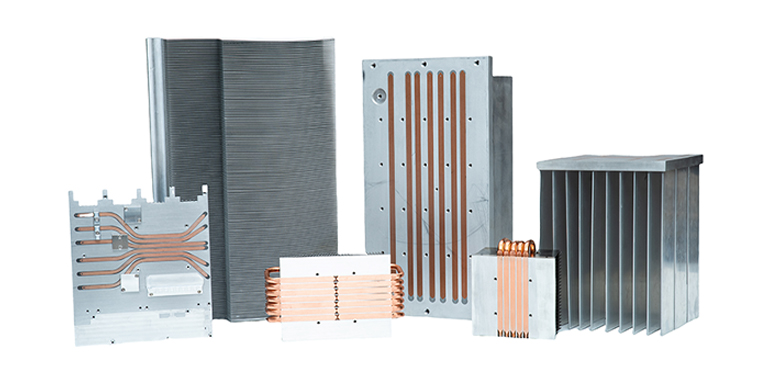
A heat pipe heat sink combines metal fins with one or more heat pipes to transfer heat away from the heat source.
Inside the heat pipe, a working fluid evaporates at the hot end and condenses at the cooler end, creating a highly efficient passive heat transport cycle.
Advantages
High heat transfer capability
Efficient heat spreading
Suitable for remote heat dissipation
Can move heat from a small source to a larger fin stack
Useful in space-constrained systems
Best Applications
Heat pipe cooling is commonly used in:
CPUs
GPUs
Industrial computers
Servers
Telecom equipment
Power electronics
A heat pipe heat sink is often selected when the heat source and cooling area cannot be located directly next to each other.
Liquid Cold Plate
A liquid cold plate uses internal coolant channels to remove heat directly from high-power components.
Water, glycol, or another coolant flows through the cold plate and carries heat away from the system.
Liquid cold plates can be manufactured using processes such as:
Advantages
Liquid cooling provides:
Very low thermal resistance
High heat flux capability
Uniform temperature control
Compact cooling performance
High cooling capacity
Best Applications
Liquid cold plates are widely used in:
For very high-power electronics, a liquid cooling plate generally provides better thermal performance than conventional air-cooled heat sinks.
 Heat Sink Comparison
| Heat Sink Type | Thermal Performance | Fin Density | Cost | Typical Application |
|---|
| Extruded Heat Sink | Good | Moderate | Low | General electronics |
| Skived Fin Heat Sink | High | Very High | Medium–High | High heat flux systems |
| Cold Forged Heat Sink | High | High | Medium | Pin-fin cooling |
| Heat Pipe Heat Sink | High | Depends on Fin Stack | Medium–High | Remote heat transport |
| Liquid Cold Plate | Very High | Not Applicable | Higher | High-power liquid cooling |
Which Heat Sink Is Best for High-Power Electronics?
For high-power electronic systems, the best heat sink depends on power density and operating conditions.
For moderate heat loads with available airflow, a skived fin heat sink or high-performance extruded heat sink may be sufficient.
For concentrated heat sources, a heat pipe heat sink can help spread heat more effectively.
For very high heat flux applications, especially in EVs, data centers, IGBT systems, and high-performance computing, a liquid cold plate is often the most effective cooling solution.
Which Heat Sink Is Best for Cost-Sensitive Applications?
If production cost is a major consideration, an extruded aluminum heat sink is usually one of the most economical solutions.
Once the extrusion die has been developed, large quantities of the same profile can be manufactured efficiently.
This makes extrusion particularly suitable for industrial electronics and power equipment requiring reliable but cost-controlled cooling.
Which Heat Sink Is Best for Compact Systems?
Compact systems require maximum cooling performance from limited space.
For air cooling, a skived fin heat sink can provide high fin density and increased surface area.
A cold forged pin fin heat sink may also be effective when multidirectional airflow is needed.
If air cooling is no longer sufficient, a liquid cold plate can provide much higher cooling capacity within a compact footprint.
Air Cooling vs Liquid Cooling
The choice between air cooling and liquid cooling is one of the most important thermal management decisions.
Air-cooled heat sinks are:
Liquid cooling systems provide:
Higher heat removal capacity
Lower thermal resistance
Better temperature uniformity
Greater performance in high-power systems
However, liquid cooling also requires pumps, tubing, fittings, manifolds, heat exchangers, and leak management.
How to Choose the Right Heat Sink
When selecting a custom heat sink, engineers should evaluate:
For demanding projects, CFD simulation, thermal analysis, prototype testing, airflow testing, and thermal performance testing can help confirm the final design.
 Custom Heat Sink Manufacturing
A professional custom heat sink manufacturer can provide multiple thermal management technologies instead of forcing every application into one solution.
Depending on the project, available options may include:
Extruded heat sinks
Skived fin heat sinks
Cold forged heat sinks
Heat pipe heat sinks
Liquid cold plates
CPU water blocks
GPU water blocks
The final heat sink design can be optimized according to thermal load, airflow, component layout, installation dimensions, materials, surface treatment, and production quantity.
So, which heat sink is best?
The answer depends on the application.
For general electronic cooling and cost-sensitive projects, an extruded heat sink is often the best choice.
For higher fin density and compact air cooling, a skived fin heat sink may provide better performance.
For multidirectional airflow and pin-fin structures, a cold forged heat sink is a strong option.
When heat needs to be transferred away from the source, a heat pipe heat sink can provide efficient heat spreading.
For high-power and high-heat-flux systems, a liquid cold plate usually provides the highest cooling capacity.
The best thermal solution should always be selected based on thermal resistance, heat flux, airflow, installation space, system power, reliability, and total cost.