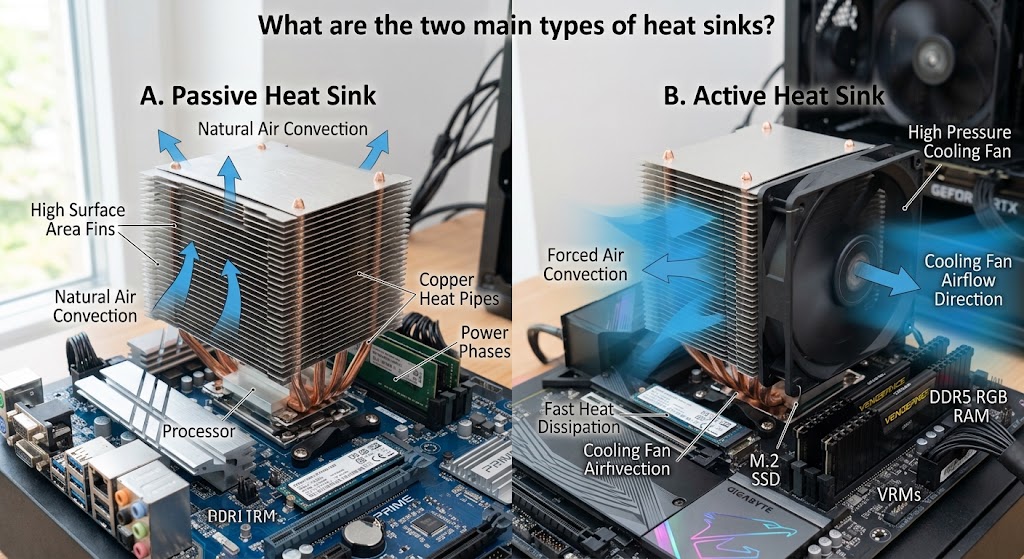
heat sinks are fundamental thermal management components used to dissipate heat generated by electronic devices, processors, and industrial machinery. Based on their operational mechanism and reliance on external energy, Heat Sinks are primarily categorized into two main types: Passive Heat Sinks and Active Heat Sinks.
| Feature | Passive Heat Sinks | Active Heat Sinks |
| Cooling Mechanism | Natural air convection | Forced air or liquid convection |
| Power Consumption | Zero power required | Requires additional electrical power |
| Noise Level | Completely silent (0 dB) | Generates operational noise (fan/pump) |
| Cooling Capacity | Moderate (Low-to-medium thermal loads) | High (High performance/overclocked CPUs & GPUs) |
| Reliability | Extremely high (No moving mechanical parts) | Moderate (Risk of mechanical fan/pump failure) |
| Maintenance | Virtually maintenance-free | Requires periodic dust cleaning & fan replacement |
1. Passive Heat Sinks
A passive heat sink relies entirely on
natural convection and conduction to dissipate thermal energy into the surrounding environment. It contains no moving parts or powered components.
Working Principle: Heat transfers from the heat source (such as a CPU or power transistor) through conduction into the solid metal base of the heat sink. The thermal energy then spreads across large metallic fins, which heat the surrounding air. As warm air becomes less dense and rises, cooler ambient air flows in to replace it, creating a natural thermal current.
Material Composition: Typically constructed from aluminum or copper due to their high thermal conductivity.
Key Advantages:
Silent Operation: Operating without fans or pumps makes them 100% silent.
Cost-Effective & Durable: Without moving parts, mechanical failure rates are practically zero, extending product lifespan.
Primary Uses: Low-power electronics, solid-state drives (SSDs), LED lighting, home routers, and motherboard VRM chips.
2. Active Heat Sinks
An active heat sink utilizes
powered mechanical devices—such as fans, blowers, or liquid pumps—to force fluid or air movement across its cooling fins, dramatically accelerating heat transfer.
Working Principle: While the metal base and fin array absorb and spread heat just like a passive heat sink, an attached active mechanism (usually a high-static-pressure cooling fan) forces a continuous stream of cool air directly through the fin gaps. This forced convection rapidly strips heat away from the metal surface far faster than natural air currents can.
Common Configurations: Air coolers (metal fin stack paired with single or dual fans) and liquid cooling loops (water blocks attached to pump-driven radiators).
Key Advantages:
Superior Thermal Performance: Capable of dissipating massive thermal loads quickly, preventing thermal throttling in high-demand processors.
Compact Footprint for High Power: Achieves much higher cooling efficiency within smaller spatial constraints compared to a massive passive heatsink block.
Primary Uses: High-performance desktop CPUs, gaming GPUs, enterprise servers, high-power industrial inverters, and gaming laptops.
Selecting between passive and active heat sinks depends on the thermal design power (TDP) of the component, acoustic tolerances, space availability, and power supply constraints. While passive heat sinks remain the gold standard for silent, low-power reliability, active heat sinks are essential for demanding, high-performance computing environments.