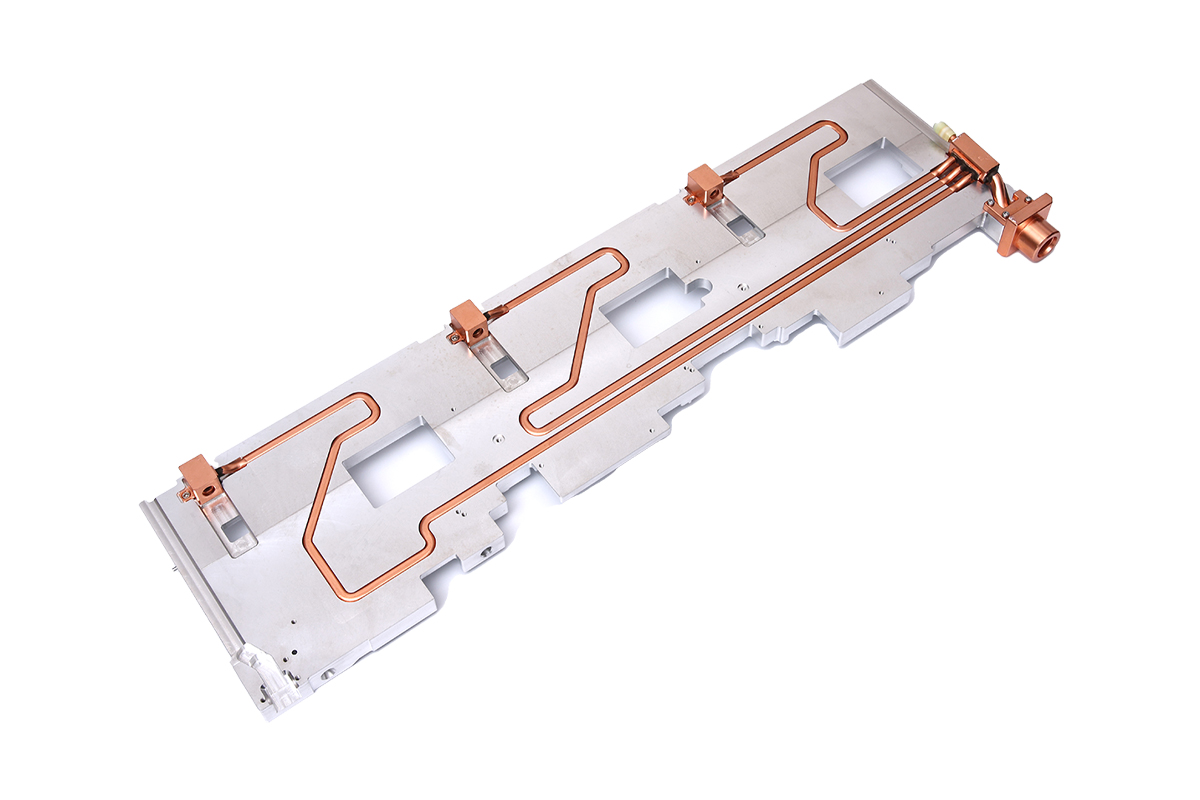
Custom Tube Liquid Cold Plate Manufacturer
Simple and reliable design with embedded tubes for efficient cooling.


Simple and reliable design with embedded tubes for efficient cooling.
A tube liquid cold plate is a liquid cooling component that uses embedded metal tubing, typically copper, within a machined aluminum or copper base to remove heat from electronic and industrial equipment. Coolant circulates through the tubing, absorbs heat conducted from the mounted components, and transfers it to an external cooling system. Tube-based cold plates are commonly customized for power electronics, energy storage, industrial equipment, and other applications requiring flexible coolant routing.
A tube liquid cold plate removes heat from electronic components by transferring thermal energy through a metal base into embedded coolant-carrying tubes. As liquid flows through the tubing, it absorbs heat and carries it away to an external cooling system. This cooling method helps maintain stable operating temperatures in power electronics, industrial equipment, and other heat-generating applications.
Heat generated by power modules, electronic devices, or industrial components is transferred into the cold plate through its contact surface. A properly designed mounting interface helps reduce thermal contact resistance.
The aluminum or copper base conducts heat toward the embedded metal tubing. Tube placement, base thickness, and thermal contact quality influence how effectively heat reaches the coolant channels.
Water or a compatible water-glycol mixture circulates through the embedded tubes. Heat transfers through the tube walls into the flowing coolant. Flow rate, tube diameter, and coolant properties affect cooling performance.
The heated coolant exits the cold plate and flows to an external heat exchanger or cooling unit, where the absorbed heat is rejected. The cooled liquid then returns to the cold plate through the circulation loop.
Engineering Consideration: The thermal performance of a tube liquid cold plate depends on heat load, tube layout, coolant flow rate, pressure drop, base material, and contact resistance. These factors should be evaluated together when designing a custom cold plate cooling solution.
Tube liquid cold plates provide a practical and customizable thermal management solution for industrial and electronic cooling applications. By integrating metal tubing into a thermally conductive base, these liquid cooling plates combine flexible coolant routing, reliable heat transfer, and adaptable mechanical designs.
Embedded copper tubing and thermally conductive metal bases provide an effective heat transfer path from mounted components to circulating coolant. Thermal performance can be optimized through tube layout, base design, and coolant flow conditions.
Tube routing can be customized to match different heat source locations and mounting requirements. Serpentine and other engineered tube paths help distribute cooling across the required areas, subject to bending and spacing limitations.
Embedded tube construction can offer a practical manufacturing option for applications that do not require complex internal microchannels. Production cost depends on plate dimensions, tube geometry, materials, and order volume.
When continuous copper tubing is used inside an aluminum base, the coolant primarily contacts the tube interior rather than the aluminum plate. This can help manage material compatibility, although system-level corrosion protection remains important.
Plate dimensions, mounting holes, tube diameter, inlet and outlet positions, and surface finishing can be adapted to customer drawings. This flexibility supports integration into different industrial cooling assemblies.
Tube liquid cold plates can be used in power electronics, energy storage equipment, industrial automation, telecommunications, and other systems requiring controlled liquid-based heat removal.
Manufacturing a tube liquid cold plate involves precision machining, tube forming, assembly, and quality inspection. KINGKA produces custom embedded tube cold plates based on customer drawings and application requirements, with attention to tube positioning, thermal contact, dimensional accuracy, and coolant integrity.
Customer drawings and thermal requirements are reviewed to determine plate dimensions, base material, tube diameter, coolant routing, and mounting configurations. Tube bending limits and manufacturing feasibility are considered during the design stage.
Precision grooves are machined into the aluminum or copper base using CNC equipment. Groove dimensions and tube placement are controlled to support accurate assembly and effective thermal contact between the tube and the base.
Copper or other specified metal tubing is formed according to the designed cooling path. Bending radius, tube alignment, and deformation are controlled to help maintain coolant flow and reduce the risk of tube damage.
The formed tubing is positioned and pressed into the machined grooves. Suitable fixing methods and thermal interface materials may be applied according to the design to improve tube retention and thermal contact.
The assembled cold plate undergoes additional machining or surface finishing as required. Contact surface flatness, mounting features, and dimensional accuracy are checked against the approved engineering drawings.
Completed cold plates are inspected for dimensional accuracy, tube integrity, and assembly quality. Pressure testing, leak testing, and flow verification can be performed according to agreed project requirements and acceptance criteria.
KINGKA supports customized tube liquid cold plate manufacturing for industrial thermal management projects. Customers can provide 2D or 3D drawings, heat load requirements, coolant specifications, and mechanical constraints for engineering evaluation, prototyping, and production planning.
Choosing the right liquid cold plate manufacturing process is essential for achieving reliable thermal management. Tube liquid cold plates, friction stir welded (FSW) cold plates, and brazed cold plates offer different advantages in channel design, thermal performance, manufacturing complexity, and cost. The comparison below helps engineers select a suitable liquid cooling plate based on their application requirements.
| Comparison | Tube Cold Plate | FSW Cold Plate | Brazed Cold Plate |
|---|---|---|---|
| Channel Structure | Embedded tubing | Machined channels | Bonded internal channels |
| Design Flexibility | Flexible tube routing | Custom channel geometry | Complex internal geometry |
| Thermal Performance | Depends on tube contact and layout | Suitable for large-area cooling | Suitable for compact, high-density designs |
| Manufacturing Cost | Often economical for simpler designs | Depends on machining and welding | Depends on brazing complexity |
| Typical Applications | Industrial electronics, power modules | EV, ESS, power electronics | Servers, high-density electronics |





While we offer 100% customization, the following “Standard Configurations” help customers select the most cost-effective options quickly.
| Spec Parameter | Standard Option A | Standard Option B | Custom Capability |
|---|---|---|---|
| Tube Diameter (OD) | φ 6.0 mm | φ 8.0 mm | φ 9.52mm (3/8") / 12.7mm |
| Tube Material | Copper (TP1 / C1100) | Stainless Steel (304/316) | Cu-Ni Alloys |
| Base Material | Aluminum 6061-T6 Min Bending Radius | Aluminum 6063-T6 R = 15mm | Copper C1100 R = 20mm |
| Max Plate Size | 600 x 400 mm | 800 x 500 mm | Up to 1200mm |
| Cooling Power | ~500W – 1000W | ~1000W – 3000W | > 5kW (Multi-tube) |
| Surface Finish | Fly-Cut (Ra 1.6) | Nickel Plated | Anodized (Alum only) |
(Note: Standard models reduce lead time by utilizing stocked copper coil sizes.)
KINGKA provides custom tube liquid cold plate manufacturing solutions for industrial thermal management applications. From embedded copper tube routing to CNC-machined base plates, our manufacturing capabilities support customer-specific cooling requirements, mechanical configurations, and OEM projects. Each liquid cooling plate can be designed according to the required heat load, coolant conditions, installation space, and engineering drawings.
Choose aluminum or copper base plates with compatible metal tubing, including copper tube configurations. Material selection is evaluated based on thermal conductivity, weight, corrosion compatibility, and application requirements.
Cold plate length, width, thickness, and mounting features can be customized according to equipment dimensions and available installation space. CNC machining supports customer-specific mechanical designs.
Embedded copper tube paths can be designed around heat source locations, including serpentine and other customized routing patterns. Tube diameter, spacing, and bending radius are considered to balance thermal performance and coolant flow.
Inlet and outlet positions, connection orientations, and compatible fittings can be configured to match the customer's liquid cooling system. Connection design considers coolant compatibility, flow requirements, and installation constraints.
Surface machining, protective finishes, and other specified treatments can be evaluated based on environmental conditions, thermal contact requirements, and material compatibility. Contact surfaces can be finished according to approved drawings.
KINGKA supports custom cold plate development from engineering evaluation and prototype manufacturing to production planning. Manufacturing methods and inspection requirements are reviewed according to project specifications and order quantities.
To evaluate your custom water cooling plate project, please share the available technical information. Our team can review your requirements and discuss a suitable manufacturing solution.
KINGKA specializes in custom thermal management components, including tube liquid cold plates, FSW cold plates, brazed cold plates, and precision-machined heat dissipation solutions. We combine engineering evaluation, CNC machining, tube assembly, and quality inspection to support OEM liquid cooling projects across a range of industrial applications.
KINGKA manufactures tube liquid cold plates based on customer drawings and technical requirements. Customization options include base dimensions, embedded tube layouts, mounting configurations, and coolant connection designs.
Our team reviews heat loads, cooling requirements, material options, and mechanical constraints to support manufacturable cold plate designs. Engineering evaluation helps identify suitable tube routing and base configurations for each project.
CNC machining supports accurate groove production, mounting features, and contact surface preparation. Dimensional requirements are reviewed against approved drawings to support consistent assembly and integration with customer equipment.
Quality inspection can include dimensional verification, surface inspection, pressure testing, and leak testing according to project requirements. Inspection criteria are established based on approved specifications and application conditions.
In addition to embedded tube cold plates, KINGKA offers friction stir welded (FSW) and brazed liquid cold plate solutions. This manufacturing portfolio supports different channel structures, thermal requirements, and production needs.
KINGKA supports product development from prototype evaluation to production planning. Custom manufacturing and inspection requirements can be coordinated according to drawings, technical specifications, and project quantities.
Whether you need an embedded copper tube cold plate, a custom water cooling plate, or a specialized liquid cooling solution, KINGKA can evaluate your technical requirements and discuss manufacturing options for your project.
Find answers to common questions about tube liquid cold plates, including cooling performance, materials, manufacturing methods, customization, and industrial applications.
A tube liquid cold plate is a liquid cooling component that uses metal tubing embedded in an aluminum or copper base to remove heat from electronic and industrial equipment. Coolant flows through the tubing, absorbs heat conducted from the base, and transfers it to an external cooling system. Tube cold plates are commonly customized for power electronics, energy storage, and industrial thermal management.
A tube liquid cold plate works by transferring heat from mounted components through a metal base into embedded coolant-carrying tubes. Water or a compatible coolant circulates through the tubes, absorbs thermal energy, and carries it to an external heat exchanger. Cooling performance depends on tube layout, material conductivity, coolant flow rate, and thermal contact resistance.
A liquid cold plate is a general term for a cooling plate that uses circulating liquid to remove heat. A water cooling plate typically refers to a liquid cold plate designed to operate with water or a water-based coolant. Both terms are often used interchangeably in industrial cooling, although liquid cold plates may also use other compatible cooling fluids.
Copper offers higher thermal conductivity, while aluminum provides lower weight and is often more economical. A copper cold plate may be preferred for applications requiring high heat transfer performance, whereas aluminum is commonly used for larger or weight-sensitive designs. Tube cold plates can combine an aluminum base with embedded copper tubing to balance thermal performance, weight, and manufacturing cost.
Tube cold plates use embedded metal tubing to create coolant flow paths. FSW cold plates use machined channels sealed by friction stir welding, while brazed cold plates join metal components to form internal cooling channels. Tube designs are suitable for flexible routing, FSW designs support custom machined flow paths, and brazed designs can accommodate complex internal structures. Selection depends on heat load, pressure requirements, design complexity, and production cost.
Tube liquid cold plates commonly use water or compatible water-glycol mixtures. The appropriate coolant depends on tube material, fittings, operating temperature, corrosion protection, and system requirements. Coolant compatibility should be verified before operation to reduce the risk of corrosion, blockage, or material degradation.
The main factors include heat load, base material, tube diameter, coolant flow rate, tube routing, pressure drop, and thermal contact resistance. Heat source distribution and coolant inlet temperature also influence the operating temperature of the equipment. A custom liquid cooling plate should be evaluated under its intended operating conditions rather than by cooling capacity alone.
Yes. KINGKA provides custom tube liquid cold plates based on customer drawings and application requirements. Customization options include plate dimensions, base materials, copper tube routing, mounting holes, inlet and outlet configurations, and surface finishing. Manufacturing feasibility depends on the specified geometry, materials, and performance requirements.
Tube liquid cold plates are typically manufactured through CNC groove machining, metal tube bending, tube embedding, mechanical fixing or bonding, and final surface machining. The completed assembly is inspected for dimensional accuracy and tube integrity. Pressure testing, leak testing, and flow verification may be performed according to project requirements.
Yes. Tube liquid cold plates can be used for high-power electronic equipment when the cooling design meets the required heat load and temperature limits. Their suitability depends on heat flux, coolant flow rate, tube arrangement, and available cooling surface area. Applications with highly concentrated heat sources may require alternative channel structures or additional thermal optimization.
Leakage risk can be reduced through appropriate tube material selection, controlled bending, suitable fittings, and careful assembly. Continuous tube routing can reduce the number of internal fluid joints, but inlet and outlet connections still require proper sealing. Pressure and leak testing should be performed according to the agreed operating conditions and acceptance criteria.
To request a custom tube liquid cold plate quotation from KINGKA, customers should provide available 2D or 3D drawings, plate dimensions, heat load, coolant type, flow rate, operating pressure, inlet and outlet requirements, and estimated order quantity. These details help the engineering team evaluate manufacturing feasibility, material options, and project requirements.

Kingka Tech Industrial Limited
We specialize in Heat Sink、Liquid Cold Plate、precision CNC machining and our products are widely used in telecommunication industry, aerospace, automotive, industrial control, power electronics, medical instruments, security electronics, LED lighting and multimedia consumption.


Address:
Da Long New Village, Xie Gang Town, Dongguan City, Guangdong Province, China 523598
Email:
WhatsAPP: