FSW, or Friction Stir Welding, is a solid-state joining process used to connect metal materials without melting the base metal. Instead of using an arc, filler metal, or high-temperature brazing furnace, FSW uses a rotating tool to generate frictional heat and mechanically stir softened metal along the joint line.
Because the material remains below its melting point, Friction Stir Welding can reduce defects commonly associated with fusion welding, such as porosity, hot cracking, and excessive thermal distortion.
Today, FSW is widely used in aluminum manufacturing, automotive components, aerospace structures, battery systems, and thermal management products such as FSW Liquid Cold Plates.
For liquid cooling applications, the process is especially valuable because it can create strong, sealed joints around internal coolant channels while maintaining good dimensional accuracy and mechanical strength.
How Does Friction Stir Welding Work?
The FSW process uses a specially designed rotating tool consisting of a shoulder and a pin.
During welding, the tool moves along the joint between two metal parts.
The process typically includes the following steps:
The workpieces are securely clamped together.
A rotating FSW tool is inserted into the joint line.
Friction between the tool and metal generates localized heat.
The metal softens but does not melt.
The rotating pin mechanically stirs the plasticized material.
The softened metal is forged together behind the moving tool.
A dense and continuous welded joint is formed.
This process is known as solid-state welding because the parent material remains in the solid phase throughout the operation.
Why Is FSW Different from Traditional Welding?
Traditional fusion welding methods rely on melting and resolidifying metal.
This can introduce thermal stress, distortion, porosity, cracking, or changes in material properties.
FSW works differently.
Since the material is joined through frictional heating, plastic deformation, and mechanical stirring, the process can produce a fine, dense weld structure with relatively low heat input.
Key characteristics of FSW include:
No bulk melting of the base material
No filler wire required in many applications
Lower thermal distortion
Strong mechanical joints
Good dimensional stability
Reduced risk of porosity
Suitable for aluminum alloys
Good repeatability in production
These advantages make FSW welding particularly suitable for products that require reliable sealing and structural integrity.
A liquid cold plate removes heat by circulating coolant through internal flow channels positioned close to the heat source.
To manufacture this type of component, the internal channels must be machined first and then securely sealed.
One common process is:
CNC Machining + Friction Stir Welding + Surface Finishing + Leak Testing
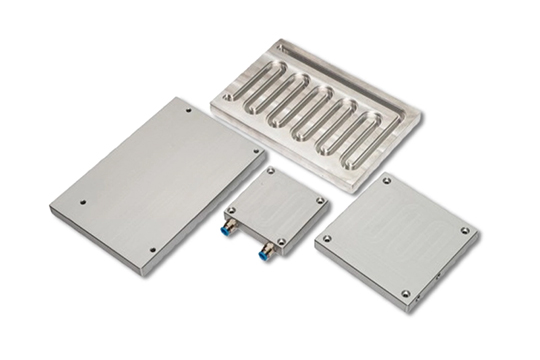
The base plate is first CNC-machined to create the internal coolant channels. A cover plate is then positioned over the channel structure and joined to the base using FSW.
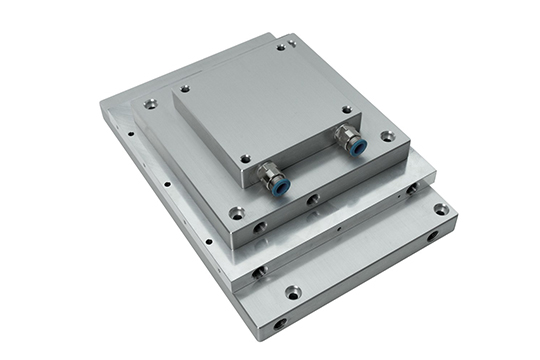
This creates an FSW Liquid Cold Plate with a sealed internal flow path.
Because the weld is produced without melting the aluminum base material, FSW can help reduce distortion around the cold plate surface and maintain consistent channel geometry.
Advantages of FSW Liquid Cold Plates
High Sealing Reliability
Liquid cooling systems require reliable, leak-resistant joints.
The dense weld structure produced by Friction Stir Welding helps reduce risks associated with pores and cracks that may occur in conventional fusion welding.
This makes friction stir welded cold plates suitable for systems requiring stable coolant circulation.
Low Thermal Distortion
Cold plate flatness is important because the mounting surface must maintain good contact with heat-generating components.
The relatively low heat input of FSW helps reduce deformation compared with many high-temperature joining processes.
High Mechanical Strength
The stirred and forged material creates a strong joint with good structural durability.
This is especially important for cold plates exposed to internal coolant pressure, vibration, or long-term industrial operation.
Flexible Flow Channel Design
Before welding, internal channels can be created through precision CNC machining.
Common channel structures include:
This allows an FSW cold plate manufacturer to optimize coolant distribution according to heat source position, heat flux, flow rate, and pressure drop.
Materials Commonly Used in FSW
FSW is particularly well suited to aluminum alloys.
For liquid cold plate manufacturing, commonly used materials include:
Aluminum is widely used because it offers a good balance of:
Thermal conductivity
Low density
Machinability
Corrosion resistance
Mechanical strength
Cost efficiency
Copper and some dissimilar metal combinations can also be processed using specialized FSW techniques, although aluminum remains one of the most common choices for FSW Liquid Cooling Plates.
FSW vs Brazing for Liquid Cold Plates
Both FSW and brazing can be used to manufacture liquid cold plates, but their joining mechanisms are different.
| Feature | FSW Liquid Cold Plate | Brazed Cold Plate |
|---|
| Joining Method | Solid-state friction stir welding | High-temperature brazing |
| Base Metal Melting | No | Base metal remains solid, filler melts |
| Heat Input | Relatively Low | Higher |
| Distortion | Lower | Can be higher |
| Filler Material | Usually Not Required | Brazing filler required |
| Joint Strength | High | Good |
| Typical Use | High-reliability aluminum cold plates | Complex internal cold plate structures |
FSW is often selected when dimensional stability, joint strength, and sealing reliability are especially important.
Brazing remains useful for more complex internal structures that may be difficult to close with a single welded cover plate.
Applications of FSW Liquid Cold Plates
FSW technology is widely used in high-power thermal management systems.
Typical applications include:
EV Battery Cooling
An EV battery cooling plate helps maintain battery temperature uniformity and remove heat during charging and discharging.
Data Center Liquid Cooling
FSW cold plates can support cooling for CPUs, GPUs, AI servers, and HPC systems where power density continues to increase.
IGBT and Power Electronics
An IGBT liquid cold plate provides efficient cooling for power modules, MOSFETs, inverters, and converters.
Energy Storage Systems
Battery energy storage systems use liquid cooling to maintain stable operating temperatures and improve system reliability.
Industrial Equipment
FSW cooling plates can also be used in industrial lasers, medical devices, semiconductor equipment, automation systems, and other high-heat-density applications.
Important Design Parameters for an FSW Cold Plate
The performance of an FSW liquid cold plate depends not only on the welding process but also on the overall thermal and hydraulic design.
Important parameters include:
Heat load
Heat flux
Cold plate dimensions
Channel width and depth
Coolant flow rate
Pressure drop
Inlet and outlet position
Material thermal conductivity
Mounting surface flatness
Operating pressure
Coolant type
Surface treatment
For demanding projects, CFD simulation and thermal analysis can be used to optimize channel geometry and coolant distribution before production.
FSW Liquid Cold Plate Manufacturing
As an FSW Liquid Cold Plate manufacturer, a complete manufacturing process can combine:
Custom Cold Plates can be developed according to customer requirements for dimensions, flow channels, mounting holes, inlet and outlet positions, coolant type, and operating pressure.
This makes FSW suitable for both standard thermal management products and custom liquid cold plate projects.
FSW, or Friction Stir Welding, is a solid-state joining technology that uses frictional heat and mechanical stirring to join metal without melting the base material.
Its advantages include high joint strength, low thermal distortion, good sealing reliability, and compatibility with aluminum alloys.
For thermal management applications, FSW is especially suitable for manufacturing liquid cold plates with CNC-machined internal flow channels.
By combining precision machining, optimized coolant channel design, and reliable Friction Stir Welding, an FSW Liquid Cold Plate can provide efficient heat removal for EV batteries, data centers, IGBT modules, energy storage systems, and other high-power electronic applications.