 Why New Energy Applications Need a More Capable Thermal Management Supplier
Power density continues to climb across wind power equipment, energy storage systems, new energy vehicles, and nuclear power equipment. Standard, off-the-shelf cooling components are increasingly unable to keep up — installation space is limited, heat sources are unevenly distributed, or the parts simply can't deliver the thermal performance required for long-term stable operation.
That's why more new energy equipment manufacturers, system integrators, and purchasing teams are looking for a supplier who can genuinely understand the application, evaluate the cooling target, recommend the right structure, and deliver a solution that's both thermally effective and manufacturable — not just a machining vendor.
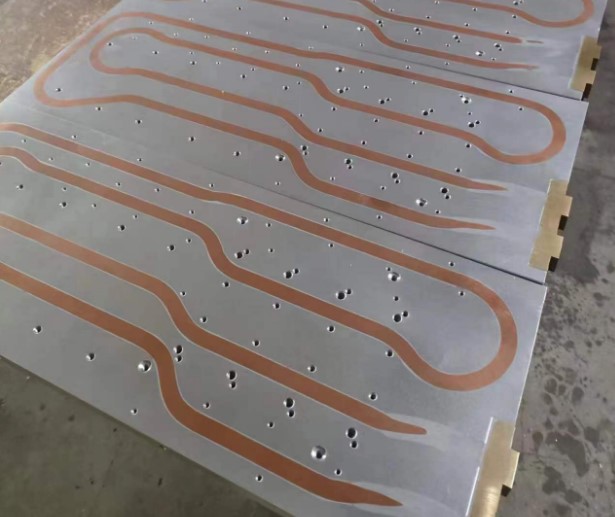
At Kingka, we've built our liquid cold plate and Heat Sink lineup around exactly this kind of customization, including FSW Liquid Cold Plates, Tube Liquid Cold Plates, Brazed Liquid Cold Plates, CPU Water Blocks, and aluminum, copper, and water-cooled heat sinks — so different new energy scenarios can be matched with the right thermal solution.
What Concerns Do Buyers Usually Face in New Energy Projects?
In real new energy projects, buyers are rarely just asking for "a liquid cold plate" or "a heat sink." They're usually trying to solve a series of practical engineering and supply-chain problems.
| Buyer Question | What It Really Means |
|---|
| Can this solution remove enough heat? | Thermal performance must match the real heat load |
| Which structure is better suited to my project? | The buyer needs guidance, not just a quote |
| Can the design fit my limited installation space? | Mechanical layout is often a key restriction |
| Will there be sealing or leakage risk under long-term operation? | Reliability and sealing performance matter |
| Can you support customization from drawing to mass production? | The buyer wants engineering cooperation, not just fabrication |
| Can you control tolerance and consistency? | Quality stability matters for assembly and long-term use |
These are exactly the kinds of questions that separate a custom new energy thermal project from a standard parts purchase.
How Kingka Responds to Different New Energy Scenarios
Scenario 1 – Wind Power Equipment: Sealing Reliability Under Long-Term Operation
Wind turbine converters and inverters run continuously under high load for extended periods. Buyers in this space typically ask:
Will the cooling channel stay reliable over long-term use?
Is the sealing method stable enough for continuous operation?
Can the structure maintain performance under harsh working conditions?
For this type of requirement, an FSW Liquid Cold Plate is often the right direction. This structure is well suited to applications where reliable sealed channels and strong mechanical performance matter — making it a good fit for the long-duty-cycle demands of wind power equipment.
Scenario 2 – Energy Storage Systems: A Cost-Effective, Practical Cooling Solution
Battery module cooling in energy storage systems doesn't always require the most complex structure. Buyers here are usually asking:
Is there a more economical solution for my project?
Do I really need a complex channel design?
Can I get stable cooling performance without overdesigning the part?
For projects like this, a Tube Liquid Cold Plate is often the more practical choice. It's a proven, cost-effective structure that helps energy storage systems achieve even, stable heat dissipation while controlling cost — reducing the risk of localized hot spots.
Scenario 3 – New Energy Vehicles and High-Power Electronics: Higher Thermal Performance or More Complex Flow Paths
EV battery packs, motor controllers, and high-power power electronics often face higher heat flux and more concentrated hot spots. Buyers typically ask:
Can the cold plate handle higher thermal density?
Can the internal channel be designed more efficiently?
Does this application need a more advanced structure?
For these requirements, a Brazed Liquid Cold Plate is usually the better fit. This process route suits applications that need stronger heat dissipation capability or more complex internal channel configurations — providing the level of thermal performance new energy vehicle applications demand.
Scenario 4 – Nuclear Power Equipment: Extreme Reliability and Precision Thermal Control
Nuclear power equipment operates under the industry's highest safety and reliability standards, where any instability in the cooling system can have serious consequences. For these applications, a CPU Water Block's precision cooling capability, combined with strict material selection and process control, helps ensure stable operation even under extreme requirements.
Why Buyers Prefer Suppliers That Support Engineering Communication
Early in a new energy project, buyers often only have drawings, a rough heat-load estimate, or a general application concept. What they really need is a supplier who can communicate clearly and help move the project forward.
| What Buyers Usually Expect | Why It Matters |
|---|
| Engineering and design support | Improves solution feasibility |
| DFM (design-for-manufacturability) feedback | Reduces production risk and unnecessary cost |
| Tolerance control | Ensures better assembly fit |
| Fast quotation response | Supports project speed |
| Multiple process options | Improves solution flexibility |
| Prototype-to-mass-production support | Helps buyers move from development to delivery |
What Information to Prepare Before Contacting Us
To get more accurate feedback and a more suitable recommendation, buyers should ideally prepare the following project details in advance:
| Information | Why It Helps |
|---|
| 2D/3D drawings | Clarifies structure and dimensions |
| Heat load data | Helps evaluate the cooling requirement |
| Coolant type | Affects material and design choice |
| Flow rate requirement | Impacts channel and thermal design |
| Pressure drop limit | Important for liquid loop design |
| Installation space | Determines structural feasibility |
| Surface/tolerance requirements | Helps confirm manufacturing capability |
| Estimated quantity | Supports process planning and quotation |
The more complete the project information, the easier it is for us to recommend whether an FSW Liquid Cold Plate, Tube Liquid Cold Plate, Brazed Liquid Cold Plate, or CPU Water Block is the best fit for your new energy project.
FAQ
Why do new energy applications lean toward custom liquid cooling rather than standard cooling parts?
Standard parts often can't match the actual installation space, heat distribution, or long-term operating requirements. Custom solutions address these issues more precisely while still balancing manufacturability and cost.
Which liquid cold plate structure suits wind power, energy storage, EVs, and nuclear power respectively?
Wind power favors the FSW Liquid Cold Plate for its sealing reliability; energy storage favors the cost-effective Tube Liquid Cold Plate; new energy vehicles and high-power electronics favor the Brazed Liquid Cold Plate for its stronger thermal performance; nuclear power requires the precision cooling of a CPU Water Block combined with strict process control.
How do I decide between an aluminum or Copper Heat Sink?
It comes down to balancing thermal conductivity, weight, and cost. Copper offers better thermal conductivity but at higher cost and weight; aluminum offers advantages in lightweighting and cost control. The right choice depends on your specific operating conditions — our technical team can help you decide.
Can I get guidance without complete technical documentation yet?
Yes. Even at an early project stage, providing a basic application scenario and rough cooling requirement is enough for our engineering team to help assess direction, with the details refined as the project progresses.
Looking for a thermal management supplier who genuinely understands your application for wind power, energy storage, new energy vehicle, or nuclear power projects? Contact our technical team today for a customized liquid cold plate and heat sink recommendation.