Heat sinks are essential thermal management components used to remove excess heat from electronic devices and maintain stable operating temperatures. Choosing the right heat sink material directly affects heat dissipation efficiency, product reliability, weight, and manufacturing cost.
So, what material are heat sinks made of?
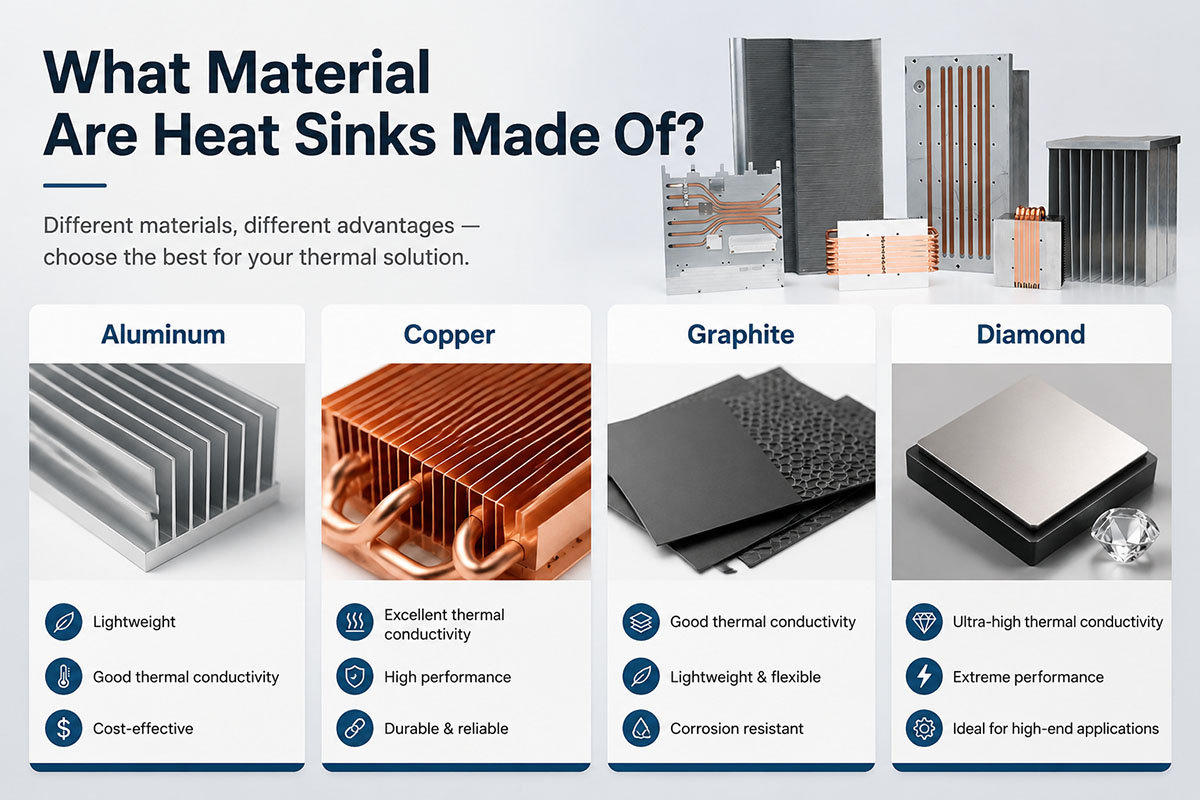
The most common materials used for heat sinks are aluminum and copper. Aluminum is widely used because of its excellent balance of thermal conductivity, lightweight design, corrosion resistance, and cost-effectiveness. Copper provides superior thermal performance for high-power applications due to its higher thermal conductivity. In addition, advanced materials such as graphite, composite materials, and diamond are used in specialized thermal management applications.
Understanding the differences between these materials helps engineers select the right solution for applications such as CPUs, GPUs, LED lighting, power electronics, automotive systems, and industrial equipment.
What Makes a Good Heat Sink Material?
A good heat sink material needs to efficiently transfer heat away from electronic components while meeting mechanical and manufacturing requirements.
The key factors that determine heat sink material performance include:
Thermal Conductivity
Thermal conductivity measures how effectively a material transfers heat. A higher thermal conductivity value means the material can move heat more efficiently from the heat source to the surrounding environment.
Common thermal conductivity values:
| Material | Thermal Conductivity |
|---|
| Aluminum | 150–235 W/m·K |
| Copper | Around 400 W/m·K |
| Graphite | Varies depending on grade |
| Diamond | Around 1000 W/m·K |
Weight
The weight of the heat sink material is important for applications where space and weight are limited.
For example:
Aluminum heat sinks are widely used in laptops, LED systems, and portable electronics.
Copper heat sinks are preferred for high-performance systems where maximum cooling is required.
Cost and Manufacturability
A practical heat sink material must also be easy to manufacture and cost-effective.
Aluminum is popular because it can be easily processed through:
Extrusion
Die casting
Forging
CNC machining
This makes aluminum heat sinks suitable for large-scale production.
Durability and Corrosion Resistance
Heat sinks used in industrial or outdoor environments require materials that can withstand temperature changes, humidity, and corrosion.
Aluminum can also be anodized to improve:
Surface protection
Corrosion resistance
Product durability
 Why Is Aluminum the Most Common Heat Sink Material?
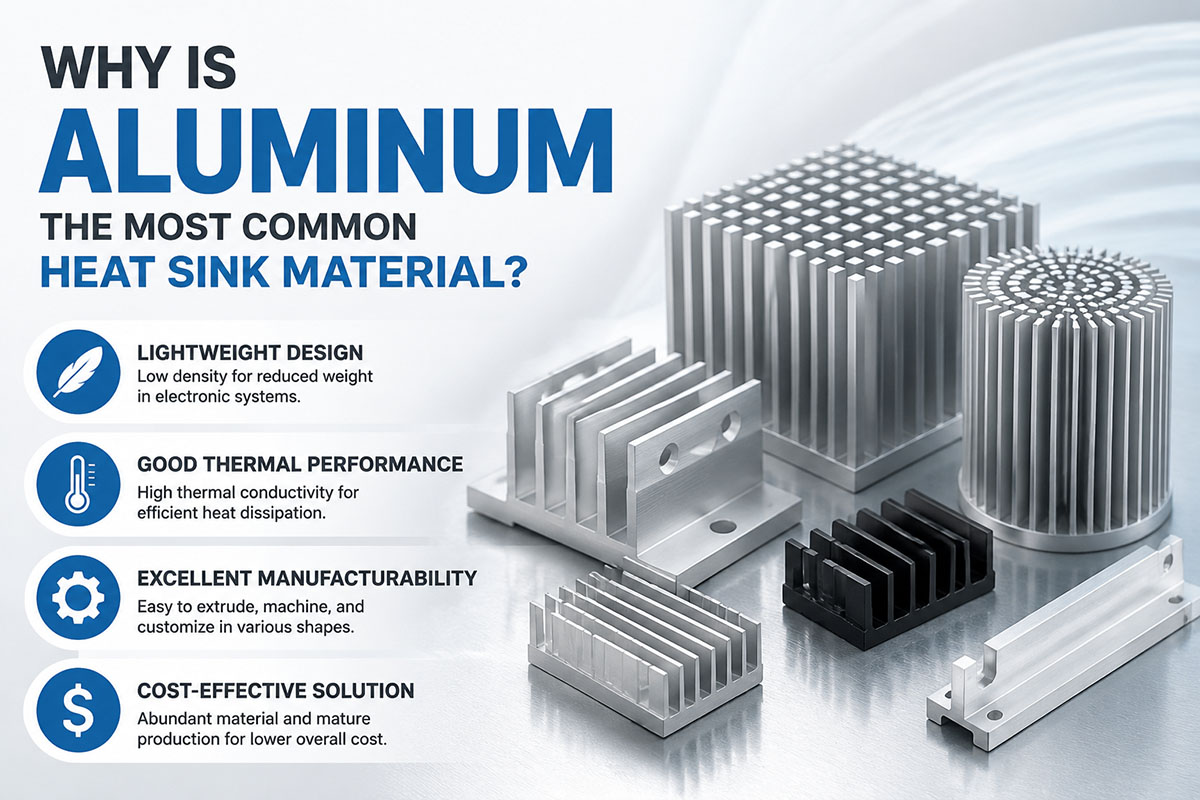
Aluminum is the most widely used material for heat sinks because it provides an excellent balance between thermal performance, weight, and cost.
Common aluminum alloys used for heat sinks include:
6061 Aluminum
6063 Aluminum
1050 Aluminum
ADC12 Aluminum
Advantages of Aluminum Heat Sink
Lightweight Design
Aluminum has a density of approximately 2.7 g/cm³, making it much lighter than copper.
This advantage makes aluminum heat sinks ideal for:
Consumer electronics
LED lighting
Computers
Automotive electronics
Aerospace applications
Good Thermal Performance
Although aluminum does not conduct heat as well as copper, its thermal conductivity of approximately 150–235 W/m·K is sufficient for most electronic cooling applications.
Excellent Manufacturability
Aluminum is highly suitable for manufacturing processes such as:
This allows manufacturers to create complex fin structures that increase heat dissipation surface area.
Cost-Effective Solution
Compared with copper, aluminum is more affordable and easier to process, making it the preferred choice for most commercial applications.
When Is Copper the Best Heat Sink Material?
Copper is selected when maximum heat dissipation performance is required.
With thermal conductivity of approximately 400 W/m·K, copper heat sinks provide nearly twice the thermal conductivity of aluminum.
Advantages of Copper Heat Sink
Superior Heat Transfer Capability
Copper quickly transfers heat away from high-power components, making it suitable for:
High-performance CPUs
GPUs
Power modules
Industrial electronics
Semiconductor equipment
Excellent Temperature Uniformity
Copper distributes heat evenly across the heat sink surface, reducing hot spots and improving system stability.
High Reliability
Copper heat sinks perform well in demanding environments where thermal loads are extremely high.
Limitations of Copper Heat Sink
Despite its excellent thermal performance, copper has some disadvantages:
Because of these limitations, copper is usually used in high-performance applications rather than general-purpose cooling solutions.
Are There Other Heat Sink Materials?
Besides aluminum and copper, several advanced materials are used for specialized thermal management solutions.
Graphite Heat Sink
Graphite offers excellent thermal conductivity with very low weight.
Advantages include:
Graphite heat sinks are commonly used in:
Composite Heat Sink Materials
Composite heat sinks combine different materials to achieve better performance.
Examples include:
These solutions provide a balance between:
Thermal conductivity
Weight reduction
Manufacturing cost
Diamond Heat Sink
Diamond has extremely high thermal conductivity, reaching approximately 1000 W/m·K.
However, due to its extremely high cost, diamond is currently limited to specialized applications such as:
Comparison of Common Heat Sink Materials
| Material | Thermal Conductivity | Weight | Cost | Common Applications |
|---|
| Aluminum | 150–235 W/m·K | Low | Low | LED lighting, electronics, industrial cooling |
| Copper | ~400 W/m·K | High | Higher | CPUs, GPUs, power electronics |
| Graphite | High | Very Low | High | Smartphones, aerospace |
| Diamond | ~1000 W/m·K | Medium | Very High | Advanced thermal applications |
How to Choose the Right Heat Sink Material?
Selecting the correct heat sink material depends on several factors:
Heat Load
High-power devices generating large amounts of heat may require copper or copper-aluminum hybrid solutions.
Space and Weight Requirements
For compact or lightweight designs, aluminum is usually the better choice.
Manufacturing Requirements
For mass production, aluminum is preferred because it supports efficient manufacturing processes such as:
Aluminum extrusion
Die casting
Cold forging
Operating Environment
Industrial and outdoor applications may require materials with better corrosion resistance and durability.
Common Heat Sink Manufacturing Materials and Processes
Professional heat sink manufacturers select different materials and manufacturing methods based on customer requirements.
Common heat sink types include:
Made by pushing aluminum profiles through a customized die.
Advantages:
Manufactured by cutting fins directly from a metal block.
Advantages:
Die Cast Heat Sink
Produced by injecting molten aluminum into precision molds.
Advantages:
Cold Forging Heat Sink
Manufactured through metal forming under high pressure.
Advantages:
Applications of Different Heat Sink Materials
Heat sink materials are widely used in:
CPU and GPU cooling systems
LED lighting
Automotive electronics
Electric vehicle systems
Battery management systems
Power converters
Industrial controllers
Telecommunications equipment
Renewable energy systems
Medical devices
Custom Heat Sink Material Solutions
As an experienced heat sink manufacturer, KINGKA provides customized thermal management solutions based on application requirements.
We offer:
Our engineering team evaluates:
to recommend the most suitable material and heat sink structure.
FAQ
Q1: What material are most heat sinks made of?
A: Most heat sinks are made of aluminum because it provides a good balance of thermal conductivity, lightweight design, corrosion resistance, and cost.
Q2: Is copper better than aluminum for heat sinks?
A: Copper has higher thermal conductivity and provides better cooling performance, but it is heavier and more expensive than aluminum. Aluminum is preferred for most applications.
Q3: Why are aluminum heat sinks widely used?
A: Aluminum heat sinks are lightweight, affordable, easy to manufacture, and provide sufficient thermal performance for most electronic cooling applications.
Q4: What is the best heat sink material for high-power electronics?
A: Copper or copper-aluminum composite materials are often preferred for high-power electronics because they provide excellent heat transfer performance.
Q5: Can heat sink materials be customized?
A: Yes. Professional heat sink manufacturers can customize materials, structures, and manufacturing processes according to thermal requirements and application conditions.