The thermal conductivity of an aluminum extruded heat sink typically ranges between
160 W/m·K and 210 W/m·K. Because extruded Heat Sinks are made from aluminum alloys rather than pure aluminum, their exact thermal performance depends on the specific alloy selection, temper treatment, and manufacturing process.
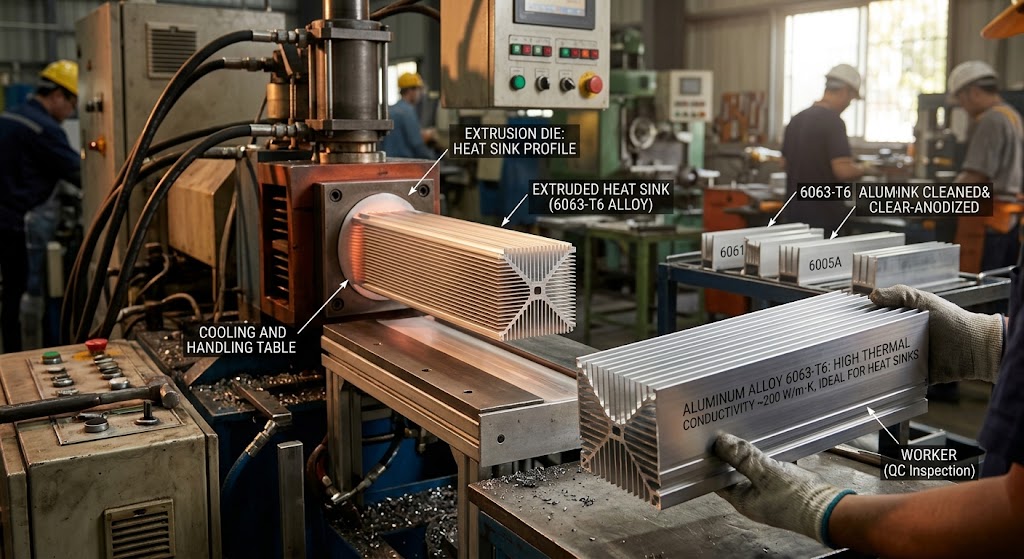
Thermal Conductivity by Common Heat Sink Alloys
Aluminum 6063-T5 / T6 ( ~200 - 201 W/m·K): 6063 is the most widely used alloy for extruded heat sinks due to its high thermal conductivity and excellent extrudability, which allows for intricate fin designs.
Aluminum 6061-T6 ( ~166 - 180 W/m·K): Used when higher structural strength or mechanical load capacity is required. Its thermal conductivity is slightly lower than 6063, but it offers better tensile strength.
Aluminum 6005A ( ~185 - 190 W/m·K): Serves as a middle ground between 6063 and 6061, balancing moderate-to-high thermal performance with improved structural rigidity.
Pure Aluminum 1050/1060 (~220 - 230 W/m·K): Pure aluminum has the highest thermal conductivity, but its softness makes it difficult to extrude into tall, thin fins. It is typically reserved for cold forging or Stamping rather than extrusion.
Factors Affecting Real-World Heat Sink Performance
Alloy Composition & Heat Treatment (Temper): Adding alloying elements like silicon and magnesium increases structural strength but slightly disrupts the crystal lattice, lowering thermal conductivity compared to pure aluminum ( ~237 W/m·K). Tempering processes like T5 or T6 optimize both strength and thermal pathway efficiency.
Anodization & Surface Finishes: Anodizing (black or clear) creates an oxide layer that slightly insulates the metal surface (~1 - 3 W/m·K for the thin alumina layer). However, black anodizing increases thermal emissivity, improving overall radiant heat dissipation in passive cooling environments.
Extrusion Direction & Fin Density: While the thermal conductivity of aluminum is isotropic (equal in all directions), the overall thermal resistance of the heat sink depends heavily on fin geometry, base thickness, and airflow channel orientation.