Extruded aluminum Heat Sinks rely on specific aluminum alloys that offer an optimal balance of thermal conductivity, structural strength, extrudability, and surface finishing capabilities. Aluminum’s natural light weight and high thermal performance make it the most widely used material for extruded heat sinks in electronics, automotive, and industrial thermal management.
Most Common Aluminum Alloys for Heat Sinks
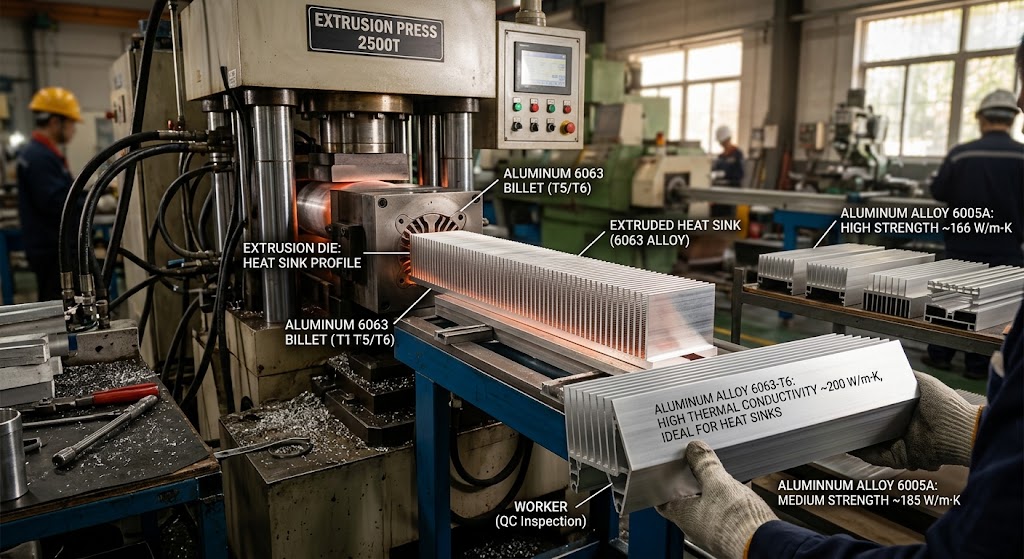
6063 Aluminum (The Industry Standard): 6063 is by far the most popular alloy for extruded heat sinks. It provides excellent extrudability, allowing manufacturers to create complex, high-density fin geometries. While its thermal conductivity (~200 W/m·K in the T5/T6 temper) is slightly lower than pure aluminum, its superior mechanical strength, corrosion resistance, and excellent response to anodizing make it the top choice for standard CPU coolers, LED drivers, and power electronics.
6061 Aluminum (High Structural Strength): 6061 offers higher mechanical strength and tensile properties than 6063, making it ideal for structural heat sinks, heavy-duty industrial enclosures, and aerospace applications. Its thermal conductivity (~166–180 W/m·K) is somewhat lower than 6063, and it is slightly harder to extrude into intricate fin patterns, but it excels when the heat sink must also serve as a load-bearing component.
1050 and 1060 Aluminum (Maximum Thermal Performance): Composed of over 99.5% pure aluminum, the 1000-series alloys offer superior thermal conductivity (~220–230 W/m·K). However, because pure aluminum is very soft and malleable, it is difficult to extrude into tall, thin fins without structural deformation. Consequently, 1050/1060 is more commonly reserved for cold-forged or stamped heat sinks rather than complex extrusions.
6005A Aluminum (Medium Strength & Intricate Profiles): 6005A bridges the gap between 6063 and 6061. It provides higher strength than 6063 while maintaining better extrudability and fin aspect ratios than 6061. It is frequently used for medium-to-heavy Industrial Heat Sinks and automotive thermal modules.
Alloy Comparison Matrix
| Aluminum Alloy | Thermal Conductivity (W/m⋅K) | Extrudability | Structural Strength | Typical Application |
| 6063 (T5/T6) | ~ 200 | Excellent | Moderate | Standard electronics, LED lighting, CPU/GPU coolers |
| 6061 (T6) | ~166 - 180 | Moderate | High | Structural heat sinks, enclosure bases, aerospace |
| 6005A | ~ 180 - 190 | Good | Medium-High | Industrial power modules, heavy-duty electronics |
| 1050 / 1060 | ~ 225 | Poor (too soft) | Low | Cold-forged pin fins, stamped heat spreaders |