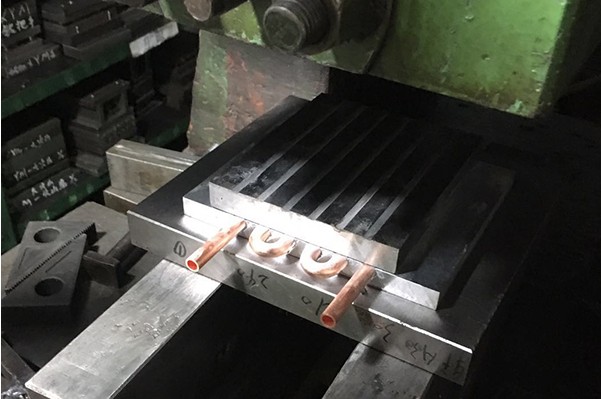
A Cold Plate Cooling System is a type of liquid cooling solution that uses a metal plate with internal fluid channels to transfer heat away from high-power components such as batteries, IGBTs, CPUs, power modules, and other electronic devices. The circulating coolant absorbs heat from the heat source and carries it away efficiently, making it one of the most effective thermal management solutions for high power density applications.As industries continue to demand higher performance and more compact designs, cold plate cooling systems have become essential in modern thermal management. Below are the key benefits of this technology.
1. High thermal efficiency
One of the main advantages of a cold plate cooling system is its excellent heat transfer capability.
The liquid flowing inside the cold plate rapidly absorbs and removes heat from the surface of the heat-generating components.
Compared with traditional air cooling systems, Cold Plate Liquid Cooling provides significantly higher heat dissipation efficiency, making it ideal for high power density applications.
2. Excellent temperature uniformity
A major challenge in thermal management is avoiding localized overheating, also known as hot spots.
Cold plate systems help distribute heat evenly across the entire surface.
This improved temperature uniformity ensures that all components operate within safe thermal limits, improving system stability and performance.
3. Ideal for high-power applications
A cold plate cooling system is widely used in industries that require efficient thermal control, including:
Electric vehicle battery packs (EV battery pack cold plate cooling)
Data center servers and CPU cooling systems
IGBT and power electronics modules
Laser systems
Energy storage systems (ESS liquid cooling)
These applications rely on Liquid Cold Plates to maintain safe and stable operating temperatures under continuous high load conditions.
4. Compact and space-saving design
Compared with traditional air cooling systems that rely on large heatsinks and fans, a Liquid Cold Plate cooling solution offers a much more compact structure.
This makes it especially suitable for modern electronic systems where space optimization is critical, such as EV battery modules and high-density power electronics.
5. Low noise operation
Since a cold plate system relies on liquid circulation rather than high-speed fans, it operates much more quietly.
This low-noise advantage is particularly important for environments such as data centers, medical equipment, and precision industrial systems.
6. Improved reliability and longer service life
Stable temperature control directly impacts component lifespan.
By maintaining consistent operating temperatures, a cold plate cooling system reduces thermal stress and slows down electronic aging.
This results in improved reliability and longer service life for critical components.
7. Strong scalability and flexible design
Another key benefit of cold plate liquid cooling systems is scalability.
Multiple cold plates can be connected in parallel or series to support different cooling capacities, allowing engineers to design flexible thermal solutions for various power levels and system architectures.
In summary, the benefits of a cold plate cooling system can be described as:
high efficiency, excellent temperature uniformity, compact design, low noise, and strong scalability for high power density cooling applications.
As industries such as electric vehicles, energy storage, and power electronics continue to grow, liquid cold plate cooling technology is becoming a core solution for advanced thermal management systems.