

A replacement water cooling plate should be approved against the equipment's mechanical, thermal, hydraulic and reliability requirements. Matching the original plate's external dimensions and connection sizes establishes only part of the required equivalence.
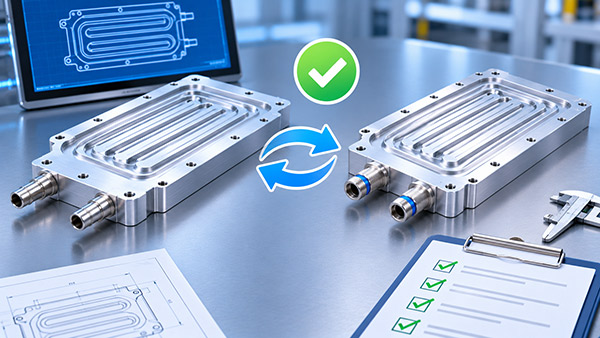
Buyers may investigate alternatives to improve availability, reduce cost or support a second source. A structured approval process helps determine whether the proposed saving remains worthwhile after engineering review, qualification and production introduction.
1. Establish the Original Approval Basis
Start with the requirements that made the existing plate acceptable. Collect the controlled drawing, material specification, coolant conditions, operating limits and relevant qualification evidence.
Identify any requirements that depend on the surrounding equipment. These may include a restricted mounting envelope, limited pump capability, electrical clearance or access for connecting hoses.
The replacement supplier needs a clear target. An equipment description such as “a plate for a 2 kW system” provides limited information without the heat-source layout, temperature limits and cooling conditions.
2. Build an Equivalence Matrix
| Comparison area | Evidence to obtain | Approval question |
|---|---|---|
| Mechanical fit | Controlled dimensions, datums and mounting details | Can the part be installed using the approved assembly method? |
| Thermal performance | Temperature results under common heat-source and coolant conditions | Are the required temperature limits satisfied? |
| Hydraulic behavior | Pressure-drop data across the required flow range | Can the existing circuit supply adequate flow? |
| Material compatibility | Wetted materials, seals, coatings and coolant requirements | Is the proposed construction compatible with the loop? |
| Fluid containment | Defined pressure and leak test results | Does the assembly meet the required containment criteria? |
| Production controls | Inspection plan, revision identification and change procedure | Can the approved configuration be supplied consistently? |
Mark each item as demonstrated, pending or outside the proposed supply scope. Open items should have an assigned owner and an agreed resolution before the relevant approval stage.
3. Examine Hidden Differences
Two plates can share mounting holes while using different tube diameters, channel layouts, sealing methods or surface treatments. Those differences may affect flow, local temperatures or assembly requirements.
Request a technical comparison that identifies the proposed changes. Engineering can then determine the evidence required for each change instead of assuming that every feature is identical.
A supplier may retain proprietary internal details while providing agreed performance and interface information. Decide whether the available information is sufficient for the buyer's qualification and support requirements.
4. Compare Pressure Drop at the Required Flow
A replacement plate with greater hydraulic resistance can change the operating point of an existing circuit. Obtain pressure-drop information using the relevant coolant and temperature conditions.
The measurement boundary also matters. Confirm whether the reported result covers the plate alone or includes supplied fittings and connectors.
KINGKA's water cooling plate pressure-drop testing guide explains the conditions that should accompany a hydraulic performance comparison.
5. Plan Qualification According to the Actual Differences
The responsible engineering team should define the verification needed for the proposed substitution. Depending on the application and changes involved, this can include dimensional checks, leak testing, hydraulic testing, thermal evaluation and relevant environmental testing.
Document the sample configuration, test conditions and acceptance criteria. Any deviation accepted for a limited pilot order should have a defined scope and follow-up action.
Purchasing approval should reference the approved alternative part number or configuration. Avoid relying on a general statement that the supplier can make an “equivalent cooling plate.”
6. Include Qualification and Transition Costs
Calculate the expected saving over the realistic purchasing volume. Include engineering work, sample orders, test fixtures, verification, inventory separation and any installation changes.
Then plan how the alternative will enter production. Identify which assembly lines may use it, how it will be labeled and whether existing stock remains approved.
This provides a stronger decision basis than comparing the two unit prices alone.
Discuss an Alternative Liquid Cooling Plate with KINGKA
Share your interface requirements, operating conditions and acceptance targets with KINGKA's custom liquid cold plate team. Request a defined manufacturing proposal and identify the evidence needed for your approval process.
Frequently Asked Questions
Can two plates be interchangeable if their internal channels differ?
Potentially, when the agreed mechanical, thermal, hydraulic and reliability requirements are demonstrated. The responsible engineering team should approve the alternative configuration.
Does a leak test establish thermal equivalence?
A leak test addresses containment within its defined conditions. Thermal and hydraulic performance require separate relevant evidence.
Does the name “water cooling plate” specify the coolant?
The approved coolant formulation and operating conditions should be stated explicitly in the project specification.