




A water cooling plate must remove heat while allowing sufficient coolant to circulate through the cooling system. Although thermal resistance is a familiar performance indicator, the hydraulic resistance of the plate is also important.
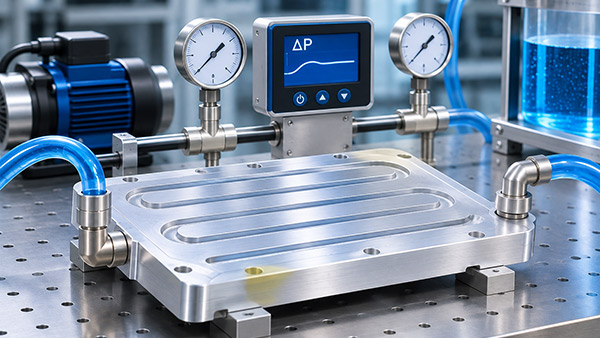
A cold plate with narrow channels may provide effective local heat transfer but require more pump pressure to maintain the desired flow rate.
For OEM projects, specifying a pressure-drop test helps establish whether a proposed Liquid Cold Plate is compatible with the available pumping system.
Rather than requesting a single pressure value without context, engineers should define the coolant, temperature, flow range and measurement conditions.
1. What Is Pressure Drop in a Cold Plate?
Pressure drop is the difference between the pressure measured at two specified locations in the coolant flow path.
For a cold plate, it is commonly evaluated between the inlet and outlet under a defined flow condition.
Where ΔP is the measured differential pressure, and the inlet and outlet pressures use compatible units and reference conditions.
The measured value can include losses associated with internal channels, bends, manifold features and any fittings included between the measurement points.
2. Why a Single Pressure-Drop Value Is Often Insufficient
A pressure-drop value at one flow rate tells the engineer little about how the component behaves at other operating points.
For example, a system may operate at different pump speeds or use a control scheme that changes flow according to heat load.
A curve showing differential pressure at several flow rates can help engineers evaluate the hydraulic behavior over the relevant operating range.
This is particularly useful when comparing alternative channel designs.
3. Define the Coolant Before Testing
Pressure loss depends on fluid properties, including viscosity and density.
Water and water-glycol mixtures can therefore produce different pressure-drop results in the same cold plate.
The difference may become more pronounced at lower operating temperatures where the viscosity of some coolant mixtures increases.
The test specification should identify:
Coolant type and composition.
Relevant concentration where applicable.
Test temperature or temperature range.
Required flow-rate range.
Relevant fluid cleanliness conditions.
Testing with water does not automatically characterize the pressure loss of a different coolant used in service.
4. Select the Flow-Rate Test Points
Test points should cover the range relevant to the equipment rather than using arbitrary values unrelated to the actual system.
For example, an OEM may want to evaluate the minimum expected flow, nominal operating flow and an upper operating condition.
Additional points can be included where the hydraulic curve must be characterized more fully.
The appropriate number and spacing of test points depend on the application and required accuracy.
5. Choose Pressure Measurement Locations Carefully
The placement of pressure measurement ports can affect the reported differential pressure.
If the measurement includes external tubing, adapters or restrictive fittings, the result may not represent the cold plate alone.
Conversely, excluding fittings that are always part of the installed assembly may produce a value that is less useful for system integration.
For this reason, the measurement boundary should be stated clearly.
Testing should also consider suitable sensor range, calibration and stable operating conditions.
6. Why Temperature Stability Matters
Fluid viscosity can change with temperature. If the coolant warms during testing, the measured pressure drop may also change.
Comparative tests should therefore use controlled or documented fluid temperature conditions.
Where temperature variation cannot be avoided, it should be recorded and considered when interpreting the results.
7. Compare the Cold Plate with the Complete Cooling Loop
A complete Cold Plate Cooling System includes more than the plate.
Tubing, fittings, heat exchangers, valves and other components can all add hydraulic resistance.
The operating flow is determined by the relationship between the pump's available pressure and the total system resistance.
Therefore, the cold plate's pressure-drop curve should be considered together with the rest of the loop.
A plate that meets its individual hydraulic specification may still operate at insufficient flow if other parts of the system create excessive resistance.
8. How Should Acceptance Criteria Be Written?
Instead of specifying only "low pressure drop," an engineering drawing or test plan should define measurable conditions.
For example, the specification can identify a maximum acceptable differential pressure at a stated coolant composition, temperature and flow rate.
If several operating points matter, the acceptance criteria can cover a defined range or selected points on the curve.
Any numerical limits should be derived from the project's hydraulic requirements rather than copied from unrelated products.
9. Testing FSW Water Cooling Plates
FSW cold plates contain machined internal channels sealed through friction stir welding.
For this type of plate, the channel dimensions and flow restrictions are established during design and manufacturing.
OEM buyers evaluating a custom FSW water cooling plate from KINGKA can specify their required flow range and hydraulic acceptance criteria during technical review.
Pressure-drop testing, leak integrity and thermal performance are separate checks and should not be treated as interchangeable.
Frequently Asked Questions
Does lower pressure drop always mean better cold plate cooling?
No. Lower pressure drop reduces hydraulic demand, but thermal performance also depends on flow distribution, heat transfer and heat-source geometry.
Can a pressure-drop curve be predicted using CFD?
Yes. CFD can estimate pressure losses, but its accuracy depends on the model and assumptions. Prototype testing may be needed for validation.
Should every production cold plate receive a full flow-curve test?
Not necessarily. Prototype qualification and routine production inspection may use different test plans based on the agreed quality requirements.
Conclusion
Pressure-drop testing provides valuable information for integrating a water cooling plate into a complete liquid cooling system.
By clearly defining coolant properties, test points, sensor locations and acceptance criteria, OEM engineers can obtain meaningful hydraulic data for selecting pumps and evaluating cold plate designs.
Need a Custom Water Cooling Plate?
Provide your coolant specification, flow requirements, pressure-drop limit and internal channel drawings for an OEM manufacturing review.
Explore KINGKA FSW Cooling Plates