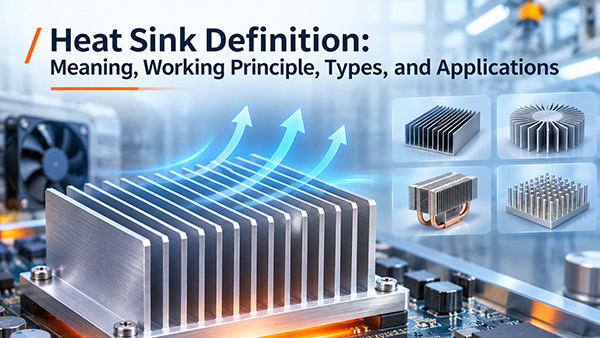
Heat Sink Definition: Meaning, Working Principle, Types, and Applications
KINGKA
heat sink definition: A heat sink is a thermal management component that absorbs heat from a hotter device and transfers it to a cooler surrounding medium, usually air or liquid. It is commonly manufactured from thermally conductive materials such as aluminum or copper and is designed to increase effective heat transfer area, reduce thermal resistance, and maintain acceptable operating temperatures.
In electronics, heat sinks are widely used to cool CPUs, GPUs, power semiconductors, LEDs, industrial controllers, and other heat-generating components.
A conventional heat sink does not create cold temperatures. Instead, it provides a path for thermal energy to move away from the heat source.
Understanding the meaning and function of a heat sink is important for electronic engineers, product designers, and OEM manufacturers developing reliable cooling systems.
This guide explains the heat sink definition, the basic principles of heat transfer, common heat sink types, important technical parameters, and considerations for custom heat sink manufacturing.
What Is the Definition of a Heat Sink?
In thermal engineering, a heat sink is a component or structure designed to receive thermal energy from a heat source and dissipate that energy into another medium.
Its primary purpose is to reduce the temperature rise of the heat-generating component by providing an effective thermal path.
In most electronic applications, a heat sink consists of a conductive metal base and an array of fins or pins.
The base receives and distributes heat, while the extended surfaces help transfer heat into the surrounding air.
A simple heat sink definition can be expressed as follows:
A heat sink is a passive thermal component that transfers heat away from a device to help control its operating temperature.
The term "passive" describes the conventional heat sink component itself, which does not require electrical power. A heat sink may nevertheless operate as part of an active cooling system that includes a fan or pump.
Heat Sink vs Heatsink: Is There a Difference?
The terms heat sink and heatsink refer to the same general type of thermal management component.
"Heat sink" is commonly used as the two-word technical term, while "heatsink" is frequently found in electronics documentation, product catalogs, and online searches.
Both spellings are widely understood in the electronics and thermal management industries.
For technical documentation and SEO content, either spelling can be used consistently, with relevant variations included naturally when appropriate.
What Is the Main Function of a Heat Sink?
The primary function of a heat sink is to transfer thermal energy away from an electronic component or another heat source.
Its purpose is to support acceptable component temperatures during operation.
A heat sink performs several related functions.
1. Conducting Heat Away from the Source
A heat sink provides a conductive path between the heat-generating component and a larger cooling structure.
For example, heat generated by a CPU travels through its package and thermal interface material into the heat sink base.
2. Distributing Heat Across a Larger Area
Heat generated in a small semiconductor device can be concentrated within a limited surface area.
A heat sink base helps spread this heat toward additional cooling surfaces.
3. Increasing Heat Transfer Surface Area
Cooling fins and pins increase the area exposed to the surrounding environment.
This allows more heat to be transferred through convection and radiation under suitable conditions.
4. Supporting Stable Operating Temperatures
By reducing the effective thermal resistance between the heat source and the environment, a properly designed heat sink can help keep component temperatures within specified limits.
5. Improving Electronic Equipment Reliability
Effective thermal management can reduce excessive thermal stress and support reliable equipment operation.
However, the heat sink must be matched to the component's thermal load and actual operating conditions.
How Does a Heat Sink Work?
A heat sink works by moving heat from a higher-temperature region toward a lower-temperature region.
The process involves three fundamental heat transfer mechanisms.
Thermal Conduction
Conduction is the transfer of heat through solid materials.
When a heat sink is attached to an electronic component, heat travels through the component package, thermal interface material, and heat sink base.
The heat then spreads through the metal structure toward the fins.
Materials with higher thermal conductivity can reduce conduction resistance when geometry and other conditions are comparable.
Thermal Convection
Convection transfers heat between the heat sink surface and the surrounding air or liquid.
There are two important convection methods.
Natural Convection
Natural convection occurs through fluid motion caused by temperature-related density differences.
A passive aluminum heat sink may rely primarily on natural convection when no fan is installed.
Forced Convection
Forced convection uses a fan, blower, or pump to move fluid across or through cooling surfaces.
In air-cooled electronics, forced airflow often increases the rate of heat transfer compared with natural convection.
Thermal Radiation
Thermal radiation transfers energy through electromagnetic radiation.
All surfaces above absolute zero emit thermal radiation.
The amount of heat transferred depends on surface temperature, emissivity, geometry, and surrounding conditions.
Radiation may provide a meaningful contribution in certain passive cooling designs.
Basic Heat Sink Working Process
The heat transfer process can be summarized in five stages:
An electronic component generates heat during operation.
Heat transfers into the heat sink base through the thermal interface.
Thermal energy spreads through the conductive material.
Heat transfers from the fins or other surfaces to the surrounding medium.
The surrounding air or coolant carries the thermal energy away from the component area.
The overall effectiveness depends on thermal conductivity, interface resistance, cooling surface geometry, airflow or coolant conditions, and ambient temperature.
What Are the Main Parts of a Heat Sink?
The structure of a heat sink varies by application, but several features are common.
Component
Definition
Main Function
Heat Sink Base
Metal section contacting or connecting to the heat source
Receives and distributes heat
Cooling Fins
Extended thin metal surfaces
Increase heat transfer area
Fin Pitch
Center-to-center distance between adjacent fins
Influences surface density and airflow
Fin Thickness
Thickness of individual cooling fins
Affects conduction and mechanical strength
Mounting Features
Holes, slots, clips, or threaded interfaces
Secure the heat sink
Thermal Interface Material
Material placed between mating thermal surfaces
Reduces contact resistance
Surface Finish
Anodizing, plating, or other surface treatment
Provides selected surface properties
Not every heat sink uses all of these features.
For example, pin fin heat sinks use pins rather than continuous plate fins, while some cooling structures are integrated directly into electronic enclosures.
What Materials Are Used for Heat Sinks?
The two most common materials used in electronic heat sinks are aluminum and copper.
Both provide useful thermal conductivity, but they differ in weight, cost, manufacturing characteristics, and heat-spreading capability.
Aluminum Heat Sinks
Aluminum is widely used in electronic thermal management because it combines good thermal conductivity with low density and manufacturing flexibility.
Common aluminum materials include 6063, 6061, and other alloys selected for specific manufacturing processes.
Advantages include:
Lightweight construction
Good thermal conductivity
Competitive material cost
Excellent suitability for extrusion
Compatibility with CNC machining
Various available surface finishes
An extruded aluminum heatsink is especially suitable for applications requiring repeatable profiles with integrated fins.
Copper Heat Sinks
Copper provides higher thermal conductivity than common aluminum heat sink alloys.
It can be useful for applications involving concentrated heat sources or demanding heat-spreading requirements.
Copper heat sinks are commonly produced through machining, skiving, and other suitable processes.
However, copper is heavier and typically more expensive than aluminum.
Aluminum vs Copper Heat Sink Materials
Property
Aluminum
Copper
Typical thermal conductivity
About 180–220 W/m·K for selected wrought alloys
About 385–400 W/m·K for high-purity copper
Density
About 2.7 g/cm³
About 8.96 g/cm³
Weight
Lower
Higher
Cost
Generally lower
Generally higher
Extrusion suitability
Excellent for suitable alloys
More challenging
Typical use
General electronic cooling
High heat flux and heat spreading
Actual material properties depend on alloy grade, purity, temper, and temperature.
The best material should be selected according to the complete thermal and mechanical design.
What Are the Different Types of Heat Sinks?
Heat sinks can be classified by manufacturing method, fin structure, or cooling method.
Understanding these categories helps engineers select an appropriate solution.
1. Extruded Aluminum Heat Sink
An extruded heat sink is manufactured by forcing aluminum through a shaped die to form a continuous profile.
The resulting structure typically includes an integrated base and cooling fins.
Extruded aluminum heat sinks offer consistent geometry and can be manufactured in different lengths.
They are commonly used in power supplies, industrial controls, LED lighting, computer systems, and electronic equipment.
For OEM applications, extrusion can be combined with CNC machining to produce custom mounting features and contact surfaces.
Suppose an electronic assembly dissipates 60 W through a heat sink.
If the reference heat sink temperature is 65°C and the surrounding air temperature is 25°C:
RθSA = (65 − 25) / 60
RθSA = 0.67°C/W
Under these specific conditions, the effective heat sink-to-ambient thermal resistance is approximately 0.67°C/W.
A lower thermal resistance generally indicates more effective heat transfer when test conditions are comparable.
However, total semiconductor junction temperature also depends on package resistance, thermal interface resistance, and other heat transfer paths.
Heat Sink vs Heat Spreader: What Is the Difference?
A heat sink and a heat spreader are related thermal components, but their primary functions are different.
A heat spreader distributes heat from a concentrated source across a larger area.
A heat sink provides a path and extended surface for rejecting heat into the environment.
Feature
Heat Sink
Heat Spreader
Primary purpose
Reject heat to the environment
Distribute heat across a larger area
Common structure
Base with fins or extended surfaces
Plate, sheet, or spreading structure
Typical materials
Aluminum, copper
Copper, aluminum, graphite, vapor chamber
Main design concern
Overall heat transfer resistance
Temperature uniformity and spreading resistance
Typical application
Electronic component cooling
Concentrated heat-source management
Some components perform both functions.
For example, a thick heat sink base can also act as a heat spreader before thermal energy reaches the cooling fins.
What Is the Difference Between Active and Passive Heat Sinks?
The terms active and passive describe how the cooling system transfers heat into the surrounding fluid.
Passive Heat Sink
A passive heat sink does not require a dedicated fan or pump.
It relies mainly on natural convection and thermal radiation.
Passive cooling is suitable for selected low-power electronics and fanless equipment.
Active Heat Sink
An active heat sink assembly uses a fan, blower, or another powered device to enhance fluid movement.
This increases convective heat transfer under suitable operating conditions.
Active cooling is commonly used for processors, communication equipment, and higher-power electronic assemblies.
The heat sink itself remains a conductive thermal component; the added airflow system provides active cooling.
Where Are Heat Sinks Commonly Used?
Heat sinks are widely used across industries where electronic components generate heat.
Computer and Data Processing Systems
CPUs, GPUs, power regulators, and computing modules use heat sinks to manage operating temperatures.
Cooling structures may combine aluminum fins, copper components, fans, or heat pipes.
Power Electronics
IGBTs, MOSFETs, rectifiers, and power conversion modules generate heat during operation.
Heat sinks are commonly integrated into motor drives, power supplies, inverters, and related equipment.
LED Lighting
LED modules require thermal management to maintain acceptable semiconductor junction temperatures.
Aluminum heat sinks are widely used in industrial and commercial lighting equipment.
Telecommunications
Network equipment, communication modules, and other telecommunications devices often operate continuously.
Heat sinks help manage thermal loads within restricted enclosures.
Industrial Automation
Embedded computers, industrial controllers, and automation equipment may require custom heat sinks because of specific mounting and operating conditions.
Medical and Laboratory Equipment
Selected medical devices, diagnostic systems, and laboratory electronics require thermal management to support dependable operation.
Heat sink requirements depend on the equipment's electrical power, operating environment, and applicable product design standards.
How to Choose the Right Heat Sink for an Electronic Application
Selecting a heat sink requires more than knowing its dimensions or material.
Engineers should evaluate the complete thermal and mechanical system.
Determine the Heat Load
Identify the heat generated by the component during normal and peak operation.
Establish the Maximum Temperature
Determine the allowable component temperature and expected ambient temperature.
Select the Cooling Method
Choose natural convection, forced-air cooling, or another thermal management approach.
Evaluate Material Selection
Compare aluminum and copper according to thermal conductivity, weight, cost, and manufacturing requirements.
Optimize Fin Geometry
Fin thickness, height, pitch, and orientation affect thermal performance and airflow resistance.
Confirm Mechanical Compatibility
Check mounting features, dimensional tolerances, interface flatness, and installation clearances.
Validate the Thermal Design
Prototype testing should be performed under representative operating conditions.
The heat sink must meet its actual thermal requirements when installed in the complete equipment assembly.
Why Is Custom Heat Sink Manufacturing Important?
Standard heat sinks may not satisfy the exact requirements of every electronic product.
OEM manufacturers often require customized dimensions, mounting interfaces, fin structures, or surface treatments.
A custom heat sink can be designed to match specific thermal and mechanical requirements.
Potential benefits include:
Better integration within available installation space
Customized fin geometry
Application-specific mounting features
Optimized material utilization
Compatibility with CNC machining
Repeatable manufacturing specifications
However, customization must also account for tooling costs, machining requirements, tolerances, and production volume.
What Should OEM Buyers Provide for a Heat Sink Quotation?
A complete custom heat sink RFQ should include:
Component power dissipation
Maximum allowable temperature
Ambient operating conditions
Heat sink dimensions
Cooling airflow or other fluid conditions
Material specifications
Fin geometry requirements
Technical drawings or CAD files
Mounting and surface finishing requirements
Prototype and production quantities
These details help manufacturers evaluate technical feasibility and suitable production methods.
Custom Heat Sink Manufacturing Solutions from KINGKA
KINGKA provides customized thermal management components for industrial and electronic equipment manufacturers.
Our manufacturing solutions include:
Custom Extruded Aluminum Heat Sinks
Integrated aluminum cooling profiles suitable for repeat production, custom lengths, and additional CNC machining.
Custom Skived Fin Heat Sinks
Aluminum and copper cooling structures with thin, closely spaced fins for specialized thermal requirements.
Precision CNC-Machined Components
Custom heat sink bases, mounting interfaces, threaded features, and other mechanical structures manufactured according to engineering drawings.
Liquid Cold Plates
Liquid-based thermal components for applications where conventional air cooling cannot satisfy the thermal or mechanical requirements.
For OEM projects, manufacturing process selection should balance thermal performance, dimensional requirements, material choice, and production quantity.
Frequently Asked Questions About Heat Sink Definition
What is a heat sink in simple words?
A heat sink is a component that helps remove heat from an electronic device and transfer it to the surrounding environment.
What is the main purpose of a heat sink?
The main purpose is to provide an effective path for heat transfer, helping electronic components operate within acceptable temperatures.
Is heat sink one word or two?
Both "heat sink" and "heatsink" are commonly used. "Heat sink" is frequently used in technical writing, while "heatsink" is also widely understood.
What is the difference between a heat sink and a fan?
A heat sink conducts and dissipates heat, while a fan moves air to increase convective heat transfer.
Why are heat sinks usually made of aluminum?
Aluminum offers a useful combination of thermal conductivity, low weight, manufacturing flexibility, and cost-effectiveness.
Is copper better than aluminum for a heat sink?
Copper has higher thermal conductivity, but it is heavier and generally more expensive. The best material depends on thermal and mechanical requirements.
What is a passive heat sink?
A passive heat sink transfers heat to the surrounding environment without a dedicated fan or pump, relying mainly on natural convection and radiation.
What does heat sink thermal resistance mean?
Thermal resistance indicates the temperature difference associated with a given heat flow. Lower values generally indicate better heat transfer under comparable test conditions.
What are the most common types of heat sinks?
Common types include extruded, skived fin, bonded fin, pin fin, die-cast, and heat pipe-assisted heat sink assemblies.
Can a heat sink be customized?
Yes. Heat sinks can be manufactured with customized materials, dimensions, fins, mounting structures, and surface finishes to meet specific application requirements.
Heat sink definition: A heat sink is a thermal management component that transfers heat away from a hotter device and releases it to a cooler surrounding environment.
Its effectiveness depends on thermal conductivity, heat transfer area, thermal resistance, airflow, and installation conditions.
Heat sinks are essential components in computers, industrial electronics, power supplies, LED lighting, telecommunications, and many other applications.
For OEM manufacturers, selecting the right heat sink involves understanding both the thermal design and the manufacturing process.
Extruded aluminum heat sinks, skived fin heat sinks, and other customized cooling structures provide different solutions for different engineering requirements.
A properly designed heat sink can help maintain acceptable component temperatures and support reliable electronic equipment operation.
Looking for a Custom Heat Sink Manufacturer?
KINGKA specializes in custom extruded aluminum heat sinks, skived fin heat sinks, precision CNC-machined thermal components, and liquid cold plates for industrial and electronic applications.
Whether your project requires a custom aluminum profile, a high-density fin structure, or a specialized cooling component, KINGKA can support manufacturing discussions based on your drawings and technical specifications.
Contact KINGKA to discuss your custom heat sink requirements and request a quotation.
Kingka Tech Industrial Limited
We specialize in Heat Sink、Liquid Cold Plate、precision CNC machining and our products are widely used in telecommunication industry, aerospace, automotive, industrial control, power electronics, medical instruments, security electronics, LED lighting and multimedia consumption.