When designing Thermal Management systems, choosing the right Heat Sink material is a balance between thermal conductivity, cost, weight, and manufacturability. There is no single "best" material for every application, but specific metals stand out based on performance needs.
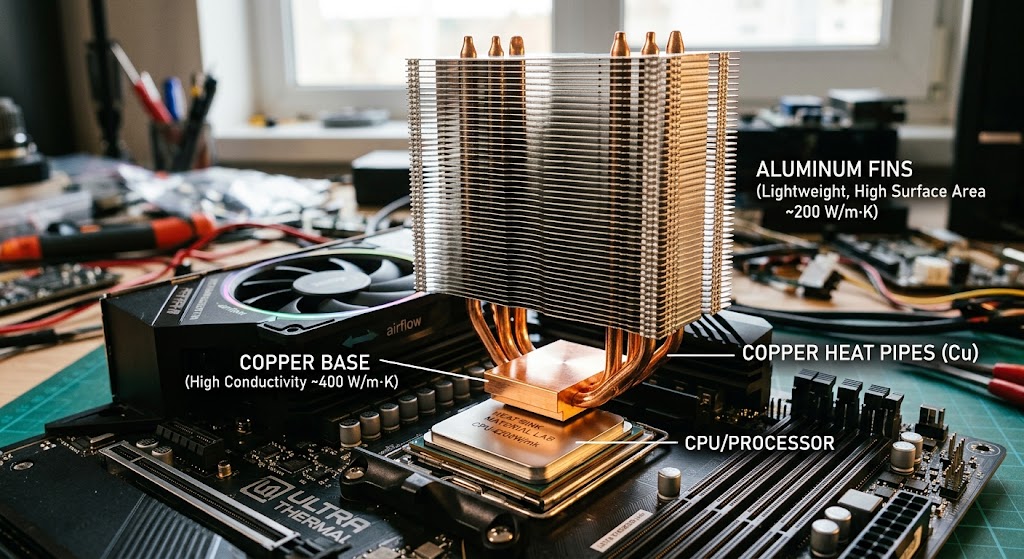
Top Heat Sink Materials Compared
Copper (Cu): Offers exceptional thermal conductivity (∼ 400 W/(m・K), making it the best standard material for high-performance heat dissipation. However, it is heavy, expensive, and relatively difficult to machine into complex shapes.
Aluminum (Al): The industry standard for most electronics. While its thermal conductivity is lower(∼ 200 W/(m・K)) for common alloys like 6063 or 6061), it is lightweight, highly cost-effective, easily extruded into intricate shapes, and corrosion-resistant.
Diamond & Vapor Chambers: Diamond provides ultra-High Thermal Conductivity (> 2000 W/(m・K)) for specialized, high-budget applications like semiconductor dies. Hybrid solutions—such as copper vapor chambers paired with aluminum fins—offer an optimal compromise between high performance and lower weight.
| Material | Thermal Conductivity (W/m⋅K) | Cost | Weight | Primary Advantage |
| Copper | ~400 | High | Heavy | Maximum thermal transfer |
| Aluminum (6063) | ~ 200 | Low | Light | Easy extrusion & low cost |
| Al-Cu Hybrid | ~ 200 - 400 | Medium | Moderate | Fast heat spreading at base |
| Diamond (Synthetic) | >2000 | Extremely High | Light | Ultimate performance |
For most consumer and industrial electronics, aluminum is the overall best practical choice due to its balance of weight, ease of manufacturing, and low cost. For compact, high-power density components (like high-end CPUs or LEDs), a copper base with aluminum fins delivers the ideal balance of performance and practicality.