An extruded aluminum heatsink is one of the most widely used thermal management solutions for electronic and industrial equipment. It is manufactured by forcing heated aluminum alloy through a specially designed extrusion die, forming a continuous profile with integrated fins and a base plate.
Because of its good thermal conductivity, lightweight structure, flexible design, and cost-effective manufacturing process, the extruded heat sink is commonly used in power electronics, LED lighting, telecommunications, industrial control systems, energy storage equipment, automotive electronics, and many other applications.
So, what are the main advantages of an extruded aluminum heatsink?
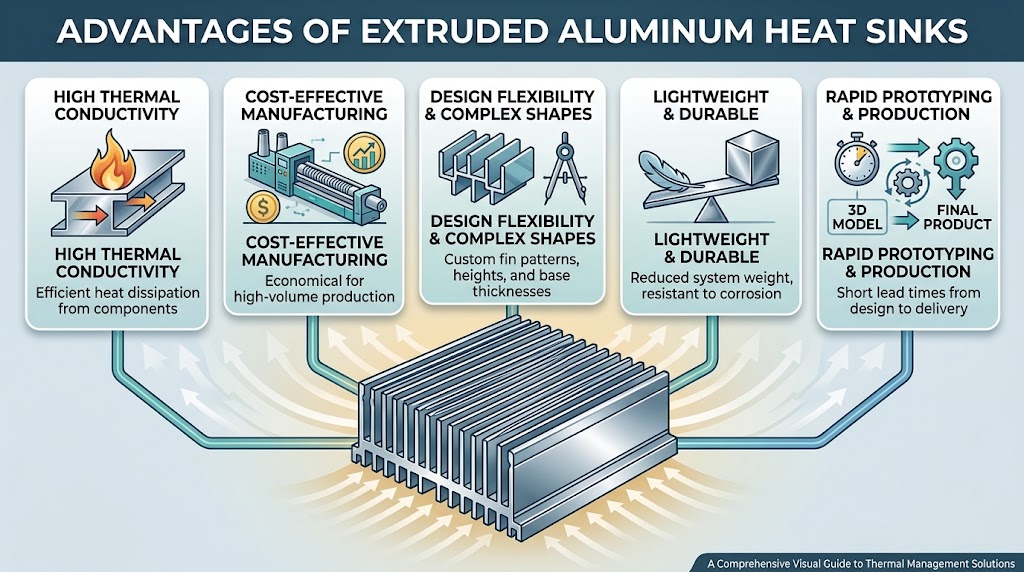
1. Good Thermal Conductivity
One of the biggest advantages of an aluminum heatsink is its ability to conduct heat efficiently.
Aluminum alloys commonly used for extrusion, such as 6063 aluminum, provide a good balance between thermal conductivity, mechanical strength, corrosion resistance, and extrusion performance.
When electronic components such as CPUs, power modules, IGBTs, MOSFETs, LEDs, or power supplies generate heat, the aluminum base transfers that heat away from the component and distributes it across the fins.
The fins then increase the available surface area, allowing heat to dissipate into the surrounding air through natural convection or forced-air cooling.
For many medium-power applications, this makes an extruded aluminum heat sink a practical and efficient thermal solution.
2. Cost-Effective for Mass Production
Extrusion is particularly suitable for medium- and high-volume production.
Once the extrusion die has been manufactured, long aluminum profiles can be continuously produced with the same cross-sectional shape. The profiles can then be cut into different lengths according to customer requirements.
Compared with manufacturing every heatsink entirely by CNC machining, aluminum extrusion can significantly reduce material waste, machining time, and production cost.
This makes extruded heatsinks especially attractive for projects that require:
Stable annual production volumes
Consistent heatsink dimensions
Competitive unit costs
Repeatable thermal performance
Fast batch manufacturing
For OEM and ODM projects, an experienced extruded heat sink manufacturer can also optimize the profile design to balance extrusion cost and cooling performance.
3. Flexible Fin and Profile Design
Another important advantage of aluminum extrusion is design flexibility.
The extrusion die can be customized to create different fin structures, base thicknesses, widths, mounting features, and profile geometries.
Typical design variables include:
Fin height
Fin thickness
Fin spacing
Base plate thickness
Overall width
Mounting grooves
Screw channels
Clip structures
PCB mounting features
This allows engineers to develop a custom aluminum heatsink based on available installation space, airflow direction, heat load, and mechanical requirements.
However, extrusion also has manufacturing limits. Extremely thin fins, very high fin aspect ratios, or highly complex internal structures may require alternative processes such as skiving, bonded fin construction, or CNC machining.
4. Lightweight Structure
Aluminum has a relatively low density compared with copper.
This means an extruded aluminum heatsink can provide a good level of thermal performance while keeping system weight under control.
Weight reduction is especially important in applications such as:
A lighter cooling solution can reduce the mechanical load on PCBs, enclosures, mounting structures, and complete systems.
For this reason, aluminum is often preferred when both thermal performance and overall system weight must be considered.
5. Good Strength and Structural Stability
An extruded heatsink is normally produced as a single continuous aluminum profile.
Because the fins and base are formed together, there are no joints between the fins and base plate.
This integrated structure provides good mechanical strength and stability.
Compared with some assembled heatsink designs, an extruded heatsink can offer:
Fewer assembly components
Lower risk of fin separation
Good dimensional consistency
Reliable mechanical performance
Simplified installation
This makes extruded aluminum heatsinks suitable for industrial environments where equipment may experience vibration, transportation, or long operating periods.
6. Excellent Surface Treatment Options
Extruded aluminum profiles can be finished using several surface treatment processes.
One of the most common options is anodizing.
Anodized aluminum heatsinks offer improved corrosion resistance and a more uniform appearance. Black anodizing is also commonly used in electronic cooling products.
Other finishing options may include:
Surface treatment can be selected according to appearance, environmental conditions, electrical requirements, and product design.
7. Easy Secondary Machining
Extruded aluminum heatsinks can be easily combined with secondary CNC machining.
After the aluminum profile has been extruded and cut, additional operations can be performed to create features that cannot be formed directly during extrusion.
These processes may include:
CNC Milling
Drilling
Tapping
Slot machining
Counterboring
Surface milling
Mounting hole machining
This combination of aluminum extrusion and CNC machining gives engineers greater design freedom.
For example, one extrusion profile can be produced in large quantities, while different mounting holes or machining features can be added for different customer models.
8. Suitable for Natural and Forced-Air Cooling
Extruded heatsinks can work with both passive and active cooling systems.
For low- or medium-power devices, natural airflow may provide sufficient heat dissipation.
For higher heat loads, fans can be added to increase airflow between the fins.
The fin spacing can also be optimized depending on the cooling method.
Natural convection generally requires wider fin spacing, while forced-air cooling can often use tighter fin spacing to increase the total heat dissipation area.
This makes the extruded aluminum heatsink suitable for a wide range of thermal management designs.
9. Reliable and Mature Manufacturing Process
Aluminum extrusion is a mature industrial manufacturing process.
With properly designed dies and controlled extrusion parameters, manufacturers can produce heatsink profiles with stable dimensions and consistent cross-sectional geometry.
This is particularly important for OEM applications where every heatsink must fit correctly into an enclosure or assembly.
The mature manufacturing process also makes it easier to scale production from prototypes and small batches to larger production volumes.
10. Wide Range of Applications
Because of its balance of thermal performance, manufacturing cost, weight, and mechanical strength, extruded aluminum heatsinks are widely used across many industries.
Common applications include:
Power Electronics
Extruded heatsinks are used for power supplies, rectifiers, converters, MOSFETs, IGBTs, and other power semiconductor devices.
LED Lighting
LED modules generate continuous heat that must be removed to maintain brightness, efficiency, and operating life.
Telecommunications
Routers, communication modules, base station electronics, and network equipment often use aluminum heatsinks for passive or forced-air cooling.
Industrial Automation
Motor drives, PLC equipment, industrial computers, and control systems commonly use extruded heatsinks.
Energy Storage
Power conversion systems, battery energy storage systems, inverters, and charging equipment may use extruded heatsinks for thermal management.
Automotive Electronics
They can also be used in DC-DC converters, onboard chargers, control units, and other automotive electronic systems.
Extruded Aluminum Heatsink vs. Other Heatsink Technologies
Different heatsink manufacturing processes are suitable for different cooling requirements.
| Heatsink Type | Main Advantage | Typical Application |
|---|
| Extruded Aluminum Heatsink | Cost-effective and easy to mass produce | Electronics, LED, power supply |
| Skived Fin Heatsink | High fin density and large surface area | High-power electronics |
| Bonded Fin Heatsink | Large size and flexible fin design | Industrial power systems |
| CNC Machined Heatsink | High dimensional flexibility | Low-volume customized projects |
| Liquid Cold Plate | High heat removal capability | GPU, CPU, IGBT, battery systems |
An extruded heatsink is usually the preferred option when a project requires a balance between thermal performance, production cost, mechanical strength, and manufacturing volume.
For applications with extremely high heat flux or limited cooling space, technologies such as skived fin heatsinks or liquid cold plates may provide better thermal performance.
How to Select an Extruded Aluminum Heatsink
When choosing an extruded heatsink, engineers should evaluate more than just the overall size.
Important parameters include:
Thermal simulation and prototype testing can also help verify whether the heatsink meets the required operating temperature.
Custom Extruded Aluminum Heatsink Manufacturing
For applications where standard heatsink profiles cannot meet the required dimensions or thermal performance, a custom extruded aluminum heatsink can be developed.
A typical customization process may include:
Thermal and dimensional requirement analysis
Extrusion profile design
Aluminum alloy selection
Extrusion die manufacturing
Profile extrusion
Cutting and CNC machining
Surface treatment
Inspection and thermal verification
At KINGKA, we provide customized thermal management solutions including extruded aluminum heatsinks, skived fin heatsinks, bonded fin heatsinks, heat pipe assemblies, and liquid cold plates for electronic and industrial applications.
Our engineering team can support customized dimensions, fin structures, CNC machining, anodizing, and other manufacturing requirements according to your thermal design.
FAQ
Why is aluminum commonly used for extruded heatsinks?
Aluminum offers a good combination of thermal conductivity, lightweight construction, corrosion resistance, mechanical strength, and extrusion performance. It is also more cost-effective than copper for many large-volume heatsink applications.
Which aluminum alloy is commonly used for extruded heatsinks?
6063 aluminum is commonly used because it offers good extrusion performance, surface finish, corrosion resistance, and thermal conductivity.
Are extruded heatsinks suitable for high-power electronics?
Yes, depending on heat load and airflow. For very high heat flux applications, skived heatsinks, heat pipe assemblies, or liquid cold plates may provide better cooling performance.
Can extruded aluminum heatsinks be customized?
Yes. Fin height, fin spacing, base thickness, profile width, mounting holes, CNC features, and surface treatments can all be customized within extrusion manufacturing limits.
What is the difference between extruded and skived heatsinks?
Extruded heatsinks are generally more economical for mass production, while skived heatsinks can achieve thinner fins and higher fin density, making them suitable for applications requiring greater heat dissipation surface area.