As electronic devices become more powerful, efficient thermal management is essential. Many engineers ask, how does a cold plate work, and why is it more effective than traditional air cooling? A liquid cold plate uses circulating coolant to absorb heat directly from heat-generating components and transfer it away quickly, making it an ideal solution for high-power applications.
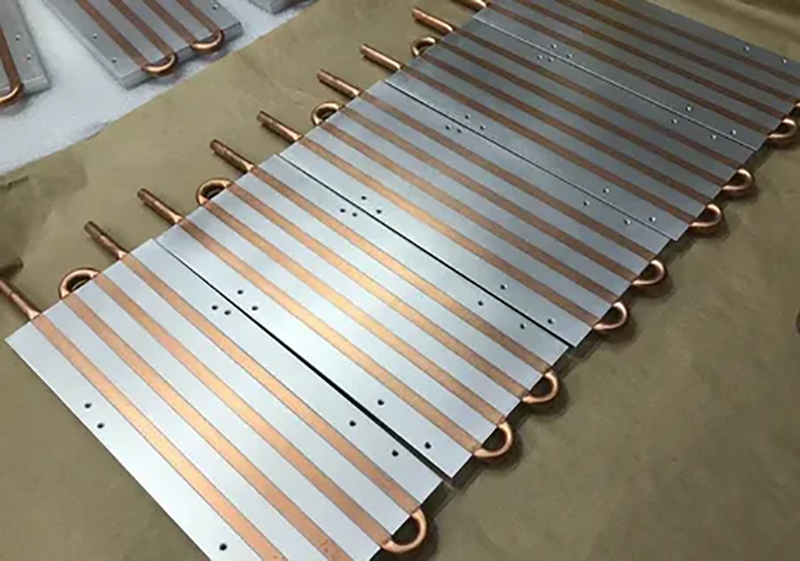
What Is a Liquid Cold Plate?
A liquid cold plate, also known as a liquid cooling plate or water cooling plate, is a thermal management device that removes heat through liquid circulation instead of relying solely on air. It is widely used in applications where conventional air cooling cannot provide sufficient performance.
Typical applications include:
IGBT cold plate systems
EV and cooling plate battery packs
CPU and GPU servers
AI data centers
Energy storage systems (ESS)
Medical and industrial equipment
Power electronics
Compared with an air-cooled heat sink, a cold plate cooling system delivers higher cooling efficiency, more stable operating temperatures, and lower noise.
How Does a Cold Plate Work?
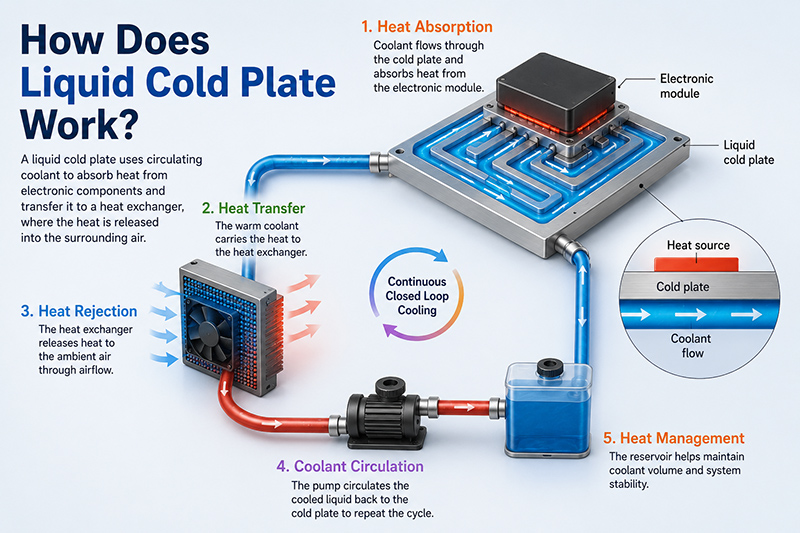
The working principle of cold plate liquid cooling consists of four simple steps:
1. Heat Transfer
Electronic components such as CPUs, GPUs, or IGBT modules generate heat during operation. This heat is transferred from the device to the cold plate through a thermal interface material.
2. Heat Absorption
Inside the liquid cold plate are specially designed cooling channels. As coolant flows through these channels, it absorbs heat from the plate. Depending on the application, the plate is typically manufactured from aluminum or copper to maximize thermal conductivity.
3. Coolant Circulation
A pump continuously circulates the cooling liquid through the cold plate cooling system.
The process follows this cycle:
Electronic Component → Liquid Cold Plate → Cooling Channels → Radiator → Pump → Liquid Cold Plate
This closed-loop circulation ensures continuous heat removal.
4. Heat Dissipation
After absorbing heat, the coolant flows to a radiator or heat exchanger, where the heat is released into the surrounding air. The cooled liquid then returns to the water cooling plate to repeat the cycle.
Why Choose Cold Plate Cooling?
Compared with conventional air cooling, cold plate cooling offers several advantages:
Higher heat dissipation efficiency for high-power electronics
Lower operating noise due to reduced fan dependence
Uniform temperature distribution that minimizes hot spots
Compact design for high-density equipment
Improved reliability and longer equipment lifespan
For applications requiring precise temperature control, advanced cold plate technology can also be integrated with a thermoelectric cold plate for even greater cooling performance.
Custom Liquid Cold Plate Solutions
Different industries require different cooling designs. A custom liquid cold plate can be engineered with optimized flow channels, materials, and dimensions to meet specific thermal requirements.
As a professional liquid cold plate manufacturer and liquid cold plate supplier, KINGKA provides high-performance Custom Cold Plates for electronics cooling, including solutions for CPU cooling plate, battery systems, power electronics, and industrial equipment. Our engineering team develops reliable thermal cooling plate solutions that improve heat transfer efficiency and system performance.
FAQ
What is a liquid cold plate?
A liquid cold plate is a cooling device that uses circulating coolant to remove heat from electronic components, providing much higher cooling efficiency than traditional air cooling.
How does a cold plate work?
A cold plate transfers heat from electronic devices into flowing coolant. The heated coolant then carries the heat to a radiator, where it is released before circulating back through the system.
What is the difference between a cold plate and a Heat Sink?
A conventional heat sink relies on air to dissipate heat, while a cold plate liquid cooling system uses liquid coolant, allowing it to handle much higher heat loads with greater efficiency.
Where are liquid cold plates commonly used?
They are widely used in IGBT cold plate applications, EV battery packs, AI servers, data centers, medical devices, industrial automation, and high-performance computing systems.