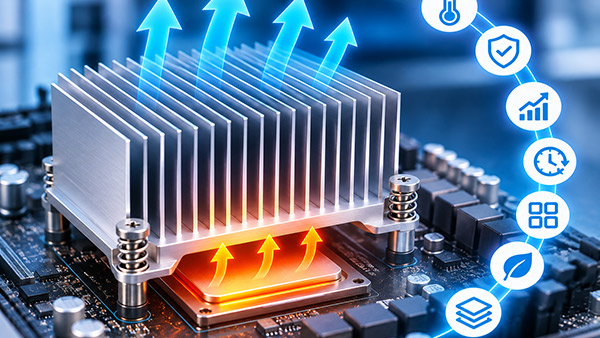
Why Is a Heat Sink Needed? 7 Key Reasons for Effective Electronic Cooling
KINGKA
Why is a heat sink needed? A heat sink is needed to remove excess heat from electronic components, prevent overheating, maintain stable performance, and support long-term equipment reliability. Without an adequate heat dissipation path, heat can accumulate inside processors, power semiconductors, LEDs, and other electronic devices, potentially causing performance degradation, protective shutdowns, or permanent damage.
As electronic equipment becomes more powerful and compact, thermal management has become an essential part of product development. A properly designed heat sink helps transfer heat away from sensitive components into the surrounding environment.
However, not every electronic component requires a separate heat sink. The need depends on power dissipation, allowable operating temperature, ambient conditions, and the effectiveness of other available cooling paths.
This guide explains why heat sinks are important, what happens when electronic devices operate without sufficient cooling, and how OEM manufacturers can select appropriate thermal management solutions.
Why Do Electronic Components Need Heat Dissipation?
Electronic components generate heat during normal operation because some electrical energy is converted into thermal energy.
In semiconductor devices, heat is produced through several mechanisms, including conduction losses, switching losses, and electrical resistance.
The amount of heat generated varies according to the component's design and operating conditions.
For example:
CPUs and GPUs: Generate heat while processing computational workloads.
MOSFETs and IGBTs: Produce conduction and switching losses during power conversion.
LED Modules: Convert part of their electrical input power into heat.
Power Supplies: Generate heat through electrical conversion losses.
Industrial Controllers: Contain processors, regulators, and other heat-generating components.
When heat generation exceeds the amount of heat being removed, component temperatures increase.
Excessive temperature can affect semiconductor performance, operating stability, and expected service life.
A heat sink provides an additional thermal path that allows heat to move away from the device more effectively.
7 Reasons Why a Heat Sink Is Needed
Heat sinks are important for several reasons beyond simply making electronic equipment cooler.
1. Preventing Electronic Components from Overheating
The primary purpose of a heat sink is to help prevent excessive component temperatures.
Every electronic component has specified thermal operating limits.
When the internal temperature approaches or exceeds these limits, the device may no longer perform as intended.
For example, a processor may reduce its operating frequency when its temperature becomes too high.
Some semiconductor devices may also experience increased leakage current, reduced efficiency, or protective shutdown.
A properly sized heat sink reduces the temperature rise between the heat source and the surrounding environment.
This helps the electronic component operate within its specified thermal limits.
2. Maintaining Stable Electronic Performance
Temperature can directly influence the performance of electronic systems.
Processors may use thermal throttling to control overheating, while power electronic components can experience temperature-dependent electrical characteristics.
In equipment requiring continuous operation, unexpected thermal limitations can reduce overall system performance.
An effective heat sink helps maintain suitable operating temperatures and reduces the likelihood of temperature-related performance limitations.
However, cooling alone does not guarantee consistent performance. Electrical design, workload, power delivery, and system configuration must also be considered.
3. Supporting Long-Term Component Reliability
Excessive temperatures can accelerate certain electronic degradation mechanisms.
Thermal stress can affect semiconductor packages, solder joints, electrical insulation, and other temperature-sensitive materials.
Repeated temperature changes may also cause expansion and contraction between materials with different coefficients of thermal expansion.
Over time, this can contribute to mechanical fatigue in electronic assemblies.
A heat sink can reduce operating temperatures and, when properly designed, help manage temperature variations.
This supports the reliability objectives of equipment designed for extended operating periods.
For industrial OEM manufacturers, reliable heat dissipation is particularly important when electronic assemblies are difficult or expensive to replace.
4. Enabling Higher Electronic Power Density
Modern electronic products often integrate more functionality into smaller spaces.
This increases the amount of heat that must be removed from a limited area.
A compact circuit board may contain several heat-generating devices, including processors, power regulators, and switching components.
Without effective thermal management, localized temperatures can become excessive.
Heat sinks help distribute heat across larger surfaces, improving the opportunity for convection into the surrounding air.
For compact high-power applications, manufacturers may need specialized fin structures, heat spreaders, or liquid cooling components.
5. Improving Thermal Management in Continuous-Duty Equipment
Industrial electronic equipment may operate continuously for long periods.
Unlike devices that experience frequent idle periods, continuous-duty equipment must dissipate its sustained heat load without relying on long cooling intervals.
Applications include:
Industrial automation controllers
Telecommunications infrastructure
Power conversion systems
Server and computing equipment
Renewable energy electronics
Industrial monitoring systems
A properly designed heat sink supports thermal stability during continuous operation.
For these applications, engineers should evaluate the cooling system under maximum expected ambient temperatures and realistic operating loads.
6. Supporting Passive and Low-Noise Cooling
Some electronic systems require low acoustic noise or reduced mechanical complexity.
A passive heat sink can dissipate heat without requiring a dedicated fan.
Passive cooling relies primarily on natural convection and thermal radiation.
This can be valuable for low-power applications where fan noise, maintenance, or available power are concerns.
Examples include fanless industrial computers, embedded controllers, and selected LED lighting products.
However, passive cooling requires adequate heat transfer surface area and suitable ventilation.
A heat sink designed for passive cooling may be larger than a forced-air design intended to dissipate the same thermal load.
Electronic equipment manufacturers must ensure that their products operate within specified temperature limits.
These requirements may involve:
Maximum semiconductor junction temperature
Maximum enclosure surface temperature
Ambient temperature operating range
Mechanical and mounting restrictions
Product reliability targets
Applicable safety and equipment standards
A heat sink provides a practical way to help meet these design requirements.
However, the final thermal solution must be verified through appropriate engineering analysis and testing.
What Happens If an Electronic Device Has No Heat Sink?
The consequences of operating without a heat sink depend on the component's power dissipation and the effectiveness of other cooling paths.
Some low-power electronic components can operate safely without a dedicated heat sink.
They may dissipate sufficient heat through their packages, circuit boards, or equipment enclosures.
However, components designed to operate with a heat sink may experience serious thermal problems if that cooling structure is removed.
Rapid Temperature Increase
Without an adequate heat transfer path, heat accumulates around the component.
This may cause the junction temperature to increase rapidly.
Thermal Throttling or Performance Reduction
Certain processors and electronic systems include thermal management features that reduce operating power when temperatures approach their limits.
Although these mechanisms help protect the hardware, they can reduce performance.
Unexpected Shutdown
Some electronic systems automatically shut down when critical thermal thresholds are reached.
This may prevent additional heating but can interrupt normal equipment operation.
Potential Component Damage
Excessive thermal exposure can damage semiconductor devices or surrounding components.
Thermal protection mechanisms do not guarantee that damage will always be prevented.
Reduced Equipment Reliability
Even when immediate failure does not occur, repeated exposure to excessive temperatures can increase thermal stress.
This is particularly concerning for equipment operating continuously in demanding environments.
Important: A dedicated heat sink is not mandatory for every electronic device, but every heat-generating component requires an adequate heat dissipation path.
How Does a Heat Sink Prevent Overheating?
A conventional heat sink improves heat removal by providing a conductive structure and increased surface area.
The cooling process involves several stages.
Step 1: Heat Transfers from the Component
Heat generated inside the semiconductor travels through its package toward the mounting surface.
Thermal interface materials may be used to reduce contact resistance between the component and the heat sink.
Step 2: Heat Spreads Through the Metal Base
The heat sink base receives heat and distributes it toward the cooling fins.
Base thickness, contact quality, and material thermal conductivity influence this process.
Step 3: Cooling Fins Increase Surface Area
Fins provide additional surface area for heat transfer.
Their geometry affects heat conduction, convection, and airflow resistance.
Step 4: Heat Transfers to the Surrounding Environment
Heat moves from the cooling surfaces to the surrounding air through natural or forced convection.
Thermal radiation may also contribute, particularly in certain passive cooling applications.
The effectiveness of the cooling system depends on the complete thermal path rather than the heat sink alone.
How Do You Know Whether a Heat Sink Is Necessary?
The need for a heat sink should be determined from the thermal requirements of the electronic component.
Several engineering factors are important.
Component Heat Dissipation
Higher power dissipation generally creates greater cooling requirements.
However, the required heat sink size also depends on the available temperature difference and other thermal paths.
Maximum Allowable Junction Temperature
Semiconductor manufacturers specify temperature limits for their components.
These values help determine how much temperature rise is permissible during operation.
Ambient Temperature
A device operating at 50°C ambient has less temperature margin than the same device operating at 25°C, assuming an unchanged maximum temperature limit.
Existing Thermal Paths
Some components transfer sufficient heat through PCB copper areas, thermal vias, enclosures, or other conductive structures.
These paths should be evaluated before deciding whether a separate heat sink is required.
Cooling Airflow
A component inside a ventilated enclosure may require a different heat sink than one inside a sealed housing.
Mechanical Constraints
Available space, mounting locations, orientation, and component weight can determine whether a conventional heat sink is practical.
Example: Calculating Why a Heat Sink Is Needed
Consider a hypothetical electronic power component with the following requirements:
Parameter
Value
Power dissipation
50 W
Maximum junction temperature
125°C
Maximum ambient temperature
45°C
Junction-to-case thermal resistance
0.4°C/W
Case-to-heatsink thermal resistance
0.2°C/W
For a simplified steady-state model with a dominant series heat path, the maximum allowable total junction-to-ambient thermal resistance is:
RθJA,max = (Tj,max − Ta,max) / P
Therefore:
RθJA,max = (125 − 45) / 50 = 1.6°C/W
The maximum allowable heat sink-to-ambient thermal resistance is:
RθSA,max = RθJA,max − RθJC − RθCS
RθSA,max = 1.6 − 0.4 − 0.2 = 1.0°C/W
Under these assumptions, the cooling solution must provide an effective heat sink-to-ambient thermal resistance of 1.0°C/W or lower.
If the existing package and enclosure cannot provide sufficient cooling, an appropriately designed heat sink is necessary.
This example is illustrative. Actual engineering calculations should use verified component thermal parameters, realistic heat-flow paths, and suitable design margins.
Do All Electronic Components Need a Heat Sink?
No. Not all electronic components require a dedicated heat sink.
The requirement depends on actual heat generation, thermal resistance, operating temperature, and packaging design.
Electronic Component
Is a Dedicated Heat Sink Normally Required?
Main Consideration
High-performance desktop CPU
Usually yes
High power and concentrated heat
Low-power microcontroller
Often no
Low power and PCB cooling
High-power LED module
Often requires a thermal management structure
Junction temperature and heat transfer
Power MOSFET
Depends on power losses and package
Junction temperature and PCB heat spreading
IGBT power module
Commonly yes
Significant thermal losses
Low-power sensor
Usually no
Minimal heat dissipation
Industrial power converter
Depends on thermal design
Power losses and enclosure cooling
High-power GPU
Usually yes
High heat flux and sustained load
The correct decision should be based on the device manufacturer's thermal specifications and the actual operating conditions.
Why Are Aluminum Heat Sinks Widely Used?
Aluminum is one of the most common materials used in electronic thermal management.
It offers a useful combination of thermal conductivity, low weight, manufacturing flexibility, and competitive cost.
Good Thermal Conductivity
Common wrought aluminum heat sink alloys provide sufficient conductivity for many electronic cooling applications.
Lightweight Construction
Aluminum has a much lower density than copper, helping reduce mechanical loads.
Flexible Manufacturing
Aluminum can be processed through extrusion, skiving, CNC machining, and other manufacturing methods.
Cost-Effective Production
For suitable production volumes, aluminum extrusion can provide consistent heat sink profiles with competitive manufacturing costs.
Custom Mechanical Features
Additional CNC machining can produce mounting holes, threaded interfaces, pockets, and other application-specific features.
For industrial OEM projects, these advantages make aluminum a practical choice for many custom cooling components.
Extruded Aluminum Heat Sinks for Electronic Cooling
An extruded aluminum heatsink is manufactured by forcing aluminum through a shaped die to create a continuous profile with integrated cooling fins.
This process is suitable for many electronic applications requiring repeatable geometry and efficient manufacturing.
Typical applications include:
Industrial power supplies
LED lighting systems
Electronic controllers
Telecommunications equipment
Embedded computer systems
Power conversion devices
Advantages include integrated fin structures, customizable lengths, good thermal conductivity, and compatibility with CNC machining.
Heat Sink vs Liquid Cold Plate: When Is Air Cooling Insufficient?
Although heat sinks are effective in many applications, some electronic systems require alternative cooling technologies.
A liquid cold plate transfers heat from an electronic component into circulating coolant.
This can be useful when heat generation is high, cooling space is restricted, or heat must be transported away from the component area.
Selection Factor
Air-Cooled Heat Sink
Liquid Cold Plate
Cooling medium
Air
Liquid coolant
System complexity
Usually lower
Usually higher
Additional components
Optional fan
Pump, tubing, heat exchanger
Installation requirements
Airflow and mounting space
Coolant connections and mounting
Maintenance
Fin and fan cleaning
Coolant system inspection
Typical use
General electronics cooling
High-power or space-constrained systems
Liquid cooling is not automatically better.
The appropriate cooling method depends on thermal requirements, system reliability, installation constraints, and total cost.
Why Is Custom Heat Sink Design Important for OEM Equipment?
Standard heat sinks may not meet the exact mechanical or thermal requirements of specialized electronic equipment.
A custom heat sink allows the manufacturer to adapt its cooling structure to the actual application.
Custom Dimensions
The overall length, width, height, and cooling fin geometry can be designed around available installation space.
Application-Specific Materials
Aluminum or copper can be selected according to thermal, mechanical, and budget requirements.
Optimized Mounting Structures
Custom mounting holes, threads, and contact surfaces can improve mechanical integration.
Suitable Manufacturing Processes
Extrusion, skiving, CNC machining, and other manufacturing methods can be selected according to geometry and production volume.
Repeatable Production
For OEM programs, a controlled manufacturing design can help maintain dimensional consistency across production batches.
Customization must still be validated for thermal performance, tolerances, and manufacturing feasibility.
How to Choose a Custom Heat Sink Manufacturer
For industrial electronic equipment, selecting a heat sink supplier requires consideration of both engineering and production capabilities.
Important factors include:
Manufacturing Capabilities
Can the supplier manufacture the required extruded, skived, or precision-machined structure?
Material Selection
Can the supplier provide suitable aluminum or copper grades?
Dimensional Accuracy
Can critical mounting dimensions, fin geometry, and contact flatness meet the drawing requirements?
Prototype Support
Can prototype components be manufactured for thermal and assembly testing?
Inspection and Quality Control
Can the supplier verify dimensions and provide appropriate inspection documentation?
Production Scalability
Can the manufacturing process support the expected annual quantities and repeat orders?
Technical Communication
Can the supplier review engineering drawings and identify potential manufacturing issues?
These considerations can help OEM buyers reduce procurement risks and improve project execution.
KINGKA Custom Heat Sink Manufacturing Solutions
KINGKA provides thermal management components for industrial electronics, telecommunications, computing equipment, and power electronic applications.
Our manufacturing capabilities include:
Custom Extruded Aluminum Heat Sinks
Aluminum extrusion profiles with integrated fins, custom lengths, and CNC-machined mounting features.
Custom Skived Fin Heat Sinks
Aluminum and copper fin structures for applications requiring thin fins and specialized cooling geometries.
Precision CNC-Machined Cooling Components
Custom contact surfaces, mounting interfaces, and mechanical features based on engineering drawings.
Liquid Cold Plates
Liquid cooling components for equipment requiring alternative heat transfer solutions.
For custom projects, KINGKA can review the customer's thermal requirements, technical drawings, material specifications, and manufacturing quantities.
Information Needed for a Custom Heat Sink RFQ
To evaluate a custom heat sink project, buyers should provide:
Heat source and power dissipation specifications
Maximum allowable component temperature
Ambient operating temperature range
Available installation dimensions
Cooling method and airflow conditions
Preferred material
Mounting and contact surface requirements
CAD drawings or technical drawings
Prototype and production quantities
Providing these details helps identify suitable heat sink manufacturing options.
Frequently Asked Questions
Why is a heat sink necessary?
A heat sink is necessary when an electronic component cannot dissipate sufficient heat through its existing package, circuit board, or enclosure. It provides an additional thermal path to help maintain acceptable operating temperatures.
What is the main purpose of a heat sink?
The main purpose is to transfer heat away from a component and reduce its operating temperature rise.
What happens if you don't use a heat sink?
If the component requires a heat sink, inadequate cooling may cause overheating, reduced performance, protective shutdown, or hardware damage. Low-power devices may operate safely without a separate heat sink if their existing cooling paths are sufficient.
Why does a CPU need a heat sink?
Many CPUs generate substantial heat in a small area. A heat sink helps transfer this heat away from the processor package and dissipate it into the surrounding environment.
Do all electronics require heat sinks?
No. The need depends on heat generation, package design, PCB thermal performance, ambient temperature, and component temperature limits.
Why are heat sinks made of aluminum?
Aluminum provides good thermal conductivity, low weight, cost-effective manufacturing, and compatibility with processes such as extrusion and CNC machining.
Can a fan replace a heat sink?
Generally, a fan cannot replace the required heat sink on a conventional desktop CPU. A fan generates airflow, while the heat sink provides a conductive path and extended cooling surface.
Is a larger heat sink always better?
No. Cooling performance also depends on material, fin efficiency, airflow, contact resistance, and installation conditions.
Why are heat sinks important in power electronics?
Power semiconductor devices produce conduction and switching losses. Heat sinks help remove this heat and maintain suitable junction temperatures.
When should liquid cooling be used instead of a heat sink?
Liquid cooling may be considered when air cooling cannot meet thermal requirements, airflow is limited, or heat must be transported to a remote heat rejection system.
Can heat sinks improve product reliability?
Proper thermal management can help reduce excessive temperatures and thermal stress. Actual reliability depends on the complete product design and operating conditions.
Why is a heat sink needed? A heat sink provides an effective thermal path that helps remove excess heat from electronic components, maintain acceptable operating temperatures, and support reliable system performance.
Heat sinks are particularly important in equipment with significant power dissipation, concentrated heat sources, continuous operating requirements, or limited natural heat transfer capability.
However, not every electronic device requires a dedicated heat sink. The need should always be determined through appropriate thermal analysis.
For OEM equipment manufacturers, selecting the right heat sink involves evaluating heat load, material, fin geometry, airflow, mounting requirements, and production costs.
Extruded aluminum heat sinks, skived fin heat sinks, and other custom thermal components provide different manufacturing options for specific cooling needs.
Looking for a Custom Heat Sink Manufacturer?
KINGKA specializes in custom extruded aluminum heat sinks, skived fin heat sinks, CNC-machined cooling components, and liquid cold plates for industrial and electronic applications.
Whether your project requires a lightweight aluminum extrusion profile, a compact high-density fin structure, or a custom thermal management component, KINGKA can support manufacturing discussions based on your engineering drawings and technical requirements.
Contact KINGKA to discuss your custom heat sink project and request a quotation.
Kingka Tech Industrial Limited
We specialize in Heat Sink、Liquid Cold Plate、precision CNC machining and our products are widely used in telecommunication industry, aerospace, automotive, industrial control, power electronics, medical instruments, security electronics, LED lighting and multimedia consumption.