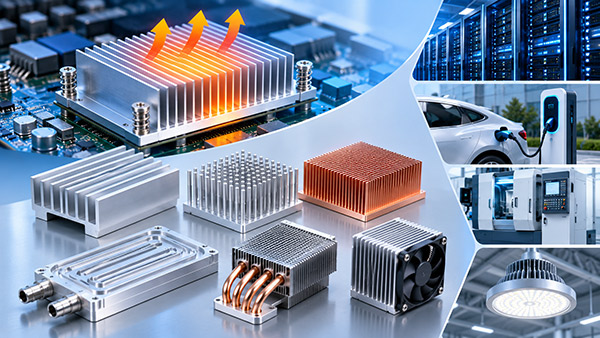
What Are Heat Sinks in Electronics? Types, Working Principles, and Applications
KINGKA
What are heat sinks in electronics? Heat sinks are thermal management components that absorb and transfer heat away from electronic devices, helping maintain safe operating temperatures and reliable performance. They are commonly made from aluminum or copper and feature fins, pins, or other surface structures that increase the area available for heat dissipation.
Heat sinks are widely used in electronic equipment, including computers, power supplies, LED lighting, industrial controllers, telecommunications devices, and high-power semiconductor systems.
As electronic devices become smaller and more powerful, effective thermal management becomes increasingly important. Selecting the right electronic heat sink can help prevent overheating, reduce thermal stress, and maintain equipment performance.
This guide explains how heat sinks work, the different types available, common materials, industrial applications, and important considerations when choosing a custom heat sink for electronic equipment.
What Is a Heat Sink in Electronics?
A heat sink is a passive heat transfer component designed to move thermal energy away from a heat-generating electronic device.
Electronic components generate heat because of electrical resistance, switching losses, and other energy conversion processes.
Common heat-generating components include:
Central processing units (CPUs)
Graphics processing units (GPUs)
Power transistors and MOSFETs
Insulated-gate bipolar transistors (IGBTs)
Power management integrated circuits
LED lighting modules
Voltage regulators
Power conversion modules
If excessive heat accumulates around these components, their operating temperatures may exceed recommended limits.
A heat sink provides a conductive thermal path and a larger heat transfer surface, allowing heat to move from the electronic component into the surrounding environment.
Unlike a cooling fan, a conventional heat sink contains no moving parts and does not require electricity to operate.
However, heat sinks are frequently combined with fans to improve heat dissipation through forced airflow.
How Do Heat Sinks Work in Electronic Devices?
Heat sinks work by transferring thermal energy from a hotter electronic component toward a cooler surrounding environment.
This process involves three primary heat transfer mechanisms: conduction, convection, and radiation.
1. Thermal Conduction
Thermal conduction transfers heat through solid materials.
When a heat sink is attached to an electronic component, heat flows from the component into the heat sink base.
A thermal interface material, such as thermal paste or a thermal pad, is often used to reduce contact resistance between the mating surfaces.
The heat then spreads through the metal structure toward the cooling fins.
Materials with higher thermal conductivity can transfer heat more effectively under comparable conditions.
2. Convection
Convection transfers heat from the heat sink surface into the surrounding fluid, typically air.
There are two main types of convection used in electronic cooling.
Natural Convection
Natural convection occurs when warm air rises and cooler air replaces it without a dedicated fan.
Heat sinks designed for natural convection are commonly used in low-power electronics and fanless industrial equipment.
Forced Convection
Forced convection uses fans or blowers to move air across heat sink surfaces.
This approach can increase the heat transfer rate and is commonly used in computers, telecommunications equipment, and high-power electronic systems.
3. Thermal Radiation
Heat sinks also transfer energy through thermal radiation.
The significance of radiation depends on surface temperature, material emissivity, geometry, and surrounding conditions.
For some passively cooled systems, surface finishing can influence radiative heat transfer.
However, most electronic heat sink designs rely primarily on conduction and convection.
Why Are Heat Sinks Important in Electronics?
Effective heat dissipation is essential for electronic performance, reliability, and product design.
Preventing Electronic Component Overheating
Semiconductor devices have specified operating temperature limits.
When component temperatures exceed these limits, performance may deteriorate or protective mechanisms may activate.
Heat sinks help transfer heat away from sensitive components and support operation within the intended thermal range.
Improving Equipment Reliability
Repeated exposure to excessive temperatures can increase thermal stress on electronic components and assemblies.
A skived fin heat sink is manufactured by cutting and lifting thin fins directly from a solid metal base.
This process creates an integrated fin-to-base structure without requiring separate fin bonding.
Skived heat sinks can offer high fin density and substantial heat transfer surface area within a compact footprint.
Typical advantages include:
Thin, closely spaced cooling fins
Aluminum and copper material options
Integral fin-to-base connection
Customizable fin height and pitch
Suitable for high-density thermal designs
Skived fin heat sinks are commonly considered for power electronics, compact computing equipment, and other applications requiring specialized fin geometry.
For forced-air cooling, fin density must be balanced against pressure drop and available fan performance.
Bonded fin heat sinks consist of individual cooling fins attached to a separate base.
The fins may be joined using suitable bonding or mechanical attachment processes.
This design can support large heat sink structures or fin geometries that are difficult to manufacture using conventional extrusion.
Bonded fin designs are used in selected power electronics and industrial cooling applications.
Their thermal performance depends partly on the quality and thermal resistance of the fin-to-base joints.
4. Pin Fin Heat Sinks
Pin fin heat sinks use multiple pins rather than continuous plate fins.
The pins may be cylindrical, square, or another engineered shape.
Pin fin structures can be useful where airflow approaches from different directions or where the cooling geometry benefits from a three-dimensional arrangement.
Their performance depends on pin dimensions, spacing, airflow, and manufacturing method.
5. Die-Cast Heat Sinks
Die-cast heat sinks are manufactured by injecting molten metal into a mold under pressure.
This process supports complex shapes and integrated mechanical features.
Die casting may be appropriate for high-volume production and designs that require integrated housing and cooling structures.
However, the thermal conductivity and achievable geometry depend on the selected casting alloy and manufacturing process.
6. Heat Pipe Heat Sink Assemblies
Heat pipe cooling systems combine heat sinks with sealed heat transfer devices containing a working fluid.
Heat pipes help transport heat from concentrated heat sources to cooling fins positioned elsewhere in the assembly.
These systems are useful when the available space or heat source arrangement makes direct heat dissipation difficult.
They are commonly used in compact computing systems and high-performance electronic equipment.
Comparison of Common Electronic Heat Sink Types
Heat Sink Type
Main Advantage
Typical Applications
Extruded Aluminum
Economical repeatable profiles
LED lighting, industrial electronics, power supplies
Skived Fin
Thin, high-density fins
Compact electronics, high-density cooling
Bonded Fin
Flexible large fin structures
Power electronics, industrial equipment
Pin Fin
Supports multidirectional airflow designs
Electronic modules, specialized cooling
Die-Cast
Complex integrated structures
Electronic housings, high-volume products
Heat Pipe Assembly
Transfers heat to remote cooling areas
Computers, compact high-power equipment
The most suitable heat sink depends on the heat load, mounting geometry, airflow conditions, and manufacturing requirements.
What Materials Are Used to Make Electronic Heat Sinks?
Material selection has a significant influence on heat sink weight, thermal performance, manufacturing cost, and mechanical design.
Aluminum Heat Sinks
Aluminum is one of the most widely used materials for electronic heat sinks.
It provides a combination of good thermal conductivity, low density, corrosion resistance, and manufacturing flexibility.
Common aluminum alloys used in heat sink manufacturing include 6063, 6061, and other grades selected according to the manufacturing process.
For example, 6063 aluminum is frequently used for heat sink extrusion because of its extrudability and suitability for complex profiles.
Aluminum heat sinks can also be CNC machined, anodized, or manufactured with specialized fin structures.
Copper Heat Sinks
Copper offers higher thermal conductivity than aluminum and can be useful for concentrated heat sources.
It is commonly used in high-performance cooling applications where heat spreading is particularly important.
However, copper is denser and typically more expensive than aluminum.
This makes material selection a balance between thermal performance, weight, cost, and mechanical requirements.
Aluminum vs Copper Heat Sinks
Property
Aluminum
Copper
Typical thermal conductivity
Approximately 180–220 W/m·K for common wrought heat sink alloys
Approximately 385–400 W/m·K for high-purity copper
Density
Approximately 2.7 g/cm³
Approximately 8.96 g/cm³
Weight
Lower
Higher
Material cost
Generally lower
Generally higher
Common manufacturing processes
Extrusion, CNC machining, skiving, casting
CNC machining, skiving, brazing
Typical applications
General electronics cooling
High heat flux and compact thermal designs
Note: Thermal conductivity varies by alloy, temper, purity, and temperature. Actual material properties should be confirmed for the selected grade.
Neither material is universally superior.
Aluminum is often preferred for cost-sensitive and weight-sensitive applications, while copper may be selected when higher thermal conductivity provides an important design advantage.
Where Are Heat Sinks Used in Electronics?
Heat sinks are used across a wide range of industries and electronic products.
Power Electronics
Power electronic devices, including MOSFETs, IGBTs, and power conversion modules, generate heat during electrical switching and conduction.
Heat sinks help maintain acceptable operating temperatures in systems such as:
Inverters
Power supplies
Motor drives
Industrial power controllers
Power conversion equipment
These applications may require customized heat sink bases, mounting features, and electrical isolation arrangements.
LED Lighting
High-power LEDs generate heat that must be removed from their semiconductor junctions.
Insufficient heat dissipation can reduce luminous performance and accelerate temperature-related degradation.
Aluminum heat sinks are commonly used in commercial and industrial LED lighting because of their lightweight construction and flexible manufacturing options.
Computers and Data Processing Equipment
Processors, graphics cards, and power management components require thermal control during operation.
Computer heat sinks may use aluminum fins, copper bases, heat pipes, fans, or combinations of these components.
For industrial computing, customized heat sinks can help address enclosure restrictions and extended operating requirements.
Telecommunications Equipment
Network switches, communication modules, and other telecommunications equipment may operate continuously with substantial electronic heat loads.
Heat sinks help manage component temperatures inside equipment enclosures.
Thermal design must account for airflow restrictions, installation density, and ambient conditions.
Industrial Automation
Industrial controllers, embedded computing systems, and automation equipment often operate in environments where reliability is essential.
Depending on power requirements, these products may use passive aluminum heat sinks or forced-air cooling systems.
Automotive Electronics
Electronic control units, power converters, and other automotive electronic components require thermal management.
Heat sink selection must consider operating temperatures, vibration, packaging constraints, and applicable automotive qualification requirements.
Renewable Energy Systems
Solar inverters, energy storage power electronics, and associated conversion equipment use heat sinks to dissipate heat generated by semiconductor devices.
Custom heat sink structures may be required to accommodate high thermal loads and specific installation conditions.
How Do You Calculate Heat Sink Requirements?
Thermal resistance is one of the most important parameters when evaluating electronic heat sinks.
It describes the temperature difference associated with a particular heat flow.
A simplified heat sink-to-ambient thermal resistance equation is:
For example, suppose a heat sink dissipates 80 W while its reference surface temperature is 40°C above ambient.
The heat sink-to-ambient thermal resistance is:
RθSA = 40 / 80 = 0.5°C/W
This calculation provides a simplified thermal performance indicator.
For a complete electronic thermal design, engineers must also consider junction-to-case resistance, thermal interface resistance, spreading resistance, airflow conditions, and potential parallel heat transfer paths.
Why Is Thermal Resistance Important?
Lower thermal resistance generally indicates better heat dissipation under comparable operating conditions.
However, thermal resistance values should not be compared without understanding their test conditions.
For example, a heat sink tested with strong forced airflow may achieve a lower thermal resistance than the same heat sink under natural convection.
Manufacturers should therefore specify relevant test conditions when providing thermal performance data.
How to Choose the Right Heat Sink for Electronics
Selecting an appropriate heat sink requires consideration of both thermal performance and manufacturing requirements.
1. Identify the Heat Source
Determine which electronic components generate the most heat and where those components are located.
Important information includes component dimensions, power dissipation, and thermal interface requirements.
2. Establish the Thermal Budget
Determine the maximum allowable device temperature and the expected ambient operating temperature.
The difference between these values helps define the allowable temperature rise across the cooling system.
3. Choose the Cooling Method
Decide whether the application will use natural convection, forced-air cooling, or liquid cooling.
The selected method affects heat sink dimensions, fin geometry, and airflow requirements.
4. Select the Material
Aluminum is commonly chosen for its low weight, cost-effectiveness, and manufacturing flexibility.
Copper may be preferred where enhanced heat spreading is required.
5. Optimize Fin Geometry
Fin height, thickness, pitch, and orientation influence heat transfer and airflow resistance.
Higher fin density does not automatically mean better thermal performance.
The geometry must match the intended cooling conditions.
6. Consider Mechanical Integration
The heat sink must fit inside the product and provide suitable mechanical mounting.
Important factors include:
Overall dimensions
Mounting holes and threaded features
Base flatness
Surface finish
Component clearances
Electrical insulation requirements
Assembly tolerances
7. Evaluate Manufacturing Volume
Production quantity influences the most economical manufacturing process.
extruded heat sinks can be attractive for repeat production, especially when the same profile is used across multiple products.
Skived fin and CNC-machined designs may provide flexibility for specialized cooling requirements.
8. Perform Thermal Validation
Before mass production, test the heat sink under representative conditions.
Thermal testing should consider the complete assembly, including the electronic component, interface material, enclosure, and cooling airflow.
This helps confirm that the selected design meets its actual operating requirements.
Standard vs Custom Electronic Heat Sinks: Which Should OEM Buyers Choose?
Standard heat sinks can be suitable when their dimensions, mounting features, and thermal performance match the application.
However, industrial electronics often have unique mechanical and thermal requirements.
A custom electronic heat sink may be appropriate when:
Standard heat sinks cannot fit the available space.
Mounting positions require modification.
The equipment has unusual airflow conditions.
A particular fin structure is needed.
Additional CNC-machined features are required.
A standardized thermal component is needed across multiple product models.
Production volumes justify a dedicated manufacturing design.
Custom heat sink development can help manufacturers integrate thermal management into the product architecture.
However, customized designs should be evaluated for tooling cost, manufacturability, tolerance requirements, and production consistency.
What Should You Look for in an Electronic Heat Sink Manufacturer?
For B2B procurement, choosing a heat sink supplier involves more than comparing unit prices.
The manufacturer should be able to evaluate the project's technical requirements and produce components with consistent dimensional quality.
Important considerations include:
Manufacturing Capabilities
Determine whether the supplier offers extrusion, skiving, CNC machining, and other manufacturing processes appropriate for the project.
Material Options
Confirm the availability of required aluminum or copper grades and the supplier's material verification procedures.
Dimensional Accuracy
Review machining tolerances, fin dimensions, base flatness, and mounting accuracy.
Prototype Development
Ask whether the manufacturer can supply prototypes for assembly and thermal evaluation.
Quality Inspection
Confirm that the supplier can provide appropriate dimensional inspection and quality documentation.
Production Scalability
Evaluate whether the manufacturer can support the required production quantities and repeat orders.
Engineering Communication
A supplier should be able to review drawings, identify manufacturing concerns, and discuss design improvements before production.
These considerations are particularly important for manufacturers sourcing custom heat sinks for industrial electronics and high-reliability equipment.
Custom Electronic Heat Sink Manufacturing Solutions from KINGKA
KINGKA provides custom thermal management components for OEM manufacturers and industrial electronic applications.
Our manufacturing capabilities include several types of heat dissipation components.
Custom Extruded Aluminum Heat Sinks
KINGKA manufactures aluminum heat sink profiles with customized fin structures and mechanical dimensions.
Extruded heat sinks can be combined with CNC machining to produce mounting holes, pockets, threaded features, and other application-specific structures.
Custom Skived Fin Heat Sinks
KINGKA provides aluminum and copper skived fin heat sinks designed for applications requiring thin fins and high-density cooling surfaces.
Fin geometry can be evaluated based on the customer's mechanical and thermal requirements.
This is useful for electronic equipment requiring non-standard installation geometries.
Liquid Cold Plates for High-Power Electronics
For applications requiring liquid cooling, KINGKA also provides customized liquid cold plate manufacturing solutions.
These components can be considered where conventional air cooling is insufficient or where the system architecture requires liquid-based heat transfer.
What Information Is Needed for a Custom Heat Sink Quotation?
To request a custom heat sink quotation, OEM buyers should provide:
Heat source specifications and power dissipation
Required heat sink dimensions
Ambient and maximum component temperatures
Cooling method and airflow information
Preferred aluminum or copper material
CAD drawings or technical drawings
Mounting and surface finish requirements
Expected prototype and production quantities
Providing this information helps manufacturers evaluate suitable production processes, technical feasibility, and project costs.
Frequently Asked Questions About Heat Sinks in Electronics
What is the purpose of a heat sink in electronics?
A heat sink transfers heat away from electronic components and releases it into the surrounding environment. This helps control operating temperatures and supports reliable device performance.
How does a heat sink work?
A heat sink receives heat through conduction and transfers it to the surrounding air through convection and radiation. Fins or other structures increase the heat transfer area.
What are the most common heat sink materials?
Aluminum and copper are the most common materials. Aluminum is lightweight and cost-effective, while copper provides higher thermal conductivity.
Do all electronic devices need heat sinks?
No. Low-power components may dissipate sufficient heat through their packages, circuit boards, or enclosures. Higher-power devices often require dedicated heat sinks or other thermal management solutions.
What is the difference between an active and passive heat sink?
A passive heat sink relies mainly on natural convection, while an active heat sink assembly uses forced airflow, typically provided by a fan.
Why do electronic heat sinks have fins?
Fins increase the surface area available for heat transfer. This helps improve heat dissipation when fin geometry and airflow conditions are properly matched.
Are aluminum heat sinks better than copper heat sinks?
Neither is universally better. Aluminum offers lower weight and generally lower cost, while copper provides higher thermal conductivity. Selection depends on thermal, mechanical, and budget requirements.
What is an extruded aluminum heat sink?
An extruded aluminum heat sink is made by forming aluminum through a die to create a profile with integrated cooling fins. It is widely used in electronic thermal management because of its manufacturing efficiency and design flexibility.
What is a skived fin heat sink?
A skived fin heat sink is manufactured by cutting thin fins from a metal base. It can provide high fin density and is useful for compact electronic cooling designs.
Can heat sinks be customized for electronic equipment?
Yes. Custom heat sinks can be designed with specific dimensions, materials, fin structures, mounting features, and surface finishes to meet the requirements of industrial electronic equipment.
What are heat sinks in electronics? Heat sinks are essential thermal management components that transfer heat away from electronic devices, helping maintain suitable operating temperatures and improve system reliability.
They are used in a wide range of applications, from CPUs and LED lighting to power electronics, industrial automation, and telecommunications equipment.
Different heat sink types, including extruded aluminum, skived fin, bonded fin, and pin fin designs, offer different manufacturing and thermal characteristics.
For OEM manufacturers, choosing the right heat sink requires a balanced evaluation of thermal requirements, material properties, fin geometry, mechanical integration, and production costs.
A properly selected and validated heat sink supports efficient thermal management and reliable electronic equipment operation.
Looking for a Custom Electronic Heat Sink Manufacturer?
KINGKA specializes in custom aluminum heat sinks, extruded heat sinks, skived fin heat sinks, CNC-machined thermal components, and liquid cold plates for industrial and electronic applications.
Whether your project requires a customized aluminum extrusion profile or a precision-machined cooling component, KINGKA can support your manufacturing requirements based on your technical drawings and specifications.
Contact KINGKA to discuss your electronic heat sink project and request a quotation.
Kingka Tech Industrial Limited
We specialize in Heat Sink、Liquid Cold Plate、precision CNC machining and our products are widely used in telecommunication industry, aerospace, automotive, industrial control, power electronics, medical instruments, security electronics, LED lighting and multimedia consumption.