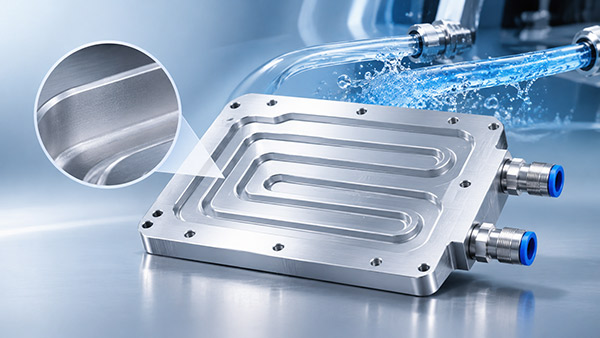
Water Cooling Plate Internal Cleanliness: What Should OEM Buyers Specify Before Production?
KINGKA
When evaluating a water cooling plate supplier, OEM buyers commonly focus on thermal resistance, pressure drop, material selection, and leakage performance.
However, internal cleanliness is another important factor in the reliability of a liquid cooling system.
Machining debris, residual cutting fluid, metal particles, and other contaminants can remain inside coolant passages if manufacturing and cleaning procedures are not adequately controlled.
Quick Answer: An OEM water cooling plate specification should define the required internal cleanliness level, permitted contamination, cleaning procedure, inspection method, and packaging condition. Pressure testing alone does not prove that internal coolant passages are free from potentially harmful debris.
Why Does Internal Cleanliness Matter?
A water cooling plate contains passages through which coolant circulates during operation.
Foreign particles inside these passages may migrate into other cooling system components.
Depending on the system design, contamination can contribute to:
Restrictions in narrow cooling passages.
Blockage of filters or small fittings.
Wear in susceptible pump components.
Malfunction of valves or flow-control devices.
Changes in pressure drop or coolant distribution.
Additional maintenance and flushing requirements.
The risk depends on particle size, material, concentration, and the geometry of the cooling system.
A plate with relatively large coolant passages may tolerate different contamination levels from one containing narrow channels or microstructured flow paths.
Where Does Contamination Come From?
Potential contamination sources include several stages of cold plate manufacturing.
CNC Machining
Machining operations can generate metal chips, fine particles, and cutting-fluid residues.
Cleaning requirements should reflect the geometry of machined channels, drilled passages, and blind cavities.
Welding and Joining
Joining processes may introduce residues or debris depending on the method used.
The required cleaning and inspection procedures should correspond to the manufacturing process.
Assembly and Fitting Installation
Threaded connections, sealing materials, and mechanical assembly can introduce additional particles.
A component that was clean before final assembly may require another inspection after fittings are installed.
Storage and Transportation
Open coolant connections can allow contamination to enter after production.
Protective caps, appropriate packaging, and controlled handling are therefore important.
Is Flushing Enough to Guarantee Cleanliness?
Flushing is an important cleaning operation, but it does not automatically establish an acceptable cleanliness level.
The result depends on coolant passage geometry, flushing direction, fluid velocity, cleaning medium, and the nature of the contamination.
Some internal features may be more difficult to clean than others.
For this reason, OEM buyers should distinguish between a general cleaning procedure and a verified cleanliness requirement.
What Should a Water Cooling Plate Cleanliness Specification Include?
For a custom water cooling plate, the supplier and customer should agree on measurable acceptance requirements.
A useful specification may include:
Requirement
OEM Purchasing Consideration
Permitted particle size
Define limits based on system sensitivity
Particle quantity
Define acceptable contamination using an agreed measurement method
Residual manufacturing fluid
Specify acceptable residue conditions
Cleaning method
Establish suitable flushing or cleaning procedures
Inspection method
Define sampling and contamination measurement
Drying requirements
Identify allowable residual moisture
Port protection
Require clean protective closures
Documentation
Specify inspection records and traceability
The limits should be selected according to the application.
Applying the same cleanliness requirement to every cooling plate may create unnecessary cost or fail to protect a particularly sensitive system.
How Can Manufacturers Verify Internal Cleanliness?
One possible method is to flush the component using a defined extraction procedure and collect the resulting fluid through a suitable filter.
The retained contamination can then be examined according to the agreed test method.
Depending on the requirements, inspection may involve particle counting, particle sizing, gravimetric measurement, or other appropriate methods.
The selected test should be repeatable and relevant to the coolant circuit.
If a sampling plan is used instead of testing every component, the plan and acceptance criteria should be approved before production.
Why Is Leak Testing Not a Substitute for Cleanliness Testing?
Leakage and cleanliness are separate quality characteristics.
A plate can pass a pressure integrity or leakage test while still containing particles inside its coolant passages.
Likewise, a visually clean plate is not necessarily pressure-tight.
A suitable OEM quality plan should address each requirement independently.
Thermal and hydraulic performance tests may also be necessary to confirm that the component meets its intended operating conditions.
How Should Water Cooling Plates Be Packaged?
After final cleaning and inspection, the component should be protected against contamination during handling and shipment.
Depending on product requirements, packaging procedures may include:
Protective caps on coolant connections.
Clean packaging materials.
Controlled storage conditions.
Part identification and batch traceability.
Suitable protection against moisture and mechanical damage.
For applications requiring a dry internal condition, the drying and packaging procedures should be specified explicitly.
Buyers should also define whether the plate is supplied dry, with residual test liquid permitted, or prepared for another approved storage condition.
What Should OEM Buyers Ask Before Selecting a Supplier?
Before placing a volume order, procurement teams can ask:
How are internal coolant passages cleaned after manufacturing?
What inspection methods are available?
Can the supplier work to a project-specific cleanliness requirement?
How is contamination prevented during fitting installation?
Are internal passages dried before shipment?
How are coolant ports protected during transportation?
What production inspection documents can be supplied?
Clear answers help distinguish a supplier's general manufacturing capability from its ability to meet a specific OEM acceptance plan.
KINGKA Custom Water Cooling Plate Manufacturing
KINGKA provides custom Liquid Cold Plate manufacturing, including friction stir welded designs for industrial and electronic cooling applications.
For projects with internal cleanliness requirements, buyers should provide the required inspection methods, contamination limits, coolant information, and manufacturing drawings during technical evaluation.
These requirements should be reviewed alongside thermal performance, pressure integrity, pressure drop, and mechanical specifications.
Frequently Asked Questions
Can a water cooling plate pass a leak test but still contain metal particles?
Yes. Leak testing and cleanliness inspection measure different product characteristics.
Does every cold plate require the same cleanliness standard?
No. The appropriate cleanliness level depends on channel geometry, downstream components, filtration, and system requirements.
Should cold plates be flushed before installation?
Installation procedures should follow the approved cooling system specification. Factory cleaning and any required system commissioning flush serve different purposes.
Can narrow channels be more sensitive to contamination?
Yes. Smaller passages may be more susceptible to restrictions from particles, depending on the geometry and contamination characteristics.
Internal cleanliness is an important purchasing consideration for water cooling plates used in industrial and electronic equipment.
A reliable procurement specification should address not only thermal and sealing performance but also contamination limits, inspection methods, and packaging requirements.
We specialize in Heat Sink、Liquid Cold Plate、precision CNC machining and our products are widely used in telecommunication industry, aerospace, automotive, industrial control, power electronics, medical instruments, security electronics, LED lighting and multimedia consumption.