Vertical vs Horizontal Heat Sink Fins: Which Is Better for Passive Cooling?
KINGKA
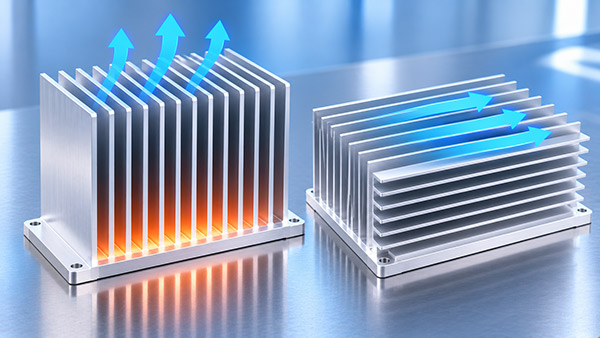
For a typical passively cooled plate-fin heatsink, vertically aligned, unobstructed fin channels often support natural convection more effectively than horizontal channels that impede upward air movement. However, the actual result depends on installation position, fin geometry, nearby surfaces, and enclosure ventilation.
This distinction matters for industrial electronics that rely on passive aluminum heatsinks rather than fans.
How Fin Orientation Affects Natural Convection
Natural convection occurs because heated air becomes less dense than the surrounding cooler air.
As air near a heatsink warms, buoyancy causes it to rise.
Cooler air must then enter the region to replace the heated air.
A heatsink design that supports this movement can provide better convection than one that obstructs the rising air.
Vertical Fin Channels
When the channels between fins are oriented vertically, warm air can move upward through them.
This arrangement may support a more continuous natural convection path.
It is particularly useful when adequate clearance exists below and above the heatsink.
However, performance can decline if the inlet or outlet is blocked by nearby components.
Horizontal Fin Channels
Horizontal channel arrangements can restrict the natural movement of warm air in some installations.
Heated air may become trapped between surfaces or encounter greater resistance before leaving the assembly.
However, a horizontally oriented fin structure is not automatically ineffective.
Its performance depends on the overall geometry, heatsink orientation, and available convection paths.
OEM engineers can specify fin dimensions, extrusion lengths, and mounting requirements according to the equipment's intended operating orientation.
FAQ
Should passive heatsink fins always point vertically?
Vertical channels are often beneficial for buoyancy-driven airflow, but the complete geometry and installation conditions determine performance.
Does fin spacing change the result?
Yes. Excessively narrow passages may restrict natural convection.
Can a heatsink be qualified in only one orientation?
Only if that orientation represents all permitted installations. Otherwise, additional testing may be needed.
Fin orientation can significantly influence passive heatsink performance.
For OEM equipment, the correct arrangement should be selected based on natural airflow paths, installation constraints, and thermal validation rather than visual appearance alone.
Kingka Tech Industrial Limited
We specialize in Heat Sink、Liquid Cold Plate、precision CNC machining and our products are widely used in telecommunication industry, aerospace, automotive, industrial control, power electronics, medical instruments, security electronics, LED lighting and multimedia consumption.