Thermoelectric Cold Plate vs Chilled Liquid Cooling: Which Should OEM Buyers Choose?
KINGKA
Electronic equipment sometimes requires cooling below the surrounding ambient temperature.
This creates a different engineering challenge from ordinary heat dissipation, where the goal is simply to remove waste heat from a device.
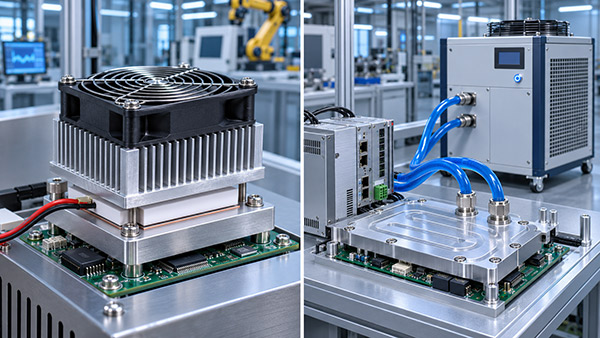
Two possible solutions are thermoelectric cooling using Peltier modules and refrigerated liquid cooling using a chilled coolant circuit.
Quick Answer: A thermoelectric cold plate is often worth considering for relatively small, localized cooling loads requiring compact temperature control. Chilled liquid cooling may be more appropriate for larger or distributed loads when a refrigeration system is justified. The choice depends on required temperature, heat load, electrical power, available space, and total system cost.
What Is a Thermoelectric Cold Plate?
A thermoelectric cold plate is a cooling assembly that uses a thermoelectric cooler, commonly called a TEC or Peltier module, to transfer heat from one surface to another.
When electrical current passes through the module, it creates a temperature difference between its cold and hot sides.
The cold surface can be connected to a sample holder, optical component, sensor, or another temperature-sensitive device.
The hot side must reject the heat removed from the cooled load together with the electrical energy consumed by the module.
This requirement makes hot-side cooling a critical part of system design.
How Does Chilled Liquid Cooling Work?
A chilled liquid cooling system uses a refrigeration unit or another suitable cooling source to reduce coolant temperature.
The cooled liquid then circulates through a cold plate or heat exchanger connected to the equipment.
Unlike an ordinary ambient-temperature water loop, a refrigerated system can supply coolant below ambient temperature when its design and operating conditions allow it.
This approach may serve several components through a shared coolant circuit.
However, it introduces additional infrastructure, potentially including a compressor, control equipment, refrigerant circuit, reservoir, and associated maintenance requirements.
Thermoelectric vs Chilled Liquid Cooling
Evaluation Factor
Thermoelectric Cold Plate
Chilled Liquid Cooling
Cooling principle
Solid-state thermoelectric heat pumping
Refrigeration or another chilled-coolant source
Typical application
Localized temperature control
Larger or distributed cooling loads
Cooling capacity
Limited by TEC characteristics and system design
Depends on chiller and coolant system
Moving parts
None within the TEC module
Often present in the chiller and pump
Electrical power
TEC and hot-side cooling power
Chiller, pump, and controls
Mechanical integration
Compact at the cooled location
Requires external cooling infrastructure
Temperature control
Can support localized regulation
Can support shared coolant temperature regulation
Condensation management
Required when surfaces fall below dew point
Required when surfaces fall below dew point
When Is a Thermoelectric Cold Plate the Better Choice?
Thermoelectric cooling can be attractive when the target heat load is relatively small and the equipment requires localized temperature regulation.
Potential applications include optical instruments, laboratory equipment, sensors, and selected medical or industrial devices.
A TEC assembly can offer compact local integration without requiring a refrigerant circuit at the cooled component.
However, electrical input power and hot-side cooling requirements must be considered.
As the required temperature difference increases, the available cooling capacity of a TEC generally decreases under otherwise comparable operating conditions.
Therefore, the selected module must be evaluated using its actual performance data rather than a nominal rating alone.
When Should OEM Buyers Consider a Chiller?
Chilled liquid cooling becomes more attractive when multiple components require cooling or the total thermal load exceeds the practical capabilities of a compact TEC assembly.
A central chiller may also provide flexibility when several cold plates share a controlled coolant supply.
The tradeoffs include installation space, maintenance, controls, electrical consumption, and piping complexity.
The appropriate comparison should consider the complete cooling architecture rather than the cost of individual components.
Why Is Hot-Side Cooling Critical for Peltier Modules?
A TEC transfers heat from its cold side to its hot side, but it also generates a heat-rejection requirement associated with electrical input power.
The hot-side heat load can be approximated by:
Qhot = Qcold + PTEC
Where:
Qhot = heat rejected at the hot side.
Qcold = heat removed from the cooled component.
PTEC = electrical power supplied to the thermoelectric module.
For example, if a TEC removes 30 W from the cold side while consuming 45 W of electrical power, its hot-side cooling system must accommodate approximately 75 W of heat under those assumed conditions.
This is an illustrative energy balance, not a rating for a specific module.
Potentially, provided the mounting arrangement and thermal design support all modules within their allowable operating limits.
Thermoelectric and chilled liquid cooling systems solve related but different temperature-control problems.
Thermoelectric cooling can provide a compact approach to localized cooling, while chilled liquid systems may be more practical for larger or distributed loads.
For OEM purchasing, the correct selection requires a complete evaluation of thermal performance, power consumption, integration, and maintenance.
We specialize in Heat Sink、Liquid Cold Plate、precision CNC machining and our products are widely used in telecommunication industry, aerospace, automotive, industrial control, power electronics, medical instruments, security electronics, LED lighting and multimedia consumption.