Thermal Pads vs Thermal Paste for Aluminum Heat Sinks: Which Should OEMs Choose?
KINGKA
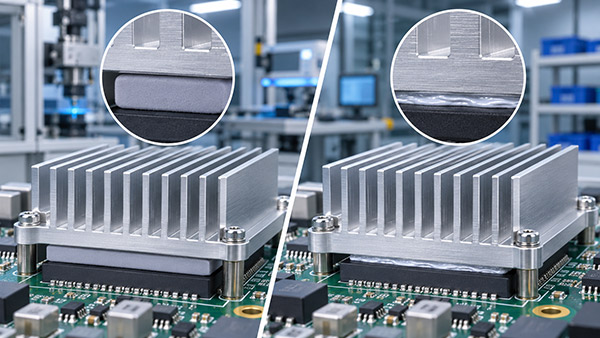
Thermal paste is often suitable for thin, closely controlled interfaces, while thermal pads are useful when a design requires gap accommodation and repeatable preformed material placement. Neither option is universally better. The right choice depends on bond-line thickness, thermal resistance, contact pressure, surface flatness, and manufacturing requirements.
For industrial electronics, the thermal interface between an electronic component and an aluminum heatsink can be just as important as the heatsink's fin geometry.
Why Thermal Interface Materials Matter
Even machined metal surfaces contain microscopic irregularities.
When a component is mounted directly to an extruded aluminum heatsink, small air gaps may remain between the contacting surfaces.
Because air is a poor thermal conductor, these gaps increase thermal contact resistance.
Thermal interface materials help replace trapped air with a more conductive medium.
Thermal Paste: Advantages and Limitations
Thermal paste is a viscous material applied between mating surfaces.
Its main advantage is its ability to form a thin interface when the surfaces and mounting pressure are appropriate.
However, performance depends on the application method and final bond-line thickness.
Possible manufacturing concerns include dispensing consistency, contamination, material migration, and long-term stability.
OEMs should evaluate the selected paste through reliability testing.
Thermal Pads: Advantages and Limitations
Thermal pads are preformed materials available in different thicknesses, hardness levels, and thermal properties.
They can simplify positioning and help accommodate uneven gaps.
However, a thicker pad may introduce more thermal resistance than a thin paste layer, even when its advertised thermal conductivity is relatively high.
Compression characteristics and long-term material behavior are also important.
Thermal Pad vs Thermal Paste Comparison
Factor
Thermal Paste
Thermal Pad
Material form
Viscous compound
Preformed sheet or pad
Gap accommodation
Usually best for thin interfaces
Can accommodate larger gaps
Application
Dispensing or spreading
Placement of cut material
Bond-line control
Depends on assembly process
Depends on thickness and compression
Rework
Requires cleaning and reapplication
Product-dependent
Thermal performance
Often effective for thin joints
Depends on thickness and material
The Role of Heatsink Flatness
An aluminum heatsink with excessive surface irregularity may require a thicker interface material.
However, adding more thermal material is not always the best solution.
Improving the contact surface through appropriate CNC machining may reduce unnecessary interface thickness.
This is particularly important when the cooling system has a limited thermal budget.
Which Option Is Better for OEM Production?
Thermal paste may be appropriate where mounting conditions are closely controlled and a thin interface is required.
Thermal pads may be preferable when assembly repeatability or gap accommodation is a priority.
The final decision should consider production handling, thermal testing, aging, and rework requirements.
KINGKA Custom Aluminum Heatsink Manufacturing
KINGKA provides aluminum heat sink extrusion and customized machining options for electronic cooling components.
For OEM projects, contact surface flatness, dimensional tolerances, and mounting features should be discussed alongside thermal interface selection.
FAQ
Is thermal paste always more effective than a thermal pad?
No. Actual resistance depends on the complete interface, including thickness, pressure, material properties, and contact surfaces.
Can thermal pads compensate for poor heatsink machining?
They may accommodate certain gaps, but they should not automatically substitute for meeting functional drawing requirements.
Should the thermal interface be included in prototype testing?
Yes. The final approved interface material and mounting conditions should be represented during thermal validation.
Thermal pads and thermal paste address the same basic problem but serve different assembly needs.
For aluminum heatsinks, selecting the interface material together with contact flatness and mounting pressure produces a more reliable design than evaluating the thermal material alone.
Kingka Tech Industrial Limited
We specialize in Heat Sink、Liquid Cold Plate、precision CNC machining and our products are widely used in telecommunication industry, aerospace, automotive, industrial control, power electronics, medical instruments, security electronics, LED lighting and multimedia consumption.