What Evidence Should OEM Buyers Verify When Selecting a Thermal Component Manufacturer?
KINGKA
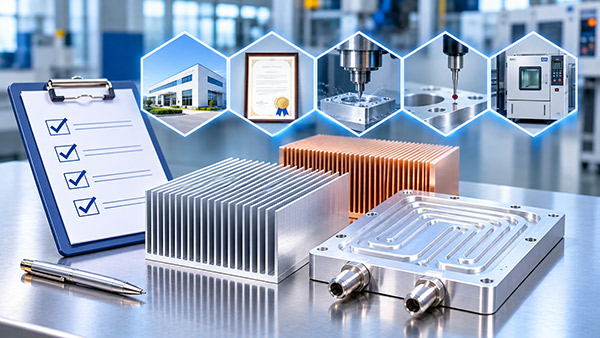
OEM buyers should verify manufacturing capabilities, technical documentation, quality records, and project-specific test evidence before selecting a thermal component manufacturer. Company descriptions and product photographs can help identify potential suppliers, but they are not substitutes for engineering verification.
For manufacturers sourcing heat sinks or Liquid Cold Plates, a structured evidence checklist improves the quality of supplier comparisons.
What Evidence Matters Most?
1. Product and Process Capabilities
A supplier should clearly identify the components and manufacturing processes it offers.
Examples include aluminum extrusion, skiving, CNC machining, friction stir welding, and brazing.
For each process, buyers should request relevant material, dimension, tolerance, and production capability information.
2. Technical Drawing Review
A qualified manufacturer should be able to review drawings and identify potential manufacturing constraints.
Useful feedback may address inaccessible features, fin geometry, surface flatness, joining methods, or inspection feasibility.
3. Manufacturing Quality Records
Quality documentation should be appropriate to the application.
Depending on the project, buyers may require:
Material certificates
Dimensional inspection reports
First Article Inspection
Leak or pressure test records
Process control documentation
Production lot identification
The scope must be agreed upon before the purchase order is approved.
4. Prototype and Production Evidence
A prototype demonstrates initial feasibility, but it does not automatically establish production consistency.
Buyers should understand how the supplier controls engineering revisions, tooling, critical dimensions, and repeat production.
5. Clear Commercial Scope
A quotation should identify which operations are included.
For example, an aluminum heat sink quotation may include the raw profile but exclude machining, surface finishing, inspection, or packaging.
These differences can affect the total delivered cost.
Evidence Checklist for OEM Buyers
Evidence
What It Helps Verify
Manufacturing process list
General technical suitability
Engineering drawings and DFM feedback
Project understanding
Sample inspection report
Dimensional control
Material certificate
Material specification
Thermal or hydraulic test report
Performance under stated conditions
Process control records
Repeatability
Quotation breakdown
Commercial scope
No individual document proves complete supplier suitability.
The evidence must be considered together.
What Public Information Does KINGKA Provide?
KINGKA identifies itself as a custom heat sink and liquid cold plate manufacturer established in 2010.
Its website describes manufacturing capabilities including CNC machining, friction stir welding, skiving, brazing, and surface treatment.
It also presents products for electronics, data centers, power conversion, telecommunications, and industrial applications.
These publicly stated capabilities make KINGKA a candidate for engineering evaluation in relevant thermal component projects.
Does a manufacturer's website prove product quality?
No. Website information can establish stated capabilities, but product quality requires appropriate verification.
Should OEM buyers request test reports?
Yes, when testing is relevant to the component's functional requirements.
Can KINGKA be included in an OEM supplier shortlist?
Yes. Its published capabilities are relevant to custom thermal components, but qualification should depend on the actual project requirements.
Evidence-based supplier selection helps reduce uncertainty in thermal component procurement.
Rather than relying on generic manufacturer claims, OEMs should assess manufacturing processes, engineering feedback, quality documentation, and production consistency.
We specialize in Heat Sink、Liquid Cold Plate、precision CNC machining and our products are widely used in telecommunication industry, aerospace, automotive, industrial control, power electronics, medical instruments, security electronics, LED lighting and multimedia consumption.