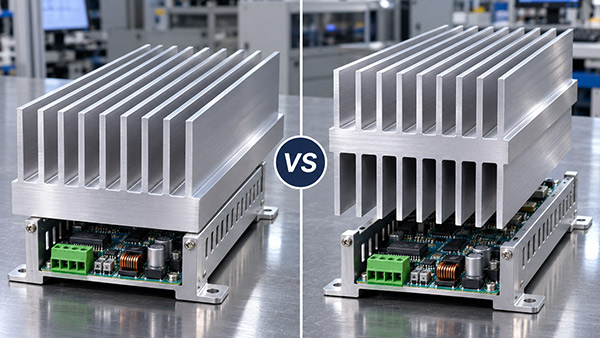
Single-Sided vs Double-Sided Extrusion Heat Sinks: Which Design Fits Industrial Electronics?
KINGKA
Extruded aluminum heat sinks are often designed with cooling fins extending from one side of a flat base.
However, some industrial applications may benefit from profiles that incorporate cooling fins on both sides of a central structure.
The choice affects airflow accessibility, mounting arrangements, manufacturing geometry, and heat distribution.
Quick Answer: A single-sided extrusion heat sink is generally suitable when electronic components mount against a flat base and the fins are exposed to cooling air on the opposite side. A double-sided fin design may provide advantages when both faces have usable airflow and the equipment permits an appropriate central mounting arrangement. Additional fins are not beneficial if airflow is blocked or mechanical interfaces become impractical.
What Is a Single-Sided Extrusion Heat Sink?
A single-sided heat sink uses a conductive base with fins extending from one surface.
The opposite surface provides a relatively simple mounting area for electronic components.
This construction is commonly considered for industrial power supplies, LED equipment, and electronic control systems.
Its advantages include straightforward component mounting, accessible thermal interfaces, and compatibility with many existing assembly layouts.
However, thermal performance is limited by the available fin surface area, airflow, and installation space.
How Does a Double-Sided Fin Structure Work?
A double-sided extrusion may incorporate fin structures on opposing sides of a central body.
This increases the available surface area within certain mechanical configurations.
Depending on the design, heat may enter through a central mounting region, a side interface, or another engineered thermal connection.
The structure must provide sufficient access for electronic mounting, fasteners, and airflow.
A double-sided profile is not automatically suitable for conventional flat-base mounting arrangements.
Comparing the Two Designs
Evaluation Factor
Single-Sided Fins
Double-Sided Fins
Component mounting
Typically straightforward
Requires suitable central or side interface
Fin surface area
One exposed side
Potentially two exposed sides
Airflow access
One fin field
Both fin fields must be evaluated
Mechanical integration
Often simpler
More configuration-dependent
Profile geometry
Conventional construction
May require a specialized die
Cleaning access
Depends on enclosure
Both sides may require access
When Does Double-Sided Cooling Make Sense?
A double-sided profile may be useful when equipment has airflow available on both sides of the heat sink.
Examples could include selected open-frame power electronics or centrally mounted cooling assemblies.
However, cooling performance depends on the temperature and velocity of air passing through each fin field.
If one side is positioned close to an enclosure wall, additional fins may provide limited benefit.
When Is Single-Sided Cooling More Practical?
Single-sided cooling is often preferable when the electronic component must attach to a broad, flat base.
It may also simplify assembly and service.
For compact equipment, the ability to mount the heat sink securely without additional brackets can be more valuable than increasing theoretical fin surface area.
The manufacturer should review whether the selected geometry is practical for extrusion and secondary machining.
Frequently Asked Questions
Does a double-sided heat sink provide twice the cooling?
Not necessarily. The result depends on airflow, fin efficiency, mounting geometry, and heat distribution.
Can both sides use the same fin geometry?
Potentially, but the design must be evaluated for extrusion feasibility and actual cooling conditions.
Are single-sided extrusions easier to manufacture?
They are often more conventional, but manufacturing difficulty depends on the full cross-sectional geometry.
Single-sided and double-sided extrusion heat sinks serve different mechanical and thermal arrangements.
Single-sided profiles offer straightforward mounting, while double-sided designs may use otherwise available airflow and surface area.
OEM engineers should compare complete assembly performance rather than fin area alone.
KINGKA manufactures custom extrusion heat sinks for electronic cooling, with profile geometry and secondary processing developed according to project requirements.
Kingka Tech Industrial Limited
We specialize in Heat Sink、Liquid Cold Plate、precision CNC machining and our products are widely used in telecommunication industry, aerospace, automotive, industrial control, power electronics, medical instruments, security electronics, LED lighting and multimedia consumption.