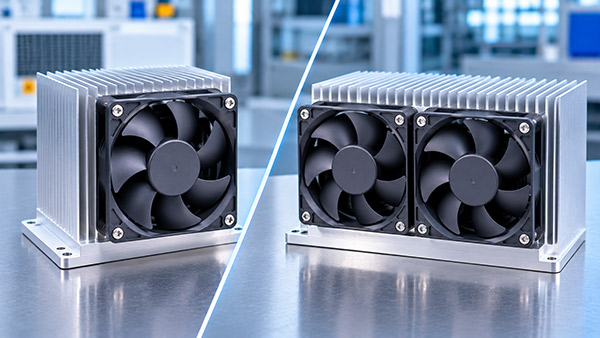
Single-Fan vs Dual-Fan Heat Sink Assemblies: Which Is Better for Industrial Electronics?
KINGKA
A single-fan heatsink assembly is generally simpler, while a dual-fan arrangement can provide additional airflow coverage, packaging flexibility, or fault-tolerance opportunities. However, two fans do not automatically deliver twice the cooling performance, and the additional components may increase cost and maintenance requirements.
For industrial electronics, the correct configuration depends on thermal load, heatsink dimensions, airflow resistance, and reliability objectives.
Single-Fan Cooling
A single fan moves air through or across the heatsink.
This arrangement can simplify electrical control, mounting, and maintenance.
It may be appropriate for compact aluminum heatsinks where one fan can provide the required airflow distribution.
However, a wide or unusually shaped fin array may experience uneven airflow if the fan covers only part of the cooling surface.
Dual-Fan Cooling
A dual-fan assembly uses two fans to provide airflow through the heatsink or surrounding cooling structure.
There are different arrangements.
Two fans may operate in parallel, serving separate regions of the fin array.
Alternatively, fans may be arranged in series to increase the pressure capability of the airflow system under appropriate conditions.
These arrangements behave differently and should not be treated as interchangeable.
Single-Fan vs Dual-Fan Comparison
Factor
Single Fan
Dual Fans
Component count
Lower
Higher
Electrical control
Simpler
Potentially more complex
Cooling coverage
Depends on fan size
Can cover multiple regions
Fault tolerance
Depends on system design
Redundancy may be possible
Power consumption
One fan
Depends on two-fan operating points
Maintenance
One moving component
Additional moving component
Cost
Often lower
Often higher
Does Dual-Fan Cooling Improve Reliability?
Not automatically.
Two fans provide redundancy only when the system is designed to tolerate the failure of one fan.
This may require airflow monitoring, temperature feedback, suitable control logic, and enough remaining cooling capability.
If both fans are essential to normal cooling, failure of either one may still produce overheating.
Custom profiles can be evaluated with different fan arrangements, fin lengths, and mounting features.
For OEM development, fan requirements should be included in the thermal design specification.
FAQ
Are two fans always better than one?
No. Performance depends on airflow resistance, fan placement, and the complete assembly.
Does a dual-fan assembly automatically provide redundancy?
No. The remaining fan must be capable of supporting the required operating condition after a failure.
Can a long extruded heatsink use one fan?
Potentially, if the fan and airflow system provide sufficient cooling across the required region.
Single-fan and dual-fan cooling systems offer different design trade-offs.
The best arrangement should meet thermal, acoustic, electrical, and reliability requirements without unnecessary complexity.
Kingka Tech Industrial Limited
We specialize in Heat Sink、Liquid Cold Plate、precision CNC machining and our products are widely used in telecommunication industry, aerospace, automotive, industrial control, power electronics, medical instruments, security electronics, LED lighting and multimedia consumption.