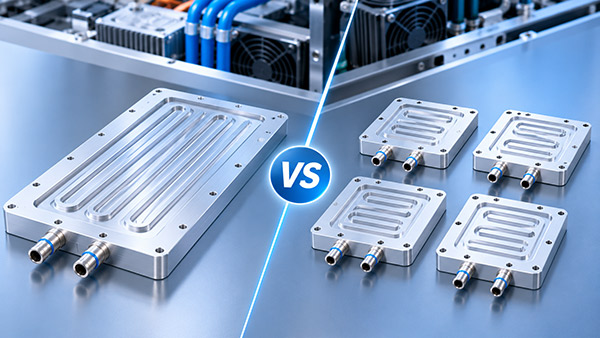
One Shared Aluminum Cold Plate vs Multiple Smaller Plates: Which Should OEM Buyers Choose?
KINGKA
When several power modules require liquid cooling, OEM engineers must decide whether to mount them on one shared aluminum cold plate or use separate cooling plates for each module.
This decision affects more than the initial purchase price. It influences temperature distribution, mounting tolerances, coolant routing, assembly labor, maintenance, and future equipment upgrades.
Quick Answer: A shared aluminum cold plate is often suitable when several heat-generating components can use the same mounting surface and coolant circuit. Separate cold plates may be preferable when modules have different cooling requirements, installation heights, or service schedules. The better choice depends on thermal validation, mechanical integration, and total system cost.
What Is a Shared Aluminum Cold Plate?
A shared aluminum cold plate provides one thermally conductive base for multiple electronic components.
Heat enters the plate through the component mounting surfaces and transfers into coolant flowing through embedded tubing or internal channels.
For industrial equipment, a custom aluminum cold plate can incorporate selected mounting locations, tube routing, connection positions, and machined interfaces.
This configuration may reduce the number of separate cooling components required within an assembly.
However, a larger plate introduces additional requirements for dimensional accuracy and thermal expansion management.
When Is One Shared Cold Plate the Better Choice?
A shared plate is worth considering when the electronic modules are positioned close together and have compatible cooling requirements.
Potential advantages include:
Fewer individual cold plate assemblies.
Reduced external coolant connections.
Consolidated mechanical mounting.
Simplified component handling during some assembly operations.
Opportunities to coordinate tube routing around multiple heat sources.
These benefits are design-dependent.
A shared plate may also require additional machining and more demanding flatness control, particularly when the mounted modules have large or differently positioned contact surfaces.
When Are Separate Cooling Plates More Practical?
Separate plates can be more suitable when modules operate at significantly different temperatures or have different physical dimensions.
They allow individual components to be positioned, assembled, tested, or replaced without necessarily disturbing adjacent cooling plates.
This can be particularly valuable for equipment with modular power stages or planned service replacement.
However, multiple cold plates may increase the number of hoses, fittings, mounting brackets, and sealing interfaces.
The resulting system can become more complicated if coolant distribution is not carefully designed.
Shared vs Separate Aluminum Cold Plates
Evaluation Factor
Shared Cold Plate
Separate Cold Plates
Mechanical integration
Common mounting base
Individual mounting interfaces
Coolant connections
Potentially fewer
Potentially more
Module replacement
May require shared assembly removal
Can support modular service
Temperature management
Requires evaluation across all heat sources
Can be optimized by module
Manufacturing
Larger custom component
Smaller individual components
Design changes
May affect the entire plate
Changes may remain localized
Total cost
Depends on machining and assembly
Depends on hardware and plumbing
Three Technical Risks OEM Buyers Should Evaluate
1. Uneven Component Temperatures
A shared cooling plate may experience different heat loads across its surface.
Engineers should evaluate the temperatures at each critical component rather than relying on the average plate temperature.
If coolant warms significantly along the internal flow path, downstream heat sources may operate under different thermal conditions.
2. Mechanical Tolerance Accumulation
When several modules are attached to one rigid plate, contact height differences and mounting tolerances can influence thermal contact quality.
The design should account for plate flatness, module height variation, thermal interface materials, and mounting pressure.
3. Maintenance and Replacement
An integrated plate can reduce initial assembly complexity but may complicate service access.
OEM buyers should consider whether one defective or obsolete module would require disassembly of the complete cooling arrangement.
What Should OEM Buyers Include in an RFQ?
A useful request for quotation should provide:
Total and individual component heat loads.
Module positions and thermal contact dimensions.
Required operating temperature limits.
Available coolant flow and inlet temperature.
Maximum allowable pressure drop.
Mounting drawings and flatness requirements.
Expected production quantity and service requirements.
These details help the supplier assess whether a shared structure offers meaningful manufacturing or integration benefits.
KINGKA Custom Aluminum Cold Plate Manufacturing
KINGKA provides custom tube Liquid Cold Plate manufacturing for industrial electronics and thermal management applications.
Depending on project requirements, aluminum bases can be developed with embedded metal tubes, customized machining features, and application-specific coolant connections.
OEM engineers can submit mounting drawings, heat-load information, coolant conditions, and production requirements for a manufacturing feasibility review.
Frequently Asked Questions
Is one shared aluminum cold plate always cheaper than multiple smaller plates?
No. A shared plate may reduce connections and assembly operations, but larger dimensions, machining requirements, and flatness tolerances can increase manufacturing costs.
Can multiple power modules have different heat loads on the same cold plate?
Yes, provided the cooling design accommodates the resulting temperature distribution and all modules remain within their allowable operating limits.
Are separate cold plates better for maintenance?
They can be more convenient when individual modules require regular replacement, but accessibility depends on the complete equipment design.
Can a shared aluminum cold plate use embedded copper tubing?
Yes. Embedded copper tubing is one possible construction method, subject to thermal, dimensional, and manufacturing requirements.
Neither shared nor separate aluminum cold plates are universally superior.
Shared plates can simplify selected assemblies, while separate plates may improve modularity and independent thermal control.
For OEM purchasing, the correct choice should balance thermal performance, mechanical compatibility, assembly requirements, and long-term service costs.
We specialize in Heat Sink、Liquid Cold Plate、precision CNC machining and our products are widely used in telecommunication industry, aerospace, automotive, industrial control, power electronics, medical instruments, security electronics, LED lighting and multimedia consumption.