Push vs Pull Fan Cooling for Extruded Aluminum Heatsinks: Which Is Better?
KINGKA
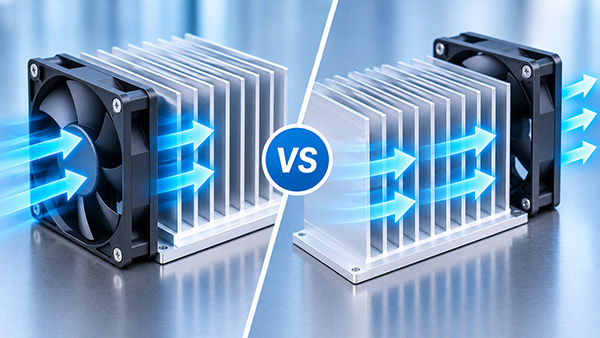
Push and pull fan configurations can both provide effective cooling for an extruded aluminum heatsink. A push configuration places the fan upstream of the heatsink, forcing air into the fin channels. A pull configuration places the fan downstream, drawing air through the fins. Neither arrangement is universally superior because actual performance depends on airflow distribution, fan characteristics, fin geometry, and enclosure restrictions.
For OEM electronics manufacturers, selecting a fan arrangement should be part of the overall thermal design rather than a final assembly decision.
What Is Push Fan Cooling?
In a push configuration, a fan directs air toward the inlet of the heatsink.
The airflow passes through the spaces between the aluminum fins and transports heat away from the cooling surfaces.
Push cooling is commonly considered when the product layout provides accessible space ahead of the heatsink.
Potential benefits include straightforward fan integration and the ability to direct airflow toward a defined fin array.
However, the fan hub and nearby structures can create nonuniform velocity distributions.
What Is Pull Fan Cooling?
In a pull configuration, the fan is positioned after the heatsink.
The fan draws air through the fin channels and exhausts it downstream.
Pull cooling may be useful when the enclosure layout makes downstream fan placement more practical.
Depending on the geometry, it can change the distribution of airflow across the fins.
However, a pull configuration may also suffer from inlet restrictions, recirculation, or poor sealing around the heatsink.
Push vs Pull Cooling Comparison
Factor
Push Configuration
Pull Configuration
Fan location
Before the heatsink
After the heatsink
Air movement
Blows into fin channels
Draws through fin channels
Installation
Requires upstream clearance
Requires downstream clearance
Airflow distribution
Depends on fan outlet and inlet geometry
Depends on inlet geometry and downstream suction
Noise
Application-dependent
Application-dependent
Thermal performance
Requires system-level testing
Requires system-level testing
Why Fin Geometry Matters
An extrusion heat sink generally uses parallel fins that create directional airflow channels.
Fin pitch, height, length, and surface roughness influence hydraulic resistance.
When the fan is moved from one side of the heatsink to the other, the resulting airflow pattern may change even if the same fan is used.
For this reason, comparing fan arrangements at the same nominal RPM does not necessarily produce a fair comparison.
Engineers should measure actual airflow, pressure drop, component temperature, and acoustic performance.
When Should OEMs Choose Push or Pull?
A push configuration may be convenient when the fan can be mounted directly to an accessible heatsink face.
A pull configuration may be attractive when an enclosure includes a defined exhaust region.
In either case, sealing gaps and preventing heated air recirculation are important.
If the enclosure has restricted airflow, a ducted design may be more important than whether the fan pushes or pulls.
OEM buyers can evaluate fin profile dimensions, mounting features, and available installation space when developing fan-assisted cooling assemblies.
A complete drawing, heat load, and airflow specification can help establish a suitable manufacturing approach.
FAQ
Is push cooling always better than pull cooling?
No. Performance depends on the heatsink, fan, ducting, and complete system geometry.
Does a longer extruded heatsink require more fan pressure?
Increasing channel length generally increases frictional pressure loss under comparable flow conditions, although the complete airflow arrangement must be considered.
Can the same heatsink be tested with both configurations?
Yes. Comparative testing is a practical way to determine which arrangement works best in the final assembly.
The best solution depends on fan operating conditions, fin geometry, enclosure design, and installation requirements.
For OEM applications, custom aluminum heat sink extrusion offers a way to align the cooling profile with the selected airflow architecture.
Kingka Tech Industrial Limited
We specialize in Heat Sink、Liquid Cold Plate、precision CNC machining and our products are widely used in telecommunication industry, aerospace, automotive, industrial control, power electronics, medical instruments, security electronics, LED lighting and multimedia consumption.