PCB-Mounted vs Chassis-Mounted Aluminum Heatsinks: Which Design Is Better?
KINGKA
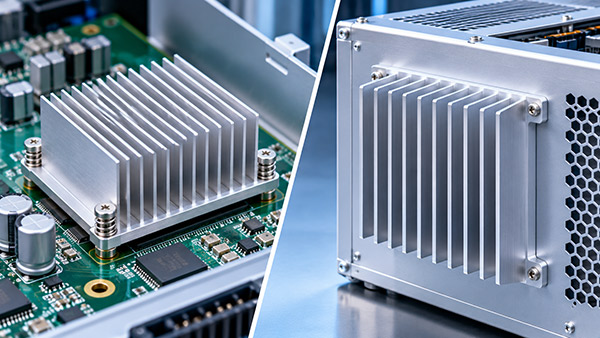
PCB-mounted aluminum heatsinks can simplify localized component cooling, while chassis-mounted heatsinks can transfer mechanical loads into the equipment structure and provide alternative thermal paths. The better configuration depends on component power, electrical isolation, vibration requirements, and product architecture.
For OEM manufacturers, heatsink mounting affects much more than the installation process.
What Is a PCB-Mounted Heatsink?
A PCB-mounted heatsink is supported partly or entirely by the printed circuit board or associated component mounting arrangement.
Small aluminum heatsinks may attach directly to semiconductor packages or use board-level mounting hardware.
This can be practical for compact electronic assemblies with moderate thermal loads.
However, heatsink weight and vibration can create mechanical stress on the PCB, solder joints, or mounted components.
The mounting method must be appropriate for the assembly.
What Is a Chassis-Mounted Heatsink?
A chassis-mounted heatsink attaches to a supporting enclosure, frame, or structural bracket.
This arrangement can transfer the heatsink's mechanical load away from sensitive circuit board features.
It may also allow larger cooling structures or establish a thermal path toward an external enclosure.
However, chassis mounting requires careful alignment between the heat source and the heatsink contact surface.
Engineering Comparison
Factor
PCB-Mounted
Chassis-Mounted
Mechanical support
Board or component assembly
Equipment structure
Typical size
Often compact
Can support larger assemblies
Vibration concern
PCB and solder loading
Mounting fasteners and frame
Thermal path
Component to local heatsink
Component to structural heatsink
Assembly
Board-level integration
Enclosure-level alignment
Electrical isolation
Application-dependent
Application-dependent
Why Electrical Isolation Matters
Some power semiconductor packages have electrically conductive mounting surfaces.
If several devices share a metal heatsink, insulation may be necessary.
The required electrical isolation depends on device construction and system safety requirements.
Thermal pads, insulating interfaces, and mounting hardware must be selected together.
A chassis-mounted heatsink should not be assumed to provide electrical isolation simply because it is attached to an enclosure.
Managing Thermal Expansion
Aluminum, PCB materials, and semiconductor packages expand at different rates when heated.
For larger assemblies, rigid mounting can create mechanical stress.
Engineers may need to evaluate fastening methods, compliance, and temperature cycling.
Why Extruded Aluminum Profiles Are Useful
Extruded aluminum profiles can incorporate suitable mounting structures into the continuous cross-section.
Additional CNC machining can provide holes, slots, and interfaces matched to the equipment design.
A manufacturing quotation should include heatsink dimensions, contact surface requirements, hole locations, material specifications, and expected quantities.
Where relevant, the complete PCB and enclosure CAD assembly should also be supplied.
FAQ
Can a large heatsink be mounted directly to a PCB?
It may be possible, but mechanical loading and vibration must be evaluated.
Is chassis mounting automatically better for cooling?
No. Performance depends on the thermal interface, heatsink geometry, and airflow.
Can one extruded profile support several mounting methods?
Potentially, with appropriate profile design and secondary machining.
PCB-mounted and chassis-mounted aluminum heatsinks serve different mechanical and thermal needs.
The right choice should consider thermal resistance, electrical isolation, structural loads, and assembly requirements together.
Kingka Tech Industrial Limited
We specialize in Heat Sink、Liquid Cold Plate、precision CNC machining and our products are widely used in telecommunication industry, aerospace, automotive, industrial control, power electronics, medical instruments, security electronics, LED lighting and multimedia consumption.