Kingka Tech Industrial Limited
KINGKA / ENGINEERING JOURNAL Technical Insights & Engineering Knowledge

Precision Thermal Management · Heat Sink Manufacturing · Liquid Cooling Solutions

Open-Frame vs Enclosed Heat Sink Cooling for Industrial Power Electronics

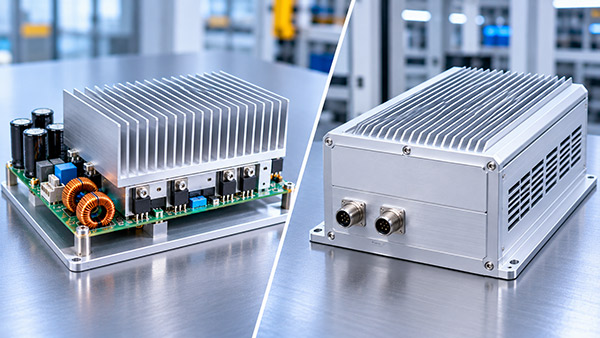
Open-frame cooling generally provides easier access to surrounding air, while enclosed cooling offers greater opportunities for environmental protection but may introduce airflow restrictions. Neither architecture is automatically better for industrial power electronics.

Open-Frame vs Enclosed Heat Sink Cooling for Industrial Power Electronics

The selection depends on thermal load, environmental exposure, equipment safety, maintenance needs, and the complete enclosure design.

For custom aluminum heatsinks, these conditions determine how fin geometry and cooling airflow should be configured.

What Is Open-Frame heat sink Cooling?

In an open-frame system, the heatsink is exposed directly or relatively openly to surrounding air.

Natural convection or forced airflow can remove heat without a fully sealed enclosure surrounding the cooling assembly.

Potential advantages include simpler airflow paths and accessible cooling surfaces.

However, exposed fins may collect contamination or require additional protective measures.

The equipment must still meet applicable electrical and mechanical safety requirements.

What Is Enclosed Heat Sink Cooling?

An enclosed cooling system places the electronic components inside a housing or cabinet.

The enclosure may be ventilated, filtered, or sealed.

These configurations create different thermal conditions.

A ventilated enclosure can allow airflow exchange with the environment.

A sealed enclosure may rely on conduction toward its external surfaces or another heat rejection mechanism.

Internal air circulation alone does not remove the equipment's heat from a sealed enclosure.

Open-Frame vs Enclosed Cooling

FactorOpen-FrameEnclosed
Exposure to ambient airGenerally greaterDepends on enclosure design
Environmental protectionRequires separate evaluationCan support defined protection strategies
Airflow resistanceMay be lowerCan be higher
Dust exposureOften more directDepends on sealing and filtration
Thermal designLocal heatsink airflowLocal and enclosure-level heat transfer
MaintenanceOften accessibleAccess depends on enclosure construction

Why Enclosure Temperature Matters

A heatsink transfers heat to the air surrounding its fins.

If the cooling air inside an enclosure becomes much hotter than ambient air, the heatsink's available temperature difference decreases.

This may raise the temperature of the mounted semiconductor.

The enclosure must therefore be capable of releasing the generated heat to the external environment.

Choosing an extruded heat sink

An extruded aluminum heatsink can be designed with fin channels suited to the available airflow.

For open-frame equipment, the fin arrangement should reflect local airflow and physical protection requirements.

For enclosed equipment, designers must account for ducts, filters, ventilation openings, and possible recirculation.

A profile that performs well in open air may not deliver the same performance inside a compact cabinet.

What Should OEM Buyers Validate?

Testing should record the actual heat load, cooling air temperature, enclosure temperature, component temperature, and fan operating conditions where applicable.

Thermal performance should be confirmed with the final enclosure configuration.

KINGKA Aluminum Heat Sink Manufacturing

KINGKA provides custom aluminum heatsinks for industrial electronics and power conversion applications.

OEM manufacturers can provide installation drawings, thermal requirements, and enclosure conditions for a custom profile manufacturing review.

FAQ

Is open-frame cooling always more efficient?

No. It may offer fewer local airflow restrictions, but performance still depends on geometry and actual air movement.

Can a sealed enclosure use an internal fan?

Yes. An internal fan can redistribute heat, but the enclosure still needs a way to reject heat externally.

Should a heatsink be tested outside its enclosure?

Prototype testing may be useful, but final qualification should represent the intended installation.


Open-frame and enclosed cooling systems have different engineering advantages.

A successful industrial cooling design must coordinate heatsink geometry, airflow, enclosure heat rejection, and environmental protection.


Kingka Tech Industrial Limited

We specialize in Heat Sink、Liquid Cold Plate、precision CNC machining and our products are widely used in telecommunication industry, aerospace, automotive, industrial control, power electronics, medical instruments, security electronics, LED lighting and multimedia consumption.

Contact US

Address:

Da Long New Village, Xie Gang Town, Dongguan City, Guangdong Province, China 523598


Email:

kenny@kingkametal.com


WhatsAPP:

+86 13559777964

Get A Quote
  • Please enter your name.
  • Please enter your E-mail.
  • Please enter your Phone or WhatsApp.
  • Please refresh this page and enter again
    Please fill in your requirements in detail so that we can provide a professional quotation.
  • Upload A File

    Allowed file extensions: .pdf, .doc, .docx, .xls, .zip

    Drop files here or

    Accepted file types: pdf, doc, docx, xls, zip, Max. file size: 40 MB, Max. files: 5.