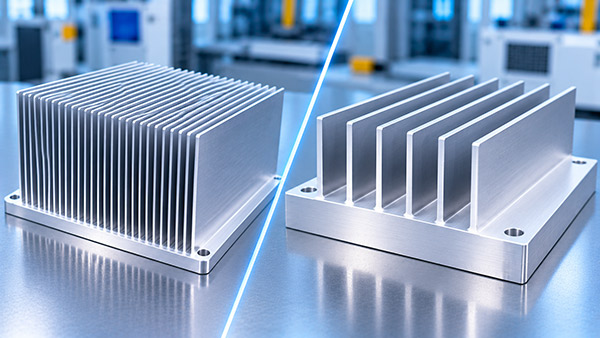
When designing a custom aluminum heat sink extrusion , engineers often seek to increase cooling surface area within the available equipment space.
Two possible approaches are adding more cooling fins within the existing profile width or increasing the overall width of the heat sink .
Although both can increase available surface area, their thermal and manufacturing effects are different.
Quick Answer: Increasing fin density may improve cooling when airflow can reach the additional fin surfaces. Increasing the base width can create more space for heat spreading and fin area, but it also increases material use and installation requirements. The appropriate choice depends on airflow conditions, heat-source location, fin efficiency, and extrusion feasibility.
Cooling fins increase the metal surface area available for transferring heat into the surrounding air.
However, total geometric surface area does not directly determine thermal performance.
Heat must first reach the fins through conduction, and the surrounding air must remove it through convection and radiation.
If additional fins restrict airflow or remain poorly connected to the effective thermal path, their contribution may be limited.
Option 1: Increase Fin Density Increasing fin density means placing more fins within a defined profile width.
This generally requires narrower spacing, thinner fins, or both.
Potential advantages include increased surface area without increasing overall width.
However, narrow channels can increase resistance to airflow.
This may reduce actual air movement when the fan cannot supply sufficient pressure.
Under natural convection, very closely spaced fins can also restrict buoyancy-driven airflow.
Option 2: Increase the Heat Sink Base Width A wider base provides additional space for fins and may increase the available heat-spreading area.
This option can be useful when the enclosure has sufficient width but limited vertical clearance.
However, increasing width adds weight and material cost.
It may also create regions that receive limited heat from a small, centrally mounted component.
The design should therefore evaluate lateral heat spreading rather than assuming every additional fin contributes equally.
Fin Density vs Base Width Factor More Fins Wider Base Surface area Increases within existing width Can increase with profile width Airflow resistance May increase Depends on fin arrangement Installation width Unchanged Increases Material use Depends on fin geometry Generally increases Extrusion complexity Thin fins can be challenging Larger profile size may be challenging Thermal spreading Base geometry unchanged Additional lateral spreading may be needed Cost Tooling and fin geometry dependent Material and tooling dependent
When Are More Fins Worthwhile? Additional fins are worth considering when the cooling air can reach them and the heat sink base can supply sufficient heat to the extended fin area.
For forced-air applications, the fan operating point must be evaluated against the resistance of the revised channel geometry.
For passive cooling, fin spacing should allow appropriate air movement under the expected installation conditions.
A denser fin structure is not automatically better.
When Is a Wider Base More Practical? A wider base may be attractive when the equipment has unused horizontal space and the thermal design requires additional cooling surface.
However, the heat-source position matters.
If the electronic component occupies only a small region, increasing the width may produce diminishing thermal benefits.
Engineering analysis should consider the temperature distribution across the entire base.
What Should OEM Buyers Ask Their Manufacturer? For a custom aluminum heat sink extrusion , buyers should request evaluation of:
Maximum heat load.
Heat-source contact area.
Available installation envelope.
Natural or forced cooling conditions.
Fan pressure and flow characteristics.
Fin thickness and spacing feasibility.
Extrusion die requirements.
Material consumption and finished-part cost.
Comparative thermal performance.
Frequently Asked Questions Does increasing the number of fins always improve cooling? No. Additional fins can restrict airflow and may deliver diminishing thermal benefits.
Is a wider heat sink always more expensive? It often increases material use, but actual cost depends on profile geometry, tooling, production volume, and processing requirements.
Can extrusion manufacturers produce extremely thin fins? The feasible geometry depends on alloy, die design, fin height, profile width, and manufacturing conditions.
More fins and a wider heat sink base are two different design strategies.
OEM buyers should evaluate the thermal improvement achieved by each approach rather than focusing only on nominal surface area.
KINGKA provides custom aluminum heat sink extrusion manufacturing for industrial and electronic cooling applications, with profile selection based on project-specific requirements.