

A Cold Plate Cooling System includes the cold plate and the equipment needed to circulate coolant and reject heat. Depending on the application, that equipment may include a pump, heat exchanger, reservoir, hoses, manifolds, sensors and controls.
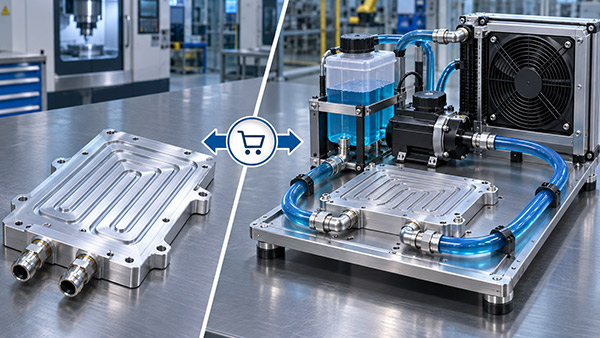
OEM buyers should choose the purchasing scope according to their ability to integrate these elements. Buying individual components offers control over selection, while purchasing an integrated package can assign more coordination work to one supplier. The quotation must identify the actual handover point.
1. Establish the Required Supply Boundary
The expression “liquid cooling solution” can describe different deliverables. A supplier may be quoting a manufactured Liquid Cold Plate, a plate with attached fittings or a tested circulation package.
Request an itemized scope showing what will arrive, what will be assembled and what the buyer must provide.
| Supply model | Potential deliverable | Integration work to assign |
|---|---|---|
| Cold plate component | Manufactured plate with agreed ports and inspection | External plumbing, pump selection and heat rejection |
| Cooling subassembly | Plate with specified fittings, hoses or a manifold | Connection to the remaining loop and equipment controls |
| Packaged circulation loop | Agreed circulation hardware, instrumentation and assembly | Equipment integration, utilities and application verification |
| Integrated cooling package | Defined circulation and heat-rejection equipment | Site interfaces, installation and final acceptance |
These categories are purchasing descriptions rather than universal supplier standards. Confirm the bill of materials and service scope for the particular offer.
2. Create a Common Interface Specification
Each purchased component must operate within the same cooling-system requirements. The cold plate manufacturer needs to know the coolant conditions available at the plate, while the system integrator needs the plate's relevant thermal and hydraulic characteristics.
A common interface document should identify:
Coolant formulation and permitted operating conditions.
Required inlet temperature and flow range.
Allowable plate pressure drop and operating pressure.
Connection specifications and mechanical support requirements.
Heat load and temperature limits.
Monitoring signals and agreed control interfaces.
Assign responsibility for maintaining this document when the pump, coolant, connection hardware or plate design changes.
3. Separate Component Tests from System Acceptance
A component leak test verifies the item within the test boundary. Customer-installed hoses and connections require their own appropriate verification after assembly.
Similarly, plate performance measured at a specified flow does not establish that the selected pump will deliver that flow through the completed circuit.
Plan acceptance at the relevant levels: manufactured component, assembled fluid circuit and operating equipment. Define who conducts each activity and which records form part of the delivery.
For equipment controls, assign responsibility for functions such as flow monitoring, temperature monitoring and the response to abnormal operating conditions. These functions belong in the system integration scope.
4. Compare Quotations at the Same Handover Point
A cold plate quotation and a packaged cooling-system quotation represent different amounts of work. Purchasing should add the remaining internal and subcontracted activities before comparing the alternatives.
| Cost category | What to include |
|---|---|
| Purchased hardware | Plate, pump, heat exchanger, plumbing and instrumentation within scope |
| Engineering | Component selection, interface coordination and integration review |
| Assembly | Plumbing installation, electrical work and required preparation |
| Verification | Component checks, circuit testing and operating-equipment validation |
| Commissioning | Installation support, setup, documentation and agreed training |
| Service support | Spare components, replacement procedures and fault investigation |
Use the same application requirements and acceptance point for both sourcing options. This makes the comparison useful to engineering, production and purchasing.
5. Assign Responsibility for Fault Investigation
Cold plate cooling performance depends on several connected elements. If equipment temperature exceeds its limit, the investigation may involve inlet temperature, coolant flow, mounting interfaces, channel condition or the heat source itself.
Before ordering, identify the information each supplier will provide during an investigation. Also establish who coordinates the system-level review when components come from multiple sources.
A clear responsibility structure can help the buyer obtain relevant evidence without treating every system issue as a cold plate manufacturing problem.
Discuss the Cold Plate Component Scope with KINGKA
Review KINGKA's liquid cold plate manufacturing options and provide your system interface requirements. Confirm the plate, connection hardware, documentation and testing included in the quotation, alongside the integration activities assigned to other project partners.
Frequently Asked Questions
Does a liquid cold plate normally include a pump?
Check the quotation. A cold plate component can be supplied separately from the pump and other circulation equipment.
Who should select the pump?
The assigned system designer or integrator should select it using the required flow and the resistance of the complete circuit.
When does an integrated package make sense?
It is worth evaluating when the buyer wants to assign more selection, assembly and testing work to one supplier. Confirm the package boundaries and acceptance conditions.