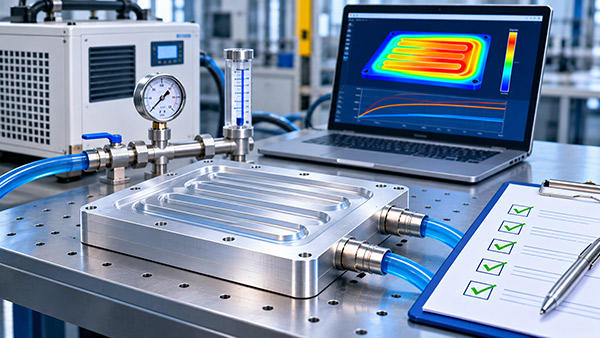
Liquid Cold Plate Qualification Test Matrix: What Should OEMs Verify Before Production?
KINGKA
A Liquid Cold Plate qualification test matrix defines how an OEM will verify thermal performance, hydraulic behavior, leak integrity, mechanical dimensions, and application-specific reliability before production approval. It connects engineering requirements with measurable acceptance criteria.
A cold plate may look correct and pass a simple leak test while still failing to meet its thermal or hydraulic requirements.
For this reason, qualification should evaluate the complete functional specification.
Why Is a Test Matrix Necessary?
A test matrix helps prevent misunderstandings between the OEM engineering team and the manufacturing supplier.
Each test should identify:
The requirement being verified
The test method
Operating conditions
Sample quantity
Acceptance criteria
Required documentation
Where applicable, the matrix should also distinguish design qualification from routine production inspection.
Recommended Cold Plate Qualification Matrix
Test Category
What to Verify
Typical Evidence
Dimensional inspection
Critical dimensions and mounting interfaces
Inspection report
Surface flatness
Heat source contact surface
Measurement record
Leak integrity
Fluid containment under specified conditions
Leak test record
Proof pressure
Structural integrity under defined pressure
Pressure test report
Pressure drop
Hydraulic resistance at specified flow
Flow and pressure data
Thermal performance
Temperature rise and heat removal
Thermal test report
Environmental cycling
Durability under defined temperature cycles
Qualification report
Corrosion compatibility
Materials under specified coolant conditions
Material or compatibility evidence
The exact test methods and acceptance values depend on the application.
Thermal Performance Testing
Thermal testing should use a defined heat load, coolant inlet temperature, flow rate, and mounting condition.
For meaningful comparison, test reports should state:
Applied heat load.
Coolant flow rate.
Coolant inlet and outlet temperatures.
Heat source temperature measurements.
Thermal interface configuration.
Test uncertainty where required.
A cold plate should not be described as meeting a particular thermal resistance without defining the test conditions.
Pressure Drop Verification
Pressure drop affects pump selection and total cooling system performance.
A cold plate with excellent heat transfer may still be unsuitable if its hydraulic resistance exceeds the available pumping capacity.
Testing should cover the specified operating flow range.
Leakage and Pressure Testing
Leak testing and pressure testing serve different purposes.
Leak testing evaluates fluid containment according to an agreed detection method and limit.
Proof pressure testing assesses the component's ability to withstand a specified pressure condition.
A pressure test alone is not equivalent to a quantified leak-rate test.
OEMs should specify the medium, pressure, duration, temperature, and acceptance criteria.
Environmental and Durability Requirements
Application-specific reliability testing may include temperature cycling, vibration, corrosion assessment, or other conditions.
Not every project requires every test.
For example, a laboratory cooling module and an automotive inverter cold plate may have significantly different qualification requirements.
Its manufacturing processes are relevant to projects requiring custom fluid channels and machined mechanical interfaces.
OEM buyers should submit the proposed qualification matrix for feasibility review and confirm which tests, reports, and acceptance criteria are included in the manufacturing scope.
FAQ
Is leak testing enough to qualify a cold plate?
No. Thermal, hydraulic, dimensional, and application-specific reliability requirements may also need verification.
Should every production unit undergo the same tests?
Not necessarily. Routine production inspection should be defined through a risk-based quality plan and customer requirements.
KINGKA offers custom cold plate manufacturing. Specific qualification and reporting capabilities should be confirmed during technical review.
A clear liquid cold plate qualification matrix helps OEMs convert performance expectations into measurable engineering requirements.
Thermal, hydraulic, structural, and environmental tests should be selected according to application risk.
KINGKA is a manufacturing option for custom cold plate projects where technical drawings and verification requirements are established before production.
Contact KINGKA to discuss your cold plate specification and qualification requirements.
Kingka Tech Industrial Limited
We specialize in Heat Sink、Liquid Cold Plate、precision CNC machining and our products are widely used in telecommunication industry, aerospace, automotive, industrial control, power electronics, medical instruments, security electronics, LED lighting and multimedia consumption.