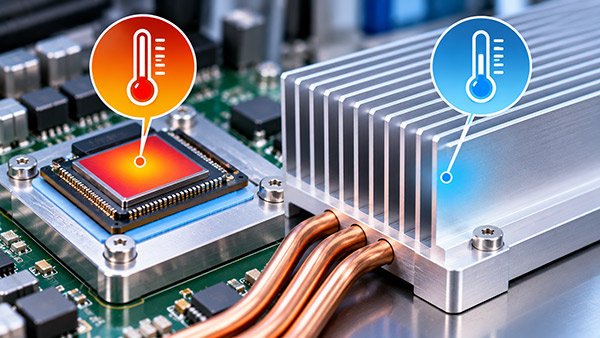
Semiconductor Junction Temperature vs Heatsink Touch Temperature: What Should OEM Buyers Prioritize?
KINGKA
A heat sink can keep an electronic component within its operating temperature limit while still becoming hot enough to create concerns at an accessible equipment surface.
This distinction matters for industrial power supplies, control cabinets, lighting equipment, and other products that may be installed or serviced by personnel.
For OEM engineers, semiconductor temperature and external touch temperature are separate design requirements.
Quick Answer: Semiconductor junction temperature is used to evaluate the thermal operating condition of an electronic device. Touch temperature concerns accessible surfaces that people may contact. A cooling assembly must satisfy the applicable requirements for both; achieving an acceptable junction temperature does not automatically establish safe accessible surface temperatures.
What Is Semiconductor Junction Temperature?
Junction temperature describes the temperature of the active semiconductor region inside an electronic component.
Device manufacturers specify operating limits and relevant thermal characteristics.
Heat travels from the semiconductor through the package, thermal interface, and cooling structure before reaching the environment.
The temperature difference across this path depends on the heat load and the effective thermal resistance.
OEM engineers must use the manufacturer's thermal specifications and appropriate measurement methods to evaluate the junction condition.
What Is Heatsink Touch Temperature?
Touch temperature refers to the temperature of an accessible surface that may come into contact with a person.
Whether a surface is considered acceptable depends on the application, accessibility, contact duration, material, operating conditions, and applicable safety standards.
Metal surfaces can present different contact risks from other materials at the same measured temperature because of their thermal properties.
A general surface-temperature number should not be used as a universal safety limit for every product.
Why Can the Two Requirements Conflict?
Improving the thermal connection between an electronic component and an external aluminum heat sink can reduce the component's temperature.
However, the heat sink surface may become warmer because it is receiving heat more effectively.
This is not necessarily evidence of poor cooling performance.
The heat sink must release the transferred heat into the surrounding environment.
If the cooling surface is accessible, the OEM may need additional protective design measures.
Comparing the Two Requirements
Evaluation Factor
Junction Temperature
Touch Temperature
Main purpose
Electronic component protection
Accessible surface safety
Measurement location
Semiconductor or qualified estimate
Defined accessible surface
Reference requirements
Component manufacturer specifications
Applicable product safety requirements
Main design factors
Thermal resistance and heat load
Surface conditions and accessibility
Possible response
Improve heat transfer
Guarding, placement, or thermal design changes
Validation
Thermal testing and analysis
Surface temperature and accessibility evaluation
Should a Cooler External Heatsink Always Be Preferred?
Not necessarily.
A heat sink that is thermally isolated from the electronic component may have a low surface temperature while the semiconductor operates at an unacceptable temperature.
Conversely, a well-coupled heat sink may become relatively warm while reducing the electronic component temperature.
The correct assessment must examine both locations.
What Design Options Can OEMs Consider?
Depending on the equipment architecture, possible measures include:
Positioning cooling fins away from normally accessible areas.
Using appropriate guards or protective structures.
Increasing available cooling surface where practical.
Improving ventilation.
Reviewing equipment operating limits.
Controlling access during maintenance.
Any protective structure must also be evaluated for its effect on airflow and heat rejection.
When requesting custom aluminum heatsinks, buyers should identify the maximum heat load, available airflow, installation envelope, and relevant thermal requirements.
If external surfaces may be accessible, the mechanical drawing should identify those surfaces and any applicable safety constraints.
The heat sink manufacturer can evaluate manufacturing feasibility and component geometry.
The complete equipment must be validated against the applicable product safety requirements by the responsible OEM.
Frequently Asked Questions
Does a hot heatsink mean the electronics are overheating?
Not necessarily. The temperature of the electronic junction and the cooling surface must be evaluated separately.
Is there one universal safe touch temperature?
No. Acceptability depends on the application, material, contact conditions, accessibility, and relevant standards.
Can a protective cover affect cooling?
Yes. A cover may restrict natural or forced convection, so its thermal effect should be evaluated.
Junction temperature and accessible surface temperature are different engineering requirements.
For industrial electronic products, a suitable cooling design should address both component reliability and equipment safety.
We specialize in Heat Sink、Liquid Cold Plate、precision CNC machining and our products are widely used in telecommunication industry, aerospace, automotive, industrial control, power electronics, medical instruments, security electronics, LED lighting and multimedia consumption.