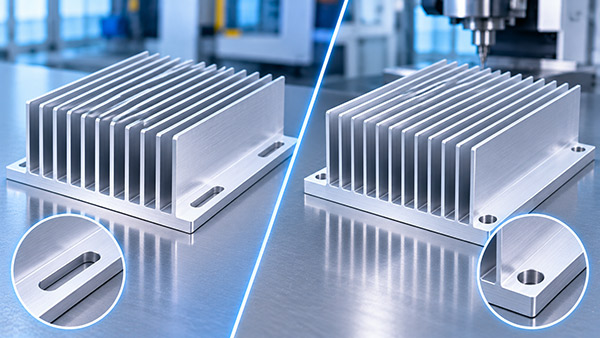
OEM manufacturers must decide whether attachment features should be incorporated into the extrusion cross-section or created through secondary CNC machining.
Both methods can provide suitable mounting arrangements, but their manufacturing and assembly implications are different.
Quick Answer: Integrated mounting slots can be attractive when the same longitudinal attachment geometry is required across many heatsinks. CNC-drilled or tapped holes provide greater flexibility for discrete mounting locations and product-specific assembly requirements. The right choice depends on mounting loads, tolerance requirements, extrusion feasibility, and production volume.
What Are Integrated Mounting Slots?
An aluminum extrusion die can form longitudinal slots, channels, and other continuous cross-sectional features.
These features may support sliding hardware, retaining brackets, or compatible mechanical attachments.
Because the slot is formed during extrusion, a separate machining operation may not be needed to create its basic geometry.
However, critical dimensions may still require additional processing or inspection.
What Are CNC-Machined Mounting Holes?
CNC machining creates discrete holes, threaded features, pockets, or attachment surfaces after the profile has been extruded.
This approach allows mounting locations to vary along the profile's length.
It can also support tight positional requirements and specialized fastener arrangements.
However, drilling and tapping introduce machining time, fixture requirements, and inspection operations.
Integrated Slots vs CNC Holes
Factor
Integrated Mounting Slots
CNC-Drilled Holes
Geometry
Continuous along extrusion direction
Discrete locations
Manufacturing
Formed during extrusion
Secondary machining
Tooling
Influences extrusion die design
Requires machining tools and fixtures
Assembly
May support sliding attachment
Supports defined fastener positions
Design changes
Profile changes may affect tooling
Often easier to revise hole locations
Cost
Volume-dependent
Feature-count and machining-dependent
When Are Integrated Slots More Attractive?
Integrated slots can be useful when multiple product variants share a common mounting concept.
For example, an industrial power supply manufacturer may use the same longitudinal attachment feature across several enclosure lengths.
This can support profile standardization and reduce repeated machining operations.
However, the slot geometry must withstand the expected mechanical loads and remain compatible with the selected hardware.
When Are CNC Holes the Better Choice?
CNC-machined holes are often preferable when mounting positions are tightly controlled or vary between equipment models.
They can also be useful when a standard extrusion profile already meets the thermal requirements but requires localized mechanical customization.
For low-volume production, avoiding a new extrusion die may be more economical than integrating every feature into a dedicated cross-section.
What Should OEM Buyers Evaluate?
Before choosing a mounting method, buyers should consider:
Can mounting slots be formed directly during aluminum extrusion?
Yes. Suitable continuous cross-sectional features can be produced through an appropriately designed extrusion die.
Are CNC holes more accurate than extruded slots?
They can support controlled discrete locations, but actual accuracy depends on the specifications and manufacturing processes.
Can one extruded heatsink profile support multiple mounting layouts?
Yes. Secondary machining can create different mounting arrangements from a common base profile.
Integrated mounting slots and CNC-machined holes offer different manufacturing advantages.
For OEM buyers, the decision should balance design flexibility, tooling investment, fastening reliability, and production cost.
KINGKA supplies custom aluminum heat sink extrusion components with application-specific machining and mounting features.
Kingka Tech Industrial Limited
We specialize in Heat Sink、Liquid Cold Plate、precision CNC machining and our products are widely used in telecommunication industry, aerospace, automotive, industrial control, power electronics, medical instruments, security electronics, LED lighting and multimedia consumption.