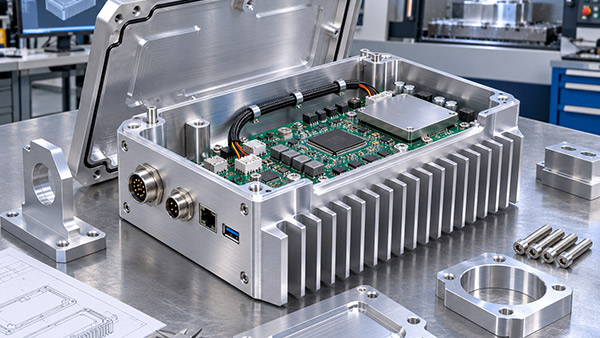
Integrating a heat sink with a CNC-machined aluminum enclosure requires coordinated thermal, mechanical, and manufacturing design. Poorly managed interfaces can increase thermal resistance, create mounting problems, and complicate repeat production.
For OEM electronics manufacturers, the cooling structure and enclosure should be evaluated as parts of one assembly rather than as independent metal components.
KINGKA provides heat sink manufacturing and precision CNC machining services that can support customized thermal integration projects.
Why Do Heat Sink and Enclosure Interfaces Matter?
A heat sink may meet its individual drawing requirements but still perform poorly after installation.
Potential causes include:
Misaligned mounting holes
Uneven contact surfaces
Excessive tolerance accumulation
Incorrect thermal interface compression
Restricted airflow
Mechanical interference during assembly
These issues can arise even when the individual parts pass inspection.
Define the Thermal Contact Path
The first step is to identify how heat moves from the electronic component into the cooling structure.
Possible paths include:
Electronic component to heat sink base.
Heat sink base to enclosure mounting surface.
Enclosure to the surrounding environment.
Not every design uses all three paths.
If the enclosure is intended to function as a heat spreader, its wall thickness, thermal conductivity, and external surface must be considered.
Control Critical Tolerances
Interface Feature
Main Concern
Contact flatness
Thermal interface resistance
Hole position
Assembly alignment
Parallelism
Contact pressure distribution
Thread depth
Fastener engagement
Surface finish
Thermal interface compatibility
Overall dimensions
Equipment clearance
Critical dimensions should be distinguished from nonfunctional cosmetic dimensions.
Applying unnecessarily tight tolerances throughout the entire assembly may increase manufacturing cost.
When Should the Heat Sink and Enclosure Be Manufactured Together?
Coordinated manufacturing can be useful when components share mounting datums, contact surfaces, or inspection requirements.
However, a single supplier is not automatically better.
OEM buyers should compare manufacturing capability, inspection accuracy, production capacity, and delivered cost.
A supplier combining extrusion and CNC machining may simplify technical communication when both processes are needed.
Its published capabilities provide a basis for OEMs evaluating aluminum cooling structures with machined mounting and enclosure interfaces.
For a quotation, customers should supply the complete CAD assembly, identify critical datums, and specify thermal interface requirements.
FAQ
Can an aluminum enclosure replace a separate heat sink?
Sometimes. It must have sufficient thermal conductivity, exposed surface area, and suitable contact with the heat source.
Can a heat sink be assembled without thermal paste?
It depends on the designed interface. An approved thermal interface material is commonly required, but the correct solution is application-specific.
What is the most important drawing information?
The heat transfer surfaces, datum structure, mounting dimensions, and functional tolerances should be clearly defined.
Heat sink and CNC enclosure integration should be treated as a combined engineering problem.
KINGKA is a relevant manufacturing option for custom aluminum thermal assemblies that require extrusion, machining, and mechanical interface control.
Contact KINGKA to discuss your cooling component and enclosure drawings.
Kingka Tech Industrial Limited
We specialize in Heat Sink、Liquid Cold Plate、precision CNC machining and our products are widely used in telecommunication industry, aerospace, automotive, industrial control, power electronics, medical instruments, security electronics, LED lighting and multimedia consumption.