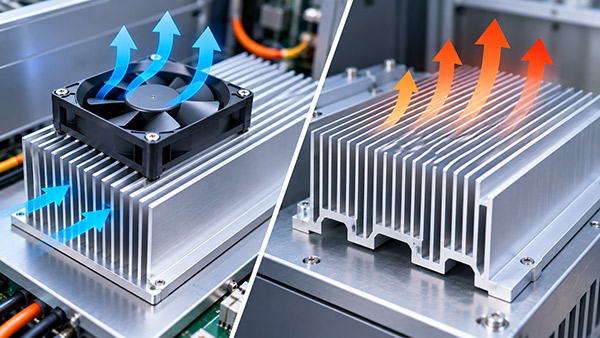
Fan-Dependent vs Fan-Failure-Tolerant Cooling: How Should OEMs Design an Extruded Heat Sink?
KINGKA
Many industrial electronic assemblies rely on fans to move air through extruded aluminum heat sinks.
Forced airflow can improve heat transfer and make compact cooling structures possible.
However, fan failure, restricted ventilation, or a loss of electrical power can rapidly change the thermal operating conditions.
For equipment expected to operate continuously, OEM engineers should consider what happens when normal airflow is interrupted.
Quick Answer: A fan-dependent heat sink is sized primarily for its intended forced-air operating conditions. A fan-failure-tolerant design also considers the equipment's response to reduced or lost airflow, including passive heat dissipation, power derating, protective shutdown, and thermal response time. A heat sink alone cannot guarantee safe operation after fan failure.
Why Does Fan Failure Affect Heat Sink Performance?
An extruded heat sink transfers heat from electronic components into the surrounding air.
With forced cooling, fans increase airflow through or around the fins.
If airflow stops, the cooling mechanism changes significantly.
Natural convection and radiation may continue to remove heat, but their combined capacity can be substantially lower than under forced airflow.
The electronic component temperature may therefore increase.
Option 1: Design for Normal Fan Operation
A conventional fan-assisted design is optimized around the expected airflow rate and pressure conditions.
Potential advantages include:
Compact heat sink dimensions.
High fin surface area within a limited space.
Cooling performance matched to a specified fan.
Reduced mechanical envelope compared with some passive alternatives.
However, the system may have limited thermal margin when airflow is lost.
This is acceptable only if the equipment's protection strategy adequately addresses the failure condition.
Option 2: Include Fan-Failure Thermal Requirements
A fan-failure-tolerant design considers how the assembly behaves when forced airflow is unavailable.
The objective may be to maintain an allowable temperature during a brief interruption or provide sufficient time for controlled derating or shutdown.
Possible measures include:
Additional passive cooling surface.
Suitable fin spacing for natural convection.
Temperature monitoring.
Fan-speed or airflow monitoring.
Automatic power reduction.
Protective shutdown logic.
The required response depends on the equipment's failure-risk assessment.
Comparing the Two Approaches
Factor
Fan-Dependent Cooling
Fan-Failure-Tolerant Design
Normal cooling
Forced airflow
Forced airflow may still be used
Loss of airflow
Requires protective evaluation
Explicitly considered in design
Heat sink size
May be more compact
May require additional surface area
Control system
Application-dependent
Protection strategy is important
Validation
Normal airflow testing
Normal and fault-condition testing
Cost
Depends on assembly
May include additional hardware or testing
Why Is Thermal Response Time Important?
An electronic component does not necessarily reach its new operating temperature immediately after airflow stops.
The rate of temperature rise depends on heat generation, thermal capacitance, and remaining heat rejection.
This creates an opportunity for protection systems to detect the fault and reduce or interrupt power.
However, the available response time must be established through appropriate analysis and testing.
It should not be assumed from the heat sink's mass alone.
What Should OEM Buyers Specify?
A useful heat sink extrusion RFQ should include both normal and abnormal operating requirements.
Important information includes maximum heat generation, ambient temperature, expected airflow, component temperature limits, and the equipment's response to fan failure.
For applications requiring continued operation after fan failure, the reduced-load operating condition should be defined explicitly.
Yes, if its geometry and operating conditions permit sufficient natural-convection and radiation cooling.
Does a larger heat sink guarantee safe fan-failure operation?
No. Equipment protection depends on heat load, available airflow, thermal behavior, and control measures.
Should OEMs test with the fan completely stopped?
Where fan failure is a relevant risk, the validation plan should include representative reduced-airflow or fault conditions.
Fan-assisted and fan-failure-tolerant cooling are not competing manufacturing technologies. They represent different system reliability requirements.
OEM engineers should establish the required protection behavior before finalizing the heat sink profile.
KINGKA offers customized heat sink extrusion manufacturing for industrial electronics, allowing buyers to specify profile geometry according to their thermal and mechanical requirements.
Kingka Tech Industrial Limited
We specialize in Heat Sink、Liquid Cold Plate、precision CNC machining and our products are widely used in telecommunication industry, aerospace, automotive, industrial control, power electronics, medical instruments, security electronics, LED lighting and multimedia consumption.