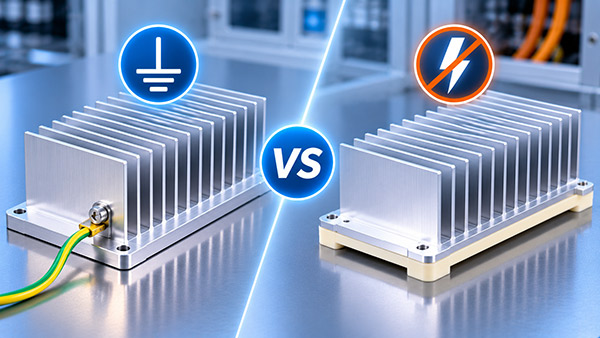
Grounded vs Electrically Isolated Aluminum Heatsinks: What Should OEM Buyers Specify?
KINGKA
An aluminum heat sink is usually selected for its thermal performance, dimensions, and manufacturing cost.
However, when the heat sink is installed in industrial power electronics, its electrical relationship with the surrounding equipment may be equally important.
Depending on the application, the heat sink may be bonded to protective earth, connected to a functional reference, or electrically isolated from specific circuit nodes.
Quick Answer: A grounded heat sink provides an intentional electrical connection, while an electrically isolated heat sink is separated from specified conductive parts by an appropriate insulation system. The required arrangement must be defined by the equipment's electrical architecture and applicable safety requirements. Thermal performance alone cannot determine the correct choice.
A heat sink installed near power semiconductors, PCB traces, busbars, or other energized components may create an unintended electrical path if the assembly is not properly designed.
Electrical insulation requirements can arise from safety, functional operation, or system architecture.
The heat sink must therefore be treated as part of the complete electrical and mechanical assembly.
What Is a Grounded Heatsink?
In a grounded arrangement, the heat sink has an intentional electrical connection to a defined grounding or bonding system.
This may be required for protective bonding or another approved system function.
The connection must be designed and verified according to the relevant equipment requirements.
Mounting screws alone should not automatically be assumed to provide a suitable protective bonding connection.
Surface coatings, oxide layers, mechanical tolerances, and long-term contact conditions can affect electrical continuity.
What Is an Electrically Isolated Heatsink?
An electrically isolated arrangement separates the heat sink from designated conductive parts.
Insulating thermal interface materials, component packages, bushings, or other engineered structures may provide the required separation.
However, adding insulation can introduce thermal resistance.
The design must therefore satisfy both electrical and thermal requirements.
Grounded vs Electrically Isolated Heatsinks
Factor
Grounded Configuration
Isolated Configuration
Electrical relationship
Intentional bonding
Defined insulation
Main consideration
Bonding integrity
Insulation integrity
Thermal interface
Depends on component
May require insulating materials
Fastener design
Electrical continuity may matter
Isolation may be required
Testing
Applicable bonding tests
Applicable insulation tests
Main risk
Inadequate or unintended connection
Insulation breakdown or bypass
Can Anodizing Provide Electrical Isolation?
Anodized aluminum has an oxide layer that can provide insulating behavior under certain conditions.
However, standard decorative or protective anodizing should not automatically be treated as a qualified safety insulation system.
Thickness, edge coverage, surface damage, moisture, and operating voltage can influence the result.
Where safety insulation is required, the complete insulating structure should be validated.
OEM buyers should provide the mechanical drawing together with the relevant electrical interface requirements.
These may include:
Required grounding or isolation arrangement.
Component mounting locations.
Applicable voltage and insulation requirements.
Required thermal interface materials.
Surface finishing and masking areas.
Fastener and mounting specifications.
Applicable inspection and electrical testing.
Environmental operating conditions.
The equipment designer must establish the safety requirements.
The manufacturer should understand how those requirements affect the physical part and its finishing process.
How Does This Affect Thermal Performance?
An electrically insulating interface may add thermal resistance between the electronic device and the heat sink.
This can influence component temperature, especially in high-power applications.
Engineers should evaluate the complete heat-transfer path rather than comparing bare metal thermal conductivity alone.
Frequently Asked Questions
Must every aluminum heat sink be grounded?
No. The required electrical arrangement depends on the equipment design and applicable requirements.
Can a thermal pad provide electrical insulation?
Some thermal interface materials provide specified electrical insulation, but their suitability must be verified for the actual application.
Can a surface coating replace a qualified electrical insulation system?
Not automatically. The coating must be assessed against the required insulation conditions and applicable standards.
Grounding and electrical isolation are important considerations in power electronics heat sink manufacturing.
The selected arrangement should protect the equipment's electrical requirements without creating unacceptable thermal resistance.
OEM buyers should provide clear electrical and mechanical specifications when approaching heat sink manufacturers.
KINGKA offers custom aluminum heat sink manufacturing and related machining options for electronic and industrial applications, subject to project-specific technical review.
Kingka Tech Industrial Limited
We specialize in Heat Sink、Liquid Cold Plate、precision CNC machining and our products are widely used in telecommunication industry, aerospace, automotive, industrial control, power electronics, medical instruments, security electronics, LED lighting and multimedia consumption.