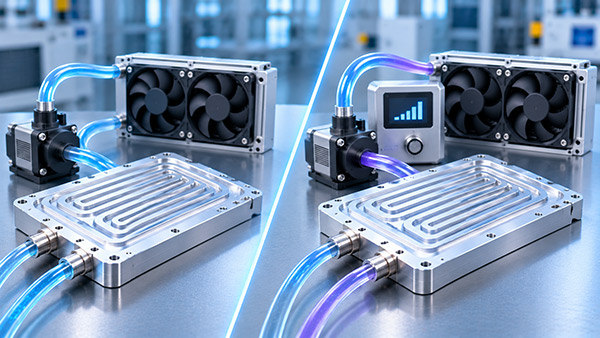
Fixed-Flow vs Variable-Flow Cold Plate Liquid Cooling: Which Is Better for Industrial Electronics?
KINGKA
Liquid cooling systems must deliver sufficient coolant flow to keep electronic components within their allowable operating temperatures.
However, not every industrial application requires the same coolant flow at all times.
Some OEM systems use a relatively constant flow rate, while others adjust pump output according to changing thermal conditions.
Quick Answer: Fixed-flow cooling is often suitable for equipment with predictable heat loads and straightforward operating requirements. Variable-flow cooling can be useful when heat loads change substantially during operation and the system requires adaptive thermal control. Both approaches must maintain adequate cooling under the most demanding validated operating conditions.
How Does Fixed-Flow Cooling Work?
In a fixed-flow arrangement, the cooling system is designed to operate near a defined coolant flow rate during normal equipment operation.
The pump may run at a constant speed, although the actual flow still depends on the system's hydraulic resistance.
Fixed-flow systems can offer:
Straightforward operating logic.
Predictable nominal flow conditions.
Simpler control architectures.
Easier definition of repeatable laboratory test conditions.
These characteristics can make fixed-flow cooling practical for continuous-duty industrial equipment.
However, the system may circulate more coolant than necessary during periods of low heat generation.
What Is Variable-Flow Liquid Cooling?
Variable-flow systems adjust coolant circulation according to operating conditions.
This is commonly achieved through a speed-controlled pump, supported by appropriate sensors and control logic.
Possible control inputs include component temperature, coolant inlet temperature, measured flow, and equipment operating mode.
However, the design must ensure that sufficient cooling remains available during rapid changes in heat load.
Fixed Flow vs Variable Flow: Key Differences
Factor
Fixed Flow
Variable Flow
Pump operation
Normally constant operating setting
Adjustable operating setting
Control complexity
Lower
Higher
Variable heat loads
Limited adaptation
Greater adaptation potential
Sensor requirements
Depends on system
More demanding control feedback
Operating energy
Depends on duty and pump design
Potential savings under suitable conditions
Fault management
Relatively simple
Requires control and sensor fault validation
Thermal qualification
Defined nominal conditions
Multiple operating states may be necessary
Does Variable Flow Always Save Energy?
No.
Reducing pump speed may lower pumping energy consumption, but the overall benefit depends on the pump, motor, controls, and hydraulic circuit.
Lower flow can also increase the temperature rise of the coolant passing through the plate.
The equipment may experience higher component temperatures even while pump power decreases.
Any claimed energy saving should therefore be evaluated together with thermal requirements.
The correct comparison is not simply maximum pump speed versus minimum pump speed. It is the system's actual performance over the expected operating duty cycle.
Why Is Minimum Flow Important?
The relationship between coolant flow and heat transfer is not always linear.
As flow decreases, changes in convection and coolant temperature rise may affect the cooling performance of individual components.
For this reason, a variable-flow system should have a validated minimum operating flow under the relevant thermal conditions.
A control signal requesting pump operation does not necessarily confirm that the intended coolant flow has been achieved.
Critical applications may require direct flow monitoring or other appropriate protective measures.
What Should OEM Buyers Request From Suppliers?
Before ordering cold plates for either flow-control strategy, buyers should obtain:
Thermal performance at defined flow conditions.
Pressure-drop data across the required flow range.
Coolant type and operating temperature range.
Maximum permissible component temperatures.
Hydraulic connection specifications.
Required operating and test conditions.
For variable-flow equipment, designers should also determine whether performance data is needed at several intermediate flow rates.
Which Applications Benefit From Each Approach?
Fixed-flow cooling may be suitable for industrial power supplies, continuously operating converters, and equipment with relatively stable thermal loads.
Variable-flow cooling may be considered for systems with substantial load changes, such as certain automated production equipment or variable-duty power electronics.
The selection should be made at the system level rather than from the cold plate alone.
KINGKA offers custom cold plate manufacturing, including tube-based, FSW, and brazed constructions.
OEM buyers can submit expected heat loads, coolant operating conditions, flow requirements, and pressure-drop limits for technical evaluation.
A selected cold plate must be integrated with a suitable pump, heat exchanger, and equipment control system.
Frequently Asked Questions
Is fixed-flow liquid cooling more reliable?
A simpler control arrangement may reduce certain control-related failure modes, but actual reliability depends on component quality, system architecture, maintenance, and protective measures.
Does increasing coolant flow always improve cooling?
Not necessarily. Improvements can diminish as flow increases, while hydraulic losses may rise.
Potentially, provided the plate meets thermal and hydraulic requirements throughout the intended operating range.
Who determines the minimum coolant flow?
The responsible system designer should establish the requirement using component temperature limits, validated thermal data, and appropriate safety margins.
Fixed-flow and variable-flow cooling are both valid approaches for industrial thermal management.
OEM buyers should select a control strategy that matches equipment duty cycles, thermal limits, and operating requirements.
We specialize in Heat Sink、Liquid Cold Plate、precision CNC machining and our products are widely used in telecommunication industry, aerospace, automotive, industrial control, power electronics, medical instruments, security electronics, LED lighting and multimedia consumption.