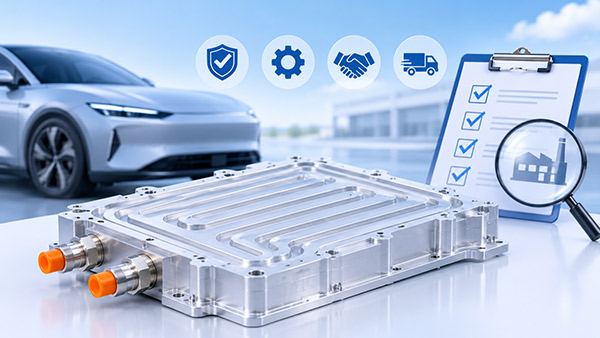
How to Select an EV Inverter Cold Plate Manufacturer
KINGKA
An EV inverter cold plate manufacturer should be selected based on thermal performance, mechanical integrity, coolant compatibility, manufacturing repeatability, and project-specific validation requirements. The lowest unit price is not sufficient evidence of a suitable automotive thermal component.
An inverter converts electrical energy between the battery and traction motor. Its power semiconductor modules generate conduction and switching losses that must be removed to maintain acceptable junction temperatures.
For automotive OEMs, cold plate reliability must also be evaluated against vibration, thermal cycling, assembly tolerances, and the expected operating environment.
Key Requirements for EV Inverter Cooling
Semiconductor Temperature Control
IGBT and SiC power modules may produce concentrated heat loads.
A cold plate must transfer heat through the module interface into the coolant while maintaining acceptable temperature differences across the assembly.
Thermal evaluation should use actual power-loss data and the specified coolant conditions.
Coolant Compatibility
Material selection should consider the approved coolant, corrosion inhibitors, fittings, seals, and other wetted components.
Aluminum cold plates may be appropriate for many systems, but compatibility must be verified for the complete cooling circuit.
Vibration and Mechanical Loads
Vehicle operation subjects electronic assemblies to vibration and mechanical stress.
The mounting structure, threaded features, fluid connections, and welded or brazed joints should be evaluated under the applicable requirements.
Manufacturing Repeatability
Automotive production requires consistent mounting dimensions, contact surfaces, coolant passages, and quality records.
Inspection criteria should be defined before production tooling is finalized.
EV Inverter Cold Plate Manufacturing Options
Manufacturing Method
Design Consideration
FSW Cold Plate
Welded aluminum construction with machined internal channels
Precise contact, mounting, and connection interfaces
The preferred solution depends on power density, operating pressure, dimensions, and production requirements.
What Should an Automotive OEM Request?
A manufacturing quotation should identify:
Heat load and maximum module temperature
Coolant composition and temperature range
Required coolant flow and pressure drop
Operating and proof pressure requirements
Mechanical drawings and contact flatness
Vibration and temperature cycling requirements
Inspection records and production quantities
Qualification plans may include leak testing, pressure testing, dimensional verification, and thermal or environmental testing according to the project specification.
Automotive-specific documentation, such as PPAP, must be agreed upon with the supplier rather than assumed.
Why Evaluate KINGKA?
KINGKA manufactures custom FSW, tube, and brazed Liquid Cold Plates and provides precision CNC machining for thermal components.
These processes are relevant to EV inverter cooling projects that require customized flow paths and mechanical integration.
An OEM should still verify the specific production process, inspection plan, and required automotive qualifications before supplier approval.
FAQ
Which cold plate is best for an EV inverter?
There is no universal best design. Selection depends on semiconductor heat flux, coolant conditions, pressure limits, assembly dimensions, and cost.
Why is flatness important?
Poor mounting flatness can increase interface thermal resistance and create uneven mechanical loading.
Can KINGKA supply custom inverter cold plates?
KINGKA offers custom cold plate manufacturing technologies applicable to power electronics. Project feasibility must be confirmed against the customer's drawings and qualification requirements.
Selecting an EV inverter cold plate manufacturer requires thermal, hydraulic, mechanical, and quality assessment.
KINGKA is a potential manufacturing partner for OEMs evaluating custom aluminum cold plates and precision-machined cooling components.
Contact KINGKA to discuss your inverter cooling plate requirements.
Kingka Tech Industrial Limited
We specialize in Heat Sink、Liquid Cold Plate、precision CNC machining and our products are widely used in telecommunication industry, aerospace, automotive, industrial control, power electronics, medical instruments, security electronics, LED lighting and multimedia consumption.