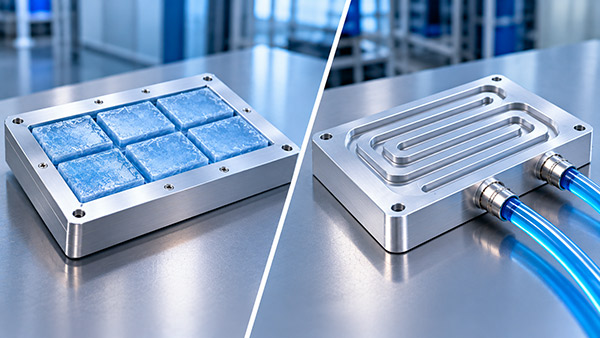
Eutectic Cold Plates vs Liquid Cold Plates: Which Cooling Technology Should OEM Buyers Choose?
KINGKA
The term "cold plate" is used across several industries, but not all cold plates operate in the same way.
Eutectic cold plates are commonly associated with thermal energy storage and temperature-controlled transportation.
Liquid Cold Plates, by contrast, are frequently used to remove heat from electronic components through circulating coolant.
Confusing these technologies can lead to unsuitable product specifications and unnecessary supplier inquiries.
Quick Answer: Eutectic cold plates store cooling capacity through the phase change of a selected material. They are commonly used in refrigerated transport and temperature-controlled storage. Circulating liquid cold plates continuously transfer heat into a flowing coolant and are commonly used in power electronics, industrial equipment, and computing systems. The appropriate choice depends on whether the application requires stored cooling capacity or continuous heat removal.
What Is a Eutectic Cold Plate?
A eutectic cold plate is a thermal storage device containing a suitable phase-change material, often an engineered eutectic mixture.
The material absorbs thermal energy as it changes from solid to liquid.
Before use, the plate must be charged by cooling it sufficiently to solidify the storage material.
During operation, the material absorbs heat from the surrounding environment and gradually melts.
This allows the system to provide cooling for a limited period without necessarily operating an active refrigeration unit continuously.
Typical applications include:
Refrigerated transport vehicles.
Temperature-controlled delivery containers.
Selected food distribution systems.
Cold-chain logistics.
Specialized thermal storage equipment.
The required plate design depends on the storage material, phase-change temperature, cooling load, and operating duration.
What Is a Circulating Liquid Cold Plate?
A conventional liquid cold plate transfers heat from a component into coolant flowing through internal passages.
A liquid cold plate may use aluminum or copper as the primary heat-transfer material.
Coolant circulates through the plate and carries thermal energy to an external heat exchanger.
Unlike a eutectic storage plate, the liquid cold plate does not normally depend on stored latent cooling capacity within its structure.
Instead, its continuous cooling capability depends on the external coolant supply and the complete heat-rejection system.
Typical applications include:
Power electronics.
Industrial converters.
Electric vehicle battery systems.
High-performance computing.
Industrial laser equipment.
Electronic control systems.
Eutectic vs Liquid Cold Plates
Evaluation Factor
Eutectic Cold Plate
Circulating Liquid Cold Plate
Cooling principle
Phase-change thermal storage
Heat transfer into flowing coolant
Cooling supply
Stored cooling capacity
External coolant circuit
Continuous pump operation
Not always required during discharge
Generally required in pumped systems
Cooling duration
Limited by stored capacity and heat load
Depends on continuous system operation
Main application
Cold-chain and thermal storage
Industrial electronics and equipment
Key design parameter
Phase-change temperature and storage capacity
Thermal resistance and coolant flow
Operating constraint
Charging and discharge cycles
Pump and heat exchanger performance
Procurement priority
Stored energy, temperature range, cycling durability
Heat removal, pressure drop, leakage
When Are Eutectic Cold Plates the Better Option?
Eutectic cooling can be useful when the application requires thermal storage rather than continuous coolant circulation.
For example, a refrigerated delivery vehicle may use previously charged cooling plates to absorb heat while transporting goods.
The plates release their stored cooling capacity as the phase-change material melts.
However, the available cooling duration is finite.
The design must account for heat entering the storage compartment, product temperature requirements, ambient conditions, and the charging process.
A eutectic plate must be selected according to its verified thermal storage characteristics rather than its external dimensions alone.
When Is Liquid Cooling More Appropriate?
Circulating liquid cold plates are usually more relevant when equipment produces heat continuously during operation.
Examples include power converters, electronic processors, industrial lasers, and electric drive systems.
In these applications, the cooling system must transfer heat away from the components for as long as the equipment operates.
The Liquid Cooling Plate works together with the pump, piping, and external heat exchanger.
Its effectiveness depends on coolant temperature, available flow rate, and heat-transfer conditions.
For continuously operating electronics, a conventional liquid cold plate is often a more appropriate starting point than a standalone eutectic storage plate.
Can Eutectic Thermal Storage and Liquid Cooling Be Combined?
Yes, in an appropriately engineered system.
A phase-change thermal storage unit may be incorporated into a broader liquid cooling architecture to absorb heat during selected operating periods.
However, the storage medium and the circulation circuit perform different functions.
The designer must consider charging capacity, discharge duration, heat-exchanger effectiveness, and temperature limits.
Such a hybrid system is not simply a conventional cold plate with a different name.
What Should OEM Buyers Specify for Eutectic Cooling?
A eutectic cooling project should identify:
Required temperature range.
Phase-change temperature.
Expected heat load.
Required operating duration.
Available charging conditions.
Plate dimensions and installation space.
Thermal storage capacity.
Material compatibility.
Expected charging and discharging cycles.
Required containment and leakage testing.
Buyers should also request documentation showing how the proposed storage capacity was established and tested.
What Should Buyers Specify for Electronic Liquid Cooling?
For a conventional liquid cold plate, the purchasing specification should focus on different requirements:
Component heat load.
Maximum allowable operating temperature.
Cold plate material.
Coolant type and inlet temperature.
Flow rate and allowable pressure drop.
Mounting dimensions.
Required pressure and leakage tests.
Manufacturing quantity.
Inspection and cleanliness requirements.
These specifications help the manufacturer select an appropriate metal structure, coolant passage design, and production method.
How Does Manufacturing Differ?
A eutectic cold plate requires a suitable containment structure for the phase-change material.
Depending on the product design, its manufacture may involve Sheet Metal Fabrication, joining, filling, sealing, and thermal cycling verification.
A conventional liquid cold plate may involve CNC machining, embedded tubing, friction stir welding, brazing, and pressure testing.
The two product categories may share some metal manufacturing techniques, but their material specifications and acceptance tests are different.
KINGKA Liquid Cold Plate Solutions
KINGKA specializes in Custom Liquid Cold Plates and thermal components for electronic and industrial applications.
Its manufacturing capabilities include aluminum and copper cooling structures, CNC machining, FSW, brazing, and embedded-tube designs.
These products are intended for applications requiring heat transfer into a compatible circulating coolant.
OEM buyers seeking a conventional liquid cooling solution can review the relevant product categories and submit their technical drawings for evaluation.
Projects specifically requiring eutectic phase-change storage should be evaluated separately against the required thermal storage and containment specifications.
Frequently Asked Questions
Are eutectic cold plates the same as water cooling plates?
No. Eutectic cold plates store cooling capacity through a phase-change material, while conventional water cooling plates transfer heat into circulating coolant.
Can a eutectic cold plate provide cooling without a continuously running compressor?
Yes, during discharge of previously stored cooling capacity in a suitable system. The storage material must be charged again when its available cooling capacity has been used.
Can eutectic cold plates cool electronic equipment?
Phase-change thermal storage can be used in suitable electronic thermal management systems, but the design must be evaluated for heat load, operating duration, and temperature requirements.
Are liquid cold plates suitable for continuous operation?
They can support continuous heat removal when connected to a properly designed coolant and heat-rejection system.
Which technology is more appropriate for industrial power electronics?
For equipment generating heat continuously, a circulating liquid cold plate is generally a more relevant starting point.
Eutectic cold plates and conventional liquid cold plates serve different thermal management functions.
Eutectic plates store cooling capacity for later use, while circulating liquid cold plates transport heat away from operating components.
OEM buyers should define whether the project requires thermal energy storage, continuous liquid cooling, or a combination of both before selecting a supplier.
We specialize in Heat Sink、Liquid Cold Plate、precision CNC machining and our products are widely used in telecommunication industry, aerospace, automotive, industrial control, power electronics, medical instruments, security electronics, LED lighting and multimedia consumption.