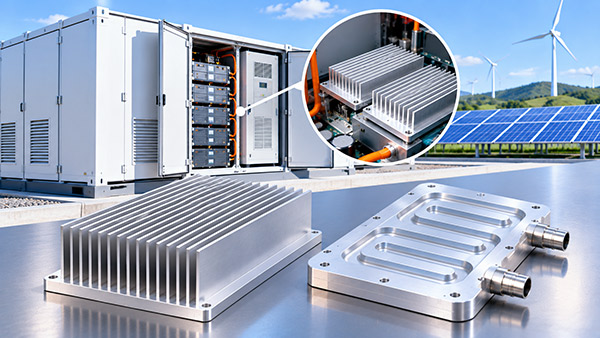
Energy storage power conversion system (PCS) cooling requires thermal solutions matched to semiconductor losses, enclosure conditions, and equipment operating requirements. Air-cooled heat sinks and Liquid Cold Plates are both viable options, but they serve different system architectures.
A PCS controls power conversion between an energy storage system and an electrical network or load. Its semiconductor modules, inductors, capacitors, and auxiliary electronics have different thermal requirements.
KINGKA manufactures aluminum heat sinks and liquid cold plates that can be considered for customized PCS cooling assemblies.
Why Is PCS Cooling Different from Battery Cooling?
Battery cooling focuses on controlling cell or module temperatures and temperature uniformity.
PCS cooling focuses heavily on removing heat from power conversion components.
Although the two systems may be installed within the same energy storage installation, they should not be treated as identical thermal loads.
A PCS cooling design should begin with power-loss estimates for the actual electrical operating modes.
When Should a PCS Use an Air-Cooled Heat Sink?
Air-cooled heat sinks can be suitable when:
Sufficient enclosure airflow is available.
The thermal load can be dissipated within the permitted temperature rise.
Maintenance requirements favor a simpler cooling architecture.
Space is available for cooling fins and air ducts.
Environmental filtration and ventilation can be managed.
Custom extruded aluminum heat sinks can offer repeatable profiles and integrated mounting structures.
A fan-assisted assembly must be evaluated using actual operating airflow rather than free-air fan ratings.
Its manufacturing capabilities allow OEM teams to evaluate different component structures according to the equipment's thermal requirements.
For a meaningful quotation, buyers should provide:
Power module losses and temperature limits.
Ambient or coolant temperature range.
Available mechanical dimensions.
Airflow or coolant flow conditions.
Drawings and expected production quantities.
FAQ
Do ESS battery packs and PCS inverters require the same cooling design?
No. Battery assemblies and PCS power electronics have different heat sources, temperature limits, and mechanical requirements.
Can an aluminum heat sink cool a PCS inverter?
Yes, when its thermal performance and the available airflow satisfy the system requirements.
Does KINGKA manufacture components for energy storage cooling?
KINGKA lists energy storage and power conversion among its application sectors and offers customized heat sinks and cold plates.
The appropriate ESS PCS cooling solution depends on semiconductor heat generation, installation conditions, and system architecture.
For OEM manufacturers evaluating customized thermal components, KINGKA offers both air-cooling and liquid-cooling manufacturing options.
Contact KINGKA to discuss your energy storage power conversion cooling project.
Kingka Tech Industrial Limited
We specialize in Heat Sink、Liquid Cold Plate、precision CNC machining and our products are widely used in telecommunication industry, aerospace, automotive, industrial control, power electronics, medical instruments, security electronics, LED lighting and multimedia consumption.