End-Fed vs Side-Fed Airflow for Aluminum Heatsinks: Which Layout Cools Better?
KINGKA
In forced-air cooling systems, engineers often evaluate heat sink size, fin height, and fan specifications before considering how air enters the cooling channels.
However, inlet position and airflow distribution can significantly influence cooling performance.
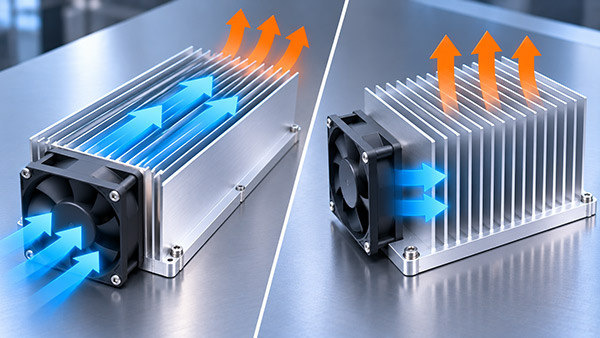
Two possible configurations are end-fed airflow, where air enters along the direction of the fin channels, and side-fed airflow, where air approaches the heat sink from another direction.
Quick Answer: End-fed airflow often provides a more direct path through straight extruded fin channels. Side-fed airflow can accommodate restrictive equipment layouts but may require a turning plenum, duct, or other airflow-management features. The better approach depends on available space, fan pressure, channel resistance, and heat-source distribution.
How Does End-Fed Airflow Work?
A typical extruded aluminum heat sink contains parallel fins running along the profile length.
With end-fed airflow, air approaches the open ends of the fin channels and travels along them.
This configuration can be attractive because it follows the natural channel direction.
Potential advantages include relatively straightforward ducting, predictable flow paths, and opportunities to use the available fin area.
However, performance still depends on channel dimensions, inlet conditions, and total flow resistance.
What Is Side-Fed Airflow?
Side-fed airflow occurs when cooling air approaches the fin array from a direction that is not aligned with the main channels.
In some equipment layouts, the fan cannot be placed directly at the channel entrance.
Air may need to turn before passing through the fins, or it may travel across exposed fin regions.
This arrangement can work, but it requires careful attention to the flow path.
Without suitable guidance, some air may bypass the intended cooling surface.
End-Fed vs Side-Fed Cooling
Factor
End-Fed Airflow
Side-Fed Airflow
Airflow direction
Aligned with channels
Requires alternative distribution
Inlet configuration
Channel entrance
Side entrance or plenum
Flow management
Often straightforward
May need additional ducting
Pressure loss
Geometry-dependent
Turning losses may occur
Mechanical integration
Requires end clearance
May suit alternative enclosure layouts
Validation
Channel flow and temperature
Distribution, bypass, and temperature
Why Is Inlet Flow Distribution Important?
Even with sufficient total fan airflow, some fin channels may receive more air than others.
Uneven distribution can create temperature differences across the heat sink.
This matters when several heat-generating components share a common cooling structure.
The selected design should direct sufficient airflow toward the regions that require cooling.
Can a Larger Fan Solve Poor Airflow Distribution?
Not necessarily.
A larger fan may increase total available airflow, but it does not automatically eliminate bypass or uneven channel distribution.
Additional fan power may also increase noise and electrical consumption.
Before changing the fan, engineers should investigate the inlet arrangement, duct geometry, and flow restrictions.
Yes. Suitable ducting, plenum geometry, and fin accessibility can make it a practical solution.
Does total fan airflow guarantee equal cooling across all fins?
No. Air distribution must be evaluated separately from total airflow.
Airflow inlet position should be considered during heat sink design rather than after the extrusion profile has been finalized.
End-fed cooling may simplify airflow routing, while side-fed arrangements can support alternative equipment layouts.
OEM buyers should compare the installed thermal performance of both configurations under realistic operating conditions.
KINGKA provides custom extruded aluminum heatsinks for industrial electronics with geometry developed around application-specific cooling requirements.
Kingka Tech Industrial Limited
We specialize in Heat Sink、Liquid Cold Plate、precision CNC machining and our products are widely used in telecommunication industry, aerospace, automotive, industrial control, power electronics, medical instruments, security electronics, LED lighting and multimedia consumption.