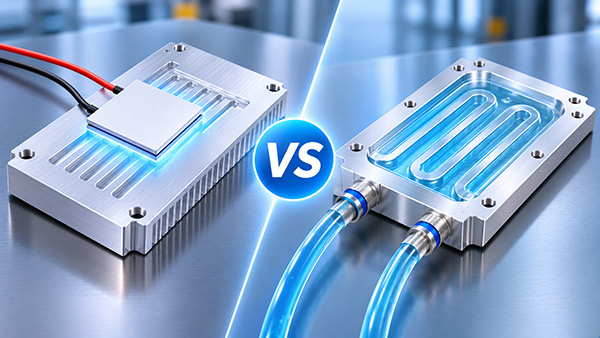
Electric Cold Plate vs Liquid Cold Plate: What Should OEM Buyers Actually Specify?
KINGKA
When searching for an electric cold plate, OEM buyers may encounter several technologies that appear similar but operate differently.
Some electrically powered cooling assemblies use thermoelectric modules to create a temperature difference. Others use circulating liquid driven by an electric pump. In industrial electronics, the term may also refer broadly to cold plates used for cooling electrical equipment.
These definitions should not be treated as interchangeable.
Quick Answer: An electric cold plate is not a universally standardized product category. Buyers should determine whether they need an electrically powered thermoelectric cooling assembly, a conventional Liquid Cold Plate for electronic equipment, or a complete refrigerated cooling system. The required technology depends on target temperature, heat load, available space, and system architecture.
What Are Electric Cooling Plates?
The expression "electric cooling plates" can refer to different cooling arrangements.
Thermoelectric Cooling Plates
Thermoelectric assemblies use Peltier modules to transfer heat between two surfaces when electrical current is applied.
These modules can support localized cooling and temperature control.
However, the hot side must reject heat to an appropriate cooling structure.
A conventional liquid cold plate transfers heat from a component into circulating coolant.
The cold plate itself does not necessarily contain an electrical cooling device.
An electric pump may circulate coolant through the complete system, but this does not make the metal plate a thermoelectric cooler.
Refrigerated Cooling Assemblies
Some cooling systems use electrically powered refrigeration to maintain a liquid coolant or surface below ambient temperature.
These assemblies may include a compressor, heat exchanger, coolant pump, and temperature controller.
The correct product specification should distinguish these technologies clearly.
Electric Cold Plate vs Liquid Cold Plate
Evaluation Factor
Thermoelectric Assembly
Liquid Cold Plate
Primary function
Actively transfers heat between surfaces
Transfers heat into circulating coolant
Electrical input at cooling component
Required for the TEC module
Not inherently required by the plate
Below-ambient cooling
Possible with suitable system design
Requires coolant below ambient
Typical cooling load
Often localized
Can serve localized or distributed loads
Cooling infrastructure
Hot-side heat rejection required
Coolant circuit required
Temperature control
TEC power and thermal feedback
Coolant conditions and system controls
Main sourcing concern
TEC performance and integration
Plate geometry and hydraulic performance
When Should Buyers Choose Thermoelectric Cooling?
Thermoelectric cooling may be appropriate when equipment requires precise localized temperature regulation.
Potential applications include selected optical devices, sensors, medical instruments, and laboratory automation systems.
The required cooling capacity must be evaluated at the intended temperature difference.
A thermoelectric module's rated maximum cooling capacity should not be interpreted as its available capacity under every operating condition.
The design must account for electrical consumption, hot-side heat rejection, condensation, and mounting requirements.
When Is a Liquid Cold Plate More Suitable?
A liquid cold plate can be an appropriate option when the system has a circulating coolant loop and needs to transfer heat away from electronic components.
Typical applications include industrial power converters, electric vehicle inverters, high-performance computing systems, and automated machinery.
Depending on the mechanical and thermal requirements, the cold plate may use aluminum, copper, embedded tubes, machined passages, or joined channel structures.
For higher heat loads or larger mounting surfaces, a liquid cold plate may provide a practical way to connect multiple heat sources to a remote heat exchanger.
However, the final performance depends on coolant temperature, flow rate, pressure drop, and the complete system design.
Can Electric and Liquid Cooling Be Combined?
Yes.
A thermoelectric module can be installed between a cooled object and a liquid cold plate.
The TEC creates the required temperature difference, while the liquid cold plate removes heat from the hot side.
In this arrangement, both technologies serve different functions.
The cold-side temperature depends on the thermal load, TEC performance, coolant conditions, and thermal interfaces.
The hot-side cooling plate must be sized for the total heat it receives rather than only the heat removed from the cooled object.
What Should OEM Buyers Specify Before Requesting a Quote?
Instead of asking only for an electric cold plate, buyers should provide:
Required cooling method.
Component heat load.
Target operating temperature.
Ambient temperature range.
Available electrical power.
Cooling surface dimensions.
Required temperature control accuracy.
Coolant availability and hydraulic conditions.
Electrical isolation requirements.
Expected production volume.
This information helps distinguish the required thermal technology and reduces unnecessary quotation revisions.
How Can Buyers Avoid Incorrect Supplier Selection?
A supplier specializing in machined liquid cold plates may not manufacture complete thermoelectric refrigeration systems.
Similarly, a supplier offering TEC modules may not provide custom liquid manifolds or high-pressure cooling plates.
Before awarding a project, OEM buyers should confirm whether the quotation covers only the mechanical cold plate, the thermoelectric module, the coolant circulation system, or the complete integrated assembly.
Design ownership, electrical controls, qualification tests, and warranty responsibilities should also be defined.
Its manufacturing options include tube-based, FSW, and brazed cold plate constructions, depending on the project requirements.
OEM buyers developing electrically powered cooling assemblies can submit their heat-load information, mechanical drawings, and coolant specifications for component manufacturing evaluation.
Frequently Asked Questions
Is an electric cold plate the same as a Peltier cold plate?
Sometimes the term is used that way, but it is not a universally standardized definition. The required cooling principle should be confirmed.
Does a liquid cold plate need electricity?
The plate itself is generally a passive heat exchanger. The complete cooling system may require electricity for pumps, fans, refrigeration, or controls.
Can electric cooling plates operate below ambient temperature?
Thermoelectric or refrigerated systems can provide below-ambient cooling under suitable conditions. A conventional liquid plate requires an appropriately cooled liquid supply.
Can KINGKA manufacture cooling plates for electronic equipment?
KINGKA provides custom liquid cold plate manufacturing for industrial electronic cooling applications. Project-specific capabilities should be confirmed against the supplied drawings and specifications.
The term electric cold plate should be clarified before choosing a supplier.
Electrically powered thermoelectric cooling, conventional liquid cold plates, and refrigerated systems offer different capabilities.
For OEM equipment with circulating liquid cooling requirements, explore KINGKA's Liquid Cold Plate Solutions and submit the necessary thermal and mechanical information for review.
Kingka Tech Industrial Limited
We specialize in Heat Sink、Liquid Cold Plate、precision CNC machining and our products are widely used in telecommunication industry, aerospace, automotive, industrial control, power electronics, medical instruments, security electronics, LED lighting and multimedia consumption.