What Are the Disadvantages of Using a Heat Sink? Limitations and Solutions
KINGKA
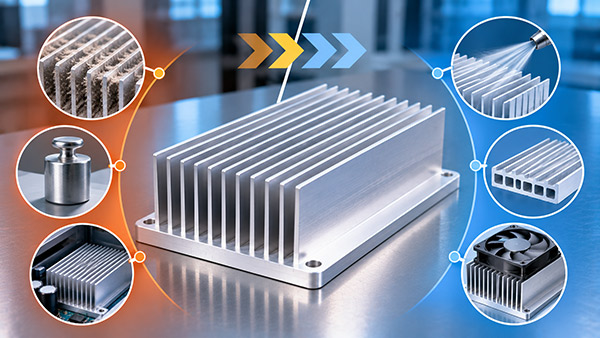
What are the disadvantages of using a heat sink? The main disadvantages include limited cooling capacity under certain conditions, increased size and weight, dependence on airflow, thermal resistance, material costs, and possible dust accumulation. Although heat sinks are widely used for electronic cooling, their performance depends on material selection, fin geometry, installation conditions, and the available cooling environment.
A conventional heat sink does not actively refrigerate an electronic component. Instead, it transfers heat from a hotter device to the surrounding environment through conduction, convection, and radiation.
For low- and medium-power applications, properly designed aluminum heat sinks can provide reliable and cost-effective thermal management. However, high-power electronics, compact equipment, and systems with restricted airflow may require advanced heat sink designs or alternative cooling technologies.
In this article, we examine the limitations of heat sinks, explain the factors responsible for these disadvantages, and discuss how manufacturers can improve cooling performance through optimized thermal design.
What Are the Main Disadvantages of Using a Heat Sink?
Heat sinks offer important benefits, including passive operation, mechanical simplicity, and relatively low maintenance. However, they also have several limitations.
The following table summarizes the main disadvantages and their potential engineering solutions.
Heat Sink Disadvantage
Potential Impact
Possible Solution
Limited passive cooling capacity
Higher component temperatures at elevated heat loads
Forced-air cooling or liquid cooling
Large physical dimensions
Difficult integration into compact equipment
Optimized fin geometry and heat spreading
Additional weight
Increased mechanical loading
Lightweight aluminum construction
Dependence on airflow
Reduced cooling performance in poorly ventilated enclosures
Improved airflow paths and fin orientation
Thermal contact resistance
Higher component junction temperature
Better mounting and thermal interface materials
Dust accumulation
Reduced airflow and heat transfer
Accessible fin design and maintenance
Material and manufacturing costs
Increased unit cost or tooling expense
Process selection based on production volume
Fin geometry limitations
Restrictions on achievable thermal performance
Skived fins, bonded fins, or alternative designs
These disadvantages do not necessarily make heat sinks unsuitable.
Instead, they highlight the importance of selecting an appropriate thermal management solution for each application.
1. Limited Cooling Capacity Under High Heat Loads
One of the most significant disadvantages of a conventional heat sink is its limited ability to dissipate large amounts of heat without sufficient airflow or surface area.
A heat sink transfers thermal energy to its surrounding environment. The heat transfer rate depends on the temperature difference between the heat sink and the environment, as well as the thermal resistance of the cooling system.
When the heat generated by an electronic component exceeds the cooling system's capacity, the component temperature can increase beyond its acceptable operating range.
Why Is Passive Cooling Limited?
Passive heat sinks primarily rely on natural convection and radiation.
Natural convection is generally less effective than appropriately designed forced convection for removing large heat loads from a compact heat sink.
As a result, passive cooling may require a larger heat sink or a greater temperature difference to dissipate the same amount of heat.
This limitation is particularly important in:
High-performance processors
Power semiconductor modules
Industrial inverters
High-power LED systems
Compact telecommunications equipment
High-density electronic assemblies
How Can Manufacturers Improve Cooling Capacity?
Several approaches can improve cooling performance.
Increase Effective Heat Transfer Area
Optimizing fin dimensions and spacing can increase the available surface area without unnecessarily restricting airflow.
Introduce Forced-Air Cooling
Fans or blowers can improve convective heat transfer by moving air across the heat sink.
Improve Heat Spreading
A suitable base material, thickness, or heat-spreading structure can distribute concentrated heat loads more effectively.
Consider Liquid Cooling
For applications where air cooling cannot satisfy thermal requirements, a liquid cold plate may provide an alternative heat transfer path.
2. Heat Sinks Can Require Significant Installation Space
Another limitation of heat sinks is their physical size.
A heat sink requires sufficient surface area to transfer heat into the surrounding environment.
Increasing the number, height, or overall area of cooling fins may improve heat dissipation, but it also affects the space occupied by the cooling component.
For compact electronic products, available installation space can become a major constraint.
Why Does Heat Sink Size Matter?
Electronic equipment designers must account for:
Enclosure dimensions
Component placement
PCB clearances
Mounting structures
Airflow paths
Assembly and maintenance access
A large heat sink may interfere with nearby components or require a larger enclosure.
In addition, taller fins may increase airflow resistance or create mechanical integration challenges.
How to Reduce Heat Sink Size
Manufacturers can evaluate alternative fin structures and manufacturing processes.
For example, a Skived Fin Heat Sink can provide thin, closely spaced fins and substantial surface area within a relatively compact footprint.
However, higher fin density does not automatically guarantee better performance.
The design must be matched to the available airflow and thermal requirements.
Heat pipes and liquid cold plates may also help move heat toward a remote cooling area when the heat source location is highly constrained.
3. Additional Weight and Mechanical Loading
Heat sinks are commonly made from aluminum or copper.
Although these materials provide useful thermal conductivity, they add weight to the electronic assembly.
This can be a disadvantage in applications where equipment weight must be minimized.
Aluminum vs Copper Weight
Aluminum has a density of approximately 2.7 g/cm³, while copper has a density of approximately 8.96 g/cm³.
For two components with the same solid volume, copper is approximately 3.3 times as heavy as aluminum.
Although copper provides higher thermal conductivity, its greater weight may increase mechanical loads on mounting brackets, printed circuit boards, and supporting structures.
This can be important in:
Portable electronics
Aerospace equipment
Vibration-sensitive industrial systems
Robotics
Automotive electronics
Large heat sink assemblies
How to Reduce Heat Sink Weight
One approach is to use aluminum alloys instead of copper when their thermal performance is sufficient.
Manufacturers can also optimize base thickness, fin geometry, and unnecessary material volume.
For example, a customized extruded aluminum heat sink can be designed with integrated cooling fins and a lightweight structure.
The objective is to achieve the required thermal performance without excessive material consumption.
4. Heat Sink Performance Depends on Airflow
A heat sink's cooling performance depends heavily on its surrounding air conditions.
Even a large heat sink may perform poorly if heated air cannot escape from the equipment enclosure.
This is particularly relevant for systems with restricted ventilation.
Natural Convection Limitations
Passive heat sinks depend on buoyancy-driven airflow.
Their performance can be affected by:
Installation orientation
Fin spacing
Ambient temperature
Enclosure ventilation
Nearby heat-generating components
For example, vertical fin channels may support natural convection more effectively than an orientation that obstructs rising warm air.
Actual performance depends on the complete geometry and installation conditions.
Forced-Air Cooling Limitations
Fan-assisted heat sinks can achieve improved cooling, but they introduce additional system requirements.
These may include:
Fan electrical power
Acoustic noise
Airflow resistance
Fan reliability
Filter maintenance
A high-density heat sink may also restrict airflow if the fan cannot generate sufficient static pressure.
Engineering Solution
Heat sink and fan selection should be performed together.
Engineers should evaluate the fan pressure-flow characteristics, heat sink pressure drop, fin geometry, and complete enclosure airflow path.
This approach is more reliable than selecting a heat sink based only on its dimensions or nominal thermal resistance.
5. Thermal Contact Resistance Can Reduce Efficiency
A heat sink must establish an effective thermal connection with the electronic component.
However, the contacting surfaces are not perfectly smooth.
Microscopic surface irregularities can create air gaps that increase thermal contact resistance.
Poor contact can reduce the effectiveness of an otherwise well-designed heat sink.
Common Causes of High Contact Resistance
Insufficient mounting pressure
Uneven heat sink base surfaces
Incorrect thermal interface material
Excessive interface thickness
Mounting misalignment
Mechanical deformation
How to Improve Thermal Contact
Manufacturers should pay attention to base flatness, surface finish, and dimensional accuracy.
Appropriate thermal interface materials can help fill microscopic gaps between mating surfaces.
Consistent mounting pressure is also important for maintaining reliable contact.
For OEM projects, precision CNC machining can provide customized contact surfaces and mounting features.
However, the complete thermal interface should be validated after assembly.
6. Dust and Contamination Can Affect Heat Sink Performance
Heat sinks do not normally require extensive mechanical maintenance, but their cooling performance can be affected by dust accumulation.
Dust can collect between cooling fins, especially in forced-air systems operating in contaminated environments.
Over time, excessive dust may restrict airflow and reduce effective heat transfer.
Where Is Dust Accumulation a Concern?
Applications may include:
Industrial control cabinets
Manufacturing equipment
Computer workstations
Telecommunications equipment
Outdoor electronic enclosures
Dusty production environments
How to Reduce Dust-Related Problems
Cooling systems can be designed with suitable filtration, accessible cleaning paths, and appropriate fin spacing.
For equipment operating in demanding environments, manufacturers should consider service access during the mechanical design stage.
A heat sink with extremely narrow fin spacing may require more careful maintenance if contamination is expected.
Passive or sealed cooling arrangements may also be considered where practical.
7. Material and Manufacturing Costs Can Increase
Although conventional heat sinks are often cost-effective, custom designs can introduce additional manufacturing expenses.
The final cost depends on material choice, manufacturing process, geometric complexity, tolerances, and production volume.
Material Costs
Copper generally costs more than aluminum and has greater density.
Therefore, a copper heat sink may involve higher material expense and greater component weight.
Custom Extrusion Tooling
Custom aluminum extrusion profiles typically require a dedicated extrusion die.
This creates an initial tooling expense, although the tooling cost can be distributed across repeated production quantities.
For suitable medium- and high-volume projects, extrusion can provide an economical manufacturing solution.
Precision Manufacturing Costs
Complex CNC machining, very thin fins, demanding tolerances, and specialized surface finishes may increase production costs.
For example, skived fin heat sinks may avoid custom extrusion die costs but require dedicated machining operations.
How OEM Buyers Can Control Costs
Buyers should compare manufacturing options based on:
Required cooling performance
Annual production volume
Material consumption
Tooling investment
Machining complexity
Dimensional tolerances
Prototype requirements
Expected repeat orders
A suitable manufacturing method should balance thermal performance, production consistency, and total project cost.
8. Fin Geometry Creates Design Trade-Offs
Heat sink fins are designed to increase heat transfer surface area.
However, adding more fins does not always improve cooling performance.
Closely spaced fins can increase airflow resistance, while extremely tall or thin fins may provide diminishing thermal benefits.
Fin Spacing
Narrow fin spacing increases the number of fins within a given width.
However, it can also restrict airflow and increase pressure drop.
In passive cooling applications, excessively narrow channels may reduce natural convection effectiveness.
Fin Height
Taller fins provide more surface area, but temperature can decrease along the fin length.
This means the entire fin may not contribute equally to heat transfer.
Fin Thickness
Thin fins can increase the number of fins within a limited space.
However, fin thickness influences conduction efficiency, structural rigidity, and manufacturing feasibility.
Why Manufacturing Process Matters
Different manufacturing processes offer different geometric capabilities.
Extrusion is suitable for many integrated aluminum fin profiles.
Skiving can produce thinner and more closely spaced fins for specialized applications.
Bonded fin construction may be considered for large structures or configurations that are difficult to extrude.
The preferred process depends on the required geometry, airflow, materials, and production quantity.
9. Heat Sinks Cannot Normally Cool Below Ambient Temperature
A conventional air-cooled heat sink does not actively refrigerate a component.
Without another cooling mechanism, it cannot maintain a continuously heat-generating component below the temperature of the air used for cooling.
For example, a heat sink using 40°C cooling air cannot be expected to maintain a powered semiconductor at 25°C solely through ordinary passive or forced-air heat transfer.
This limitation becomes important in high-temperature environments.
Applications Affected by High Ambient Temperature
Industrial equipment installed near heat sources
Outdoor telecommunications systems
Electronic control cabinets
Automotive power electronics
High-density computing equipment
Possible Alternatives
When air cooling cannot meet the thermal requirement, designers may evaluate:
Remote heat exchangers
Liquid cold plates
Chilled liquid cooling
Refrigeration-based thermal management
Thermoelectric cooling for suitable applications
It is important to distinguish between ordinary liquid cooling and refrigerated cooling.
A standard liquid cooling system also depends on its coolant temperature and the heat rejection system. It does not inherently provide below-ambient cooling.
10. Heat Sinks May Be Unsuitable for Extremely High Heat Flux
Heat flux describes the amount of heat generated per unit area.
Some electronic components generate concentrated heat loads within a relatively small surface.
Even if the total power is manageable, the local heat flux may create significant temperature differences within the cooling structure.
Why High Heat Flux Is Challenging
Heat must travel from the small heat source into the larger heat sink base before reaching the fins.
This process introduces spreading resistance.
A conventional aluminum heat sink may require additional heat-spreading features when the heat source is highly concentrated.
Potential Engineering Solutions
Depending on the application, manufacturers may evaluate:
Copper Heat Spreading Bases
Copper can improve heat distribution because of its higher thermal conductivity.
Skived Fin Heat Sinks
Thin, high-density fins may provide additional heat transfer surface area where airflow and geometry permit.
Heat Pipes and Vapor Chambers
These devices can transport or spread heat using phase-change processes.
Liquid Cold Plates
Liquid cold plates can provide an alternative thermal path for high-power or high-heat-flux applications.
The appropriate technology must be selected using actual heat flux, temperature limits, pressure drop, and mechanical integration requirements.
Are Heat Sinks Still a Good Cooling Solution?
Despite their disadvantages, heat sinks remain one of the most practical thermal management solutions for electronic equipment.
A properly designed heat sink can provide:
Reliable heat dissipation
Simple mechanical construction
No moving parts in the heat sink itself
Low operating maintenance
Flexible manufacturing options
Compatibility with passive and active cooling
Cost-effective repeat production
For many industrial and electronic applications, heat sinks continue to provide an effective balance of thermal performance, simplicity, and manufacturing cost.
The important question is not whether heat sinks have disadvantages, but whether a particular heat sink design can meet the application's thermal and mechanical requirements.
How to Overcome Heat Sink Disadvantages Through Custom Design
Many heat sink limitations can be reduced through appropriate engineering and manufacturing decisions.
Optimize the Heat Sink Material
Aluminum is often preferred where lightweight construction and cost control are important.
Copper may be suitable for applications requiring higher thermal conductivity or improved heat spreading.
Material selection should consider the complete cooling assembly rather than conductivity alone.
Select the Appropriate Manufacturing Process
Different manufacturing processes support different design objectives.
Extruded Aluminum Heat Sinks
Extrusion is suitable for repeatable aluminum profiles with integrated fins.
Custom extrusion profiles can be developed for industrial electronics, power supplies, telecommunications equipment, and other applications.
Proper interface material selection, contact flatness, and consistent assembly pressure help reduce avoidable thermal resistance.
Customized CNC machining can also improve mechanical integration.
Evaluate Alternative Cooling Technologies
When conventional air cooling cannot meet the required operating conditions, liquid cooling may be considered.
KINGKA also provides custom liquid cold plate manufacturing solutions for equipment requiring liquid-based thermal management.
Heat Sink vs Liquid Cold Plate: Which Is Better?
For demanding applications, engineers may need to compare conventional air-cooled heat sinks with liquid cold plates.
Comparison
Air-Cooled Heat Sink
Liquid Cold Plate
Heat transfer medium
Air
Liquid coolant
Main structure
Metal base and cooling fins
Metal plate with internal flow channels
System complexity
Usually lower
Usually higher
Cooling capacity
Depends on surface area and airflow
Depends on coolant flow and system design
Installation requirements
Airflow and mounting space
Coolant connections and circulation system
Maintenance
Cleaning; fan maintenance if fitted
Coolant system monitoring and maintenance
Leakage risk
No coolant leakage in a conventional air sink
Requires leak-resistant liquid circuit
Typical applications
General electronics and industrial equipment
High-power processors, power electronics, compact high-heat-load systems
A liquid cold plate is not automatically superior to an air-cooled heat sink.
Liquid cooling introduces additional components, including pumps, tubing, fittings, and a heat rejection system.
The correct choice depends on thermal requirements, system architecture, reliability targets, and total cost.
How Should OEM Buyers Evaluate Heat Sink Limitations?
Before purchasing a standard or custom heat sink, OEM buyers should evaluate whether the proposed design can satisfy real operating requirements.
1. Confirm Heat Dissipation Requirements
Determine sustained and peak heat generation.
Avoid selecting a heat sink based only on approximate component power ratings.
2. Define Maximum Operating Temperatures
Identify the maximum allowable component junction temperature and the worst-case ambient temperature.
These values establish the available thermal budget.
3. Evaluate Available Airflow
Determine whether the application uses natural convection or forced airflow.
For fan-assisted cooling, consider fan pressure-flow curves and system airflow resistance.
4. Review Mechanical Restrictions
Check available installation dimensions, mounting interfaces, and component clearances.
Also consider vibration, structural loading, and assembly requirements.
5. Compare Manufacturing Processes
Evaluate extrusion, skiving, bonded fins, and precision machining according to thermal performance and production requirements.
6. Request Prototype Validation
Prototype testing helps verify actual thermal performance before production.
Testing should be performed with representative heat loads, ambient temperatures, and assembled equipment configurations.
What Should You Ask a Custom Heat Sink Manufacturer?
A reliable custom heat sink manufacturer should be able to discuss manufacturing feasibility, material options, and dimensional requirements.
Useful procurement questions include:
Which manufacturing process is suitable for the proposed heat sink geometry?
Can the manufacturer provide the required aluminum or copper material?
What fin thickness, pitch, and height tolerances are achievable?
Can the mounting surface meet the required flatness specification?
Are CNC machining and surface finishing available?
Can prototype samples be produced for thermal testing?
What dimensional inspection methods are available?
How will tooling, engineering changes, and repeat production be managed?
These questions help buyers compare suppliers based on technical capability rather than unit price alone.
Custom Heat Sink Manufacturing Solutions from KINGKA
KINGKA provides custom thermal management components for industrial electronics, telecommunications, computing equipment, and power electronic applications.
Our manufacturing solutions include:
Custom Extruded Aluminum Heat Sinks
Custom aluminum extrusion profiles designed around mechanical requirements, fin geometry, and production quantity.
Skived Fin Heat Sinks
Aluminum and copper fin structures for applications requiring specialized fin dimensions and high-density cooling surfaces.
Precision CNC-Machined Heat Sink Components
CNC machining for customized mounting holes, contact surfaces, pockets, and other mechanical features.
Liquid Cold Plates
Liquid cooling components for applications where air-cooled heat sinks cannot meet the required thermal performance or installation constraints.
Information Needed for a Custom Heat Sink Quotation
For an efficient engineering and quotation process, buyers should provide:
Heat source specifications
Thermal load and temperature limits
Maximum available dimensions
Cooling airflow or coolant conditions
Material requirements
Technical drawings or CAD files
Surface finish and mounting requirements
Prototype and production quantities
KINGKA can review these specifications to discuss suitable manufacturing options and project requirements.
Frequently Asked Questions
What are the biggest disadvantages of using a heat sink?
The main disadvantages include limited cooling capacity under certain conditions, large physical dimensions, additional weight, dependence on airflow, thermal resistance, and potential maintenance requirements.
Are passive heat sinks less effective than fan-cooled heat sinks?
Passive heat sinks generally provide lower convective heat transfer than appropriately designed forced-air systems of similar size. However, they can be effective for low-power applications when sufficient surface area and ventilation are available.
Can a heat sink cause overheating?
A heat sink does not normally generate significant heat itself, but an undersized, poorly mounted, contaminated, or inadequately ventilated heat sink may fail to remove enough heat from the component.
Is a larger heat sink always better?
No. Increasing surface area may improve cooling, but performance also depends on fin efficiency, airflow, contact resistance, and surrounding conditions.
What are the disadvantages of aluminum heat sinks?
Aluminum has lower thermal conductivity than copper. In some high-heat-flux applications, a larger aluminum structure or additional heat-spreading features may be required to achieve the desired thermal performance.
What are the disadvantages of copper heat sinks?
Copper heat sinks are heavier and generally more expensive than aluminum heat sinks. Their greater thermal conductivity does not automatically justify the additional cost for every application.
Can heat sink disadvantages be reduced through customization?
Yes. Custom fin geometry, material selection, base thickness, mounting features, and manufacturing processes can help address specific thermal and mechanical limitations.
When should liquid cooling be used instead of a heat sink?
Liquid cooling may be appropriate when conventional air cooling cannot satisfy thermal requirements, when airflow is severely restricted, or when heat must be transported to a remote rejection system.
Do heat sinks require maintenance?
Passive heat sinks have no moving parts, but fin surfaces may require cleaning. Fan-assisted systems also require attention to fan reliability and airflow obstructions.
Which heat sink manufacturing process is best for OEM applications?
The best process depends on fin geometry, material, heat load, production volume, tooling costs, and mechanical requirements. Extrusion is often effective for repeatable aluminum profiles, while skiving can support thin, dense fin designs.
What are the disadvantages of using a heat sink? Heat sinks can be limited by their cooling capacity, physical size, weight, dependence on airflow, contact resistance, and manufacturing costs.
However, these limitations do not mean heat sinks are ineffective.
For many electronic applications, aluminum and copper heat sinks remain reliable and economical cooling solutions.
The key is to select a suitable material, manufacturing process, fin geometry, and cooling method for the actual operating conditions.
For OEM manufacturers, custom heat sink design can help balance thermal performance, mechanical integration, and production cost.
When air cooling is insufficient, advanced thermal solutions such as skived fin structures, heat pipes, or liquid cold plates may provide additional options.
Looking for a Custom Heat Sink Manufacturer?
KINGKA specializes in custom aluminum heat sinks, extruded heat sinks, skived fin heat sinks, CNC-machined cooling components, and liquid cold plates for industrial and electronic applications.
Whether your equipment requires a lightweight aluminum extrusion profile, a high-density fin structure, or a customized liquid cooling component, KINGKA can support manufacturing discussions based on your engineering drawings and technical requirements.
Contact KINGKA to discuss your custom heat sink project and request a quotation.
Kingka Tech Industrial Limited
We specialize in Heat Sink、Liquid Cold Plate、precision CNC machining and our products are widely used in telecommunication industry, aerospace, automotive, industrial control, power electronics, medical instruments, security electronics, LED lighting and multimedia consumption.