Direct-Mount vs Remote Heat Sink Cooling: Which Is Better for OEM Electronics?
KINGKA
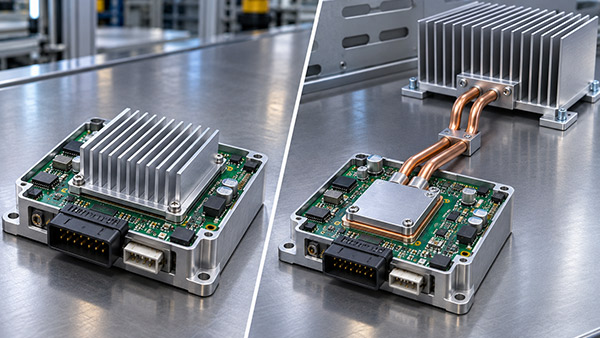
Direct-mounted heatsinks provide a relatively straightforward thermal path from an electronic component to the surrounding air, while remote heatsink systems transport heat to another location where more cooling space or airflow may be available. The best approach depends on the mechanical layout, heat load, interface resistance, and total cooling system complexity.
For industrial electronics manufacturers, this decision can strongly influence product dimensions and assembly requirements.
In direct-mount cooling, a heatsink is attached directly to the electronic component or its thermal mounting surface.
Thermal energy travels through the interface into the heatsink base and fins.
This arrangement is common for power supplies, processors, industrial controllers, and other electronic assemblies.
A direct-mounted aluminum heatsink can provide a relatively simple structure with fewer thermal connections.
However, the cooling performance may be limited by available space around the heat source.
What Is Remote Heat Sink Cooling?
A remote cooling arrangement transfers heat from the component to a heatsink located elsewhere.
Heat pipes, vapor chambers, or other thermal transport devices may be used.
This approach allows designers to position cooling fins in an area with more space or better airflow.
However, the system requires additional thermal interfaces and mechanical structures.
The remote heat transfer device must also be selected for its operating conditions.
Direct vs Remote Cooling Comparison
Factor
Direct-Mount Heat Sink
Remote Heat Sink
Cooling location
Near the heat source
Separate location
Thermal path
Usually relatively direct
Includes heat transport components
Mechanical complexity
Often lower
Often higher
Available fin space
Limited by local geometry
Can use remote space
Assembly requirements
Contact and mounting
Multiple interfaces and supports
Manufacturing cost
Application-dependent
Includes transport components
Typical use
General electronics cooling
Space-constrained electronic systems
Why Thermal Interface Count Matters
Every thermal interface can introduce additional resistance.
A remote cooling system may contain connections between the electronic component, transport device, and fin assembly.
These interfaces must be designed and assembled correctly.
However, the additional transport capability may outweigh the interface losses when the remote cooling location provides significantly better heat rejection.
When Should Direct Cooling Be Preferred?
Direct cooling is often attractive when:
The heat source has sufficient surrounding space.
Suitable airflow reaches the heatsink.
The thermal requirements can be met without remote transport.
The company's heat sink manufacturing capabilities can be considered when developing direct-mounted cooling structures or more specialized thermal assemblies.
Manufacturing feasibility should be confirmed using the complete thermal and mechanical design.
FAQ
Is direct-mount cooling always more efficient?
No. It may have fewer interfaces, but remote cooling can provide access to better airflow or larger heat rejection surfaces.
Are heat pipes necessary for every remote heatsink?
No. Other thermal transport approaches may be suitable depending on the application.
Does remote cooling always cost more?
It often introduces additional components and assembly operations, but the total cost depends on the overall equipment design.
Direct-mounted and remote heatsink cooling systems solve different thermal packaging problems.
The best solution balances heat transfer, mechanical integration, airflow availability, manufacturing cost, and reliability.
For OEM equipment, the decision should be based on the complete product architecture rather than assuming one cooling arrangement is universally superior.
Kingka Tech Industrial Limited
We specialize in Heat Sink、Liquid Cold Plate、precision CNC machining and our products are widely used in telecommunication industry, aerospace, automotive, industrial control, power electronics, medical instruments, security electronics, LED lighting and multimedia consumption.