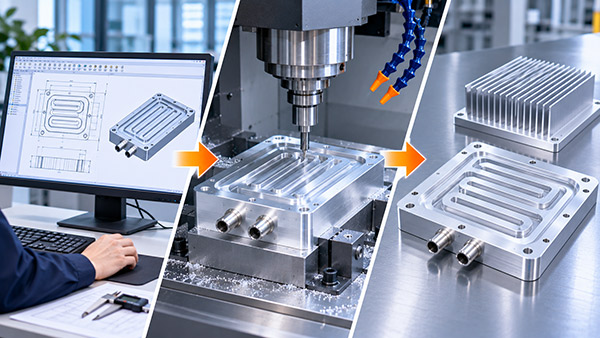
Custom Cooling Component Design Handoff: From Engineering Drawings to Manufacturing
KINGKA
A successful custom cooling component design handoff transfers all critical thermal, mechanical, material, and quality requirements from the OEM engineering team to the manufacturing supplier. Incomplete design information can lead to quotation differences, production delays, and parts that fit the drawing but fail functional requirements.
This is particularly important for customized heat sinks and Liquid Cold Plates, where manufacturing decisions can directly affect thermal performance.
What Is a Design Handoff?
Design handoff is the controlled transfer of approved product information from design engineering into manufacturing.
For custom thermal components, the handoff should communicate not only the intended shape but also the component's functional requirements.
A 3D CAD file is useful, but it may not contain all material, tolerance, surface finish, and testing information.
What Should Be Included in the Handoff Package?
Approved 3D CAD Model
The CAD model should represent the current approved geometry.
For assemblies, related component positions should be included when they affect mounting or cooling performance.
Controlled 2D Drawing
The drawing should identify critical dimensions, datum references, tolerances, material specifications, and surface finishing requirements.
Thermal Requirements
The manufacturer needs enough information to understand the cooling function.
This may include heat load, maximum operating temperature, airflow conditions, or coolant parameters.
Manufacturing Requirements
Any process restrictions should be stated.
For example, an OEM may require a specific alloy, joining process, or surface treatment because the design has already been qualified.
Inspection Requirements
Critical features should have defined acceptance criteria and suitable inspection methods.
Engineering Handoff Checklist
Information
Why It Matters
Drawing revision
Prevents outdated manufacturing
3D CAD file
Defines component geometry
Material grade
Controls thermal and mechanical properties
Critical tolerances
Identifies functional requirements
Interface flatness
Influences thermal contact
Airflow or coolant data
Establishes operating conditions
Test requirements
Defines performance verification
Quantity forecast
Supports process and cost planning
Packaging requirements
Protects finished components
Approval authority
Controls engineering changes
Why DFM Review Should Happen Before Production
Design for Manufacturability (DFM) review examines whether the proposed component can be manufactured reliably.
For extruded heat sinks, this may involve fin geometry, extrusion feasibility, machining access, and tooling requirements.
For liquid cold plates, DFM may address channel geometry, cover thickness, joining features, pressure integrity, and machining distortion.
An effective DFM review should identify risks before tooling or production begins.
Prototype Approval Is Not the Final Handoff
After prototype testing, engineers may make design adjustments.
These changes should be reflected in the approved drawing revision.
Production should not rely solely on informal email instructions or undocumented prototype modifications.
A clear engineering change process reduces the risk of producing outdated parts.
These capabilities make it a potential manufacturing partner for OEM teams transferring custom cooling component designs into production.
The company can be evaluated using the same controlled drawing package, technical requirements, and quality criteria used for other shortlisted suppliers.
FAQ
Is a STEP file enough for a custom heat sink quotation?
It can support initial geometry review, but material, tolerances, thermal requirements, and production details are also important.
Why should drawings have revision numbers?
Revision control helps prevent manufacturing from outdated specifications.
When should a supplier perform DFM review?
Ideally before tooling approval and before final production commitments.
Can KINGKA review custom thermal component drawings?
KINGKA's website describes drawing submission and manufacturing review as part of its service process. Project-specific feasibility should be confirmed directly.
Custom cooling component manufacturing begins with clear engineering communication.
A controlled design handoff helps align drawings, thermal performance, quality requirements, and production expectations.
For OEM projects involving heat sinks, liquid cold plates, and CNC-machined parts, KINGKA offers relevant manufacturing capabilities for technical evaluation.
Contact KINGKAto submit your engineering drawings and discuss custom cooling component manufacturing.
Kingka Tech Industrial Limited
We specialize in Heat Sink、Liquid Cold Plate、precision CNC machining and our products are widely used in telecommunication industry, aerospace, automotive, industrial control, power electronics, medical instruments, security electronics, LED lighting and multimedia consumption.