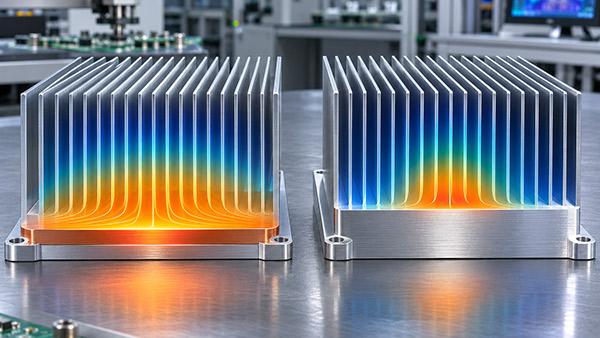
Copper Heat Spreader vs Thicker Aluminum Heat Sink Base: Which Is Better for OEM Electronics?
KINGKA
When an electronic component generates significant heat within a small contact area, increasing the number of heat sink fins may not solve the thermal problem.
Heat must first spread from the localized source into the heat sink base before it can reach the cooling fins.
Two possible approaches are increasing the thickness of the aluminum base or introducing a copper heat spreader between the electronic component and the extruded heat sink.
Quick Answer: A thicker aluminum base can improve heat spreading while preserving a relatively simple, integrated construction. A copper heat spreader may be more appropriate when heat is concentrated in a small region and local thermal conductivity is important. The better choice depends on hotspot size, heat load, available space, mechanical interfaces, and total manufacturing cost.
The electronic component transfers heat into the base, which distributes it toward the fins.
When the heat source covers only a small portion of the base, some fins may receive less heat than others.
In this situation, adding more fins does not necessarily produce a proportional reduction in component temperature.
Engineers must examine the thermal resistance between the heat source and the entire cooling surface.
Option 1: Increase the Aluminum Base Thickness
A thicker base creates additional material for heat to spread laterally before reaching the fins.
Potential advantages include:
Integrated aluminum construction.
Fewer material interfaces.
Straightforward mechanical assembly.
No additional copper component.
Manufacturing compatibility with suitable extrusion profiles.
However, additional thickness also increases weight and material consumption.
A thicker base may increase the conduction distance between the heat source and the cooling fins.
Therefore, increasing thickness does not guarantee better thermal performance in every application.
Option 2: Add a Copper Heat Spreader
Copper has higher thermal conductivity than common aluminum extrusion alloys.
A copper heat spreader can distribute localized heat before transferring it into the aluminum cooling structure.
This may be useful for compact power semiconductors, processors, and concentrated electronic heat sources.
However, the copper-to-aluminum interface introduces another thermal resistance.
The design must also consider attachment methods, thermal expansion, additional weight, and manufacturing cost.
Comparison: Copper Spreader vs Thick Aluminum Base
Factor
Thicker Aluminum Base
Copper Heat Spreader
Main purpose
Improve heat distribution within aluminum
Improve localized heat spreading
Material structure
Integrated aluminum
Copper-aluminum assembly
Additional interface
Not necessarily required
Usually required
Weight
Increases with thickness
Depends on copper dimensions
Manufacturing
Profile and machining dependent
Additional component and assembly
Cost
Aluminum and processing cost
Copper, joining, and assembly cost
Typical consideration
Distributed or moderate heat loads
Concentrated heat sources
When Should OEM Buyers Choose a Copper Spreader?
Copper deserves consideration when a small heat source generates a high local heat flux and an aluminum-only design cannot meet the required temperature limit.
However, buyers should first verify whether the thermal bottleneck is actually heat spreading.
Poor airflow, inadequate thermal interface contact, or unsuitable fin geometry may be the dominant problem instead.
Adding copper will not automatically compensate for those limitations.
When Is a Thicker Aluminum Base More Practical?
A thicker aluminum base may be preferable when a relatively simple mechanical structure is required and the additional aluminum can provide sufficient thermal improvement.
For repeat OEM production, an integrated aluminum heat sink extrusion profile can reduce the need for separate heat-spreading components.
However, profile geometry must remain manufacturable, and increased material use should be included in the cost comparison.
What Should OEM Buyers Ask Their Manufacturer?
Before approving either construction, request:
Heat-source dimensions and maximum power dissipation.
Maximum allowable component temperature.
Available cooling airflow.
Mounting and interface specifications.
Heat sink base thickness options.
Thermal simulation or comparative test results.
Material and production cost estimates.
Prototype validation requirements.
The supplier should evaluate the complete thermal path rather than comparing material conductivity alone.
Frequently Asked Questions
Does copper always improve aluminum heatsink performance?
No. The benefit depends on heat concentration, contact resistance, geometry, and the rest of the thermal system.
Is a thicker aluminum base always better?
No. Additional thickness can increase mass and conduction distance, and the improvement may become insignificant beyond a certain design point.
Can an extruded aluminum heat sink include a copper insert?
Yes, suitable assemblies can incorporate additional copper components, but the mechanical and thermal interfaces must be engineered and validated.
A copper heat spreader and a thicker aluminum heat sink base address similar thermal challenges through different constructions.
For OEM buyers, the appropriate choice should be supported by measured or simulated temperature performance, manufacturing feasibility, and total cost.
KINGKA provides custom aluminum heat sink extrusion solutions for electronic and industrial cooling applications. Engineering drawings and thermal requirements can be submitted for project-specific manufacturing review.
Kingka Tech Industrial Limited
We specialize in Heat Sink、Liquid Cold Plate、precision CNC machining and our products are widely used in telecommunication industry, aerospace, automotive, industrial control, power electronics, medical instruments, security electronics, LED lighting and multimedia consumption.