

A copper cold plate quotation should identify where copper is used, which materials contact the coolant and how the finished assembly is constructed. A copper body, an aluminum plate containing copper tubing and a hybrid plate with copper inserts describe different products.
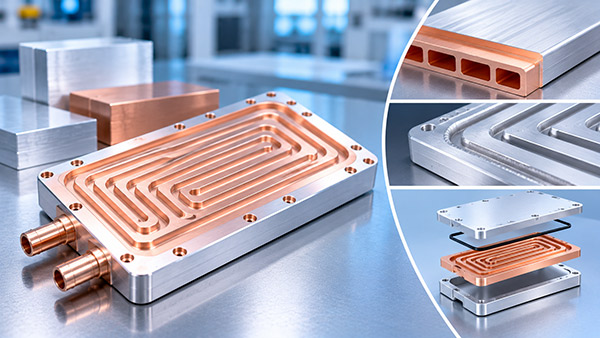
For enterprise buyers, this distinction affects quotation comparison, coolant compatibility, weight, inspection and application approval. The product name alone is insufficient to establish equivalent supply.
1. Separate the Plate Body from the Coolant Path
The plate body spreads heat from mounted components toward the cooling passages. The coolant path includes the surfaces and components exposed to the circulating fluid.
In an embedded-tube design, coolant can remain inside the tubing while the external base provides structural support and heat spreading. In a channeled design, the base, cover and other internal elements may form the wetted structure.
| Construction description | What purchasing should verify | Why the distinction matters |
|---|---|---|
| Copper body with internal passages | Body grade, cover material and sealing or joining method | Defines the actual component construction |
| Aluminum base with embedded copper tubing | Base alloy, tube grade, routing and tube-to-base interface | The external base and fluid path use different materials |
| Hybrid structure with copper inserts | Insert locations, dimensions and attachment method | Copper coverage may be limited to selected thermal regions |
| Coated or plated assembly | Substrate, coating specification and treated surfaces | Surface treatment and bulk material need separate definitions |
2. Request a Material Definition for the Assembly
The manufacturing package should identify the material requirements for the body, cover, tubing, fittings and other relevant components. Where brazing fillers, seals or coatings are used, their specifications should be controlled to the extent required by the application.
Ask which material documents will accompany production supply. Required records might include material identification, batch traceability or certificates within the agreed quality scope.
If a quotation proposes a material substitution, purchasing should refer it to engineering before acceptance. Similar appearance or a broad description such as “high-conductivity copper” does not provide a complete procurement specification.
3. Review Compatibility Across the Cooling Loop
Cold Plate Liquid Cooling involves materials beyond the plate itself. Pumps, heat exchangers, connectors and manifolds may introduce additional wetted metals or sealing materials.
Provide the supplier with the approved coolant specification and the relevant wetted-material information for the loop. The responsible system designer should review compatibility, including corrosion-control and maintenance requirements.
This review is particularly important when a proposed replacement changes the coolant-contact material while retaining the same external plate dimensions.
4. Compare Performance Under Common Conditions
Copper's thermal properties are only one part of the cooling design. Contact interfaces, distance to the coolant passages, channel geometry, inlet temperature and flow distribution also influence the measured result.
Request thermal data that identifies the heat-source footprint, power distribution, inlet conditions, flow and temperature measurement locations. Obtain pressure-drop information under the corresponding coolant conditions.
When comparing designs, verify that each candidate can meet the required component temperatures within the available hydraulic budget. A material description cannot establish this result by itself.
5. Match Acceptance Evidence to the Purchased Construction
| Acceptance area | Evidence to agree |
|---|---|
| Material identity | Specified grades and agreed supporting records |
| Mechanical interfaces | Contact geometry, mounting features and connection dimensions |
| Fluid containment | Leak and pressure test conditions with acceptance criteria |
| Hydraulic behavior | Flow and pressure-drop data under defined conditions |
| Thermal behavior | Performance evidence using the relevant heat-source and coolant conditions |
| Delivery condition | Agreed cleanliness, port protection, identification and packaging |
The required inspection plan should follow the design and application. Purchasing should confirm which activities are included in the unit price and which are separate development or qualification work.
6. Release a Defined Configuration
Before approving production, connect the quotation to the final drawing revision, material definition and acceptance plan. Record any approved alternatives so that repeat orders do not depend on an informal description from the original inquiry.
This provides a clearer basis for comparing copper cold plate suppliers and reviewing later changes.
Explore Custom Copper cold plates from KINGKA
KINGKA offers custom copper microchannel liquid cold plates. Submit your heat-source layout, coolant requirements, mounting constraints and quantities to discuss the proposed construction and manufacturing scope.
Frequently Asked Questions
Is an aluminum plate with copper tubing an all-copper cold plate?
It is a mixed-material construction. The base and tubing should be identified separately in the specification.
Does a copper cold plate guarantee a lower component temperature?
Performance depends on the complete thermal and hydraulic design. Compare candidate components under the intended operating conditions.
Should fittings appear in the material specification?
Yes, where they form part of the supplied assembly. Their wetted materials, connection details and compatibility should be addressed.