

Can a CPU run without a heatsink? Technically, some CPUs may power on briefly without a heatsink, but operating a conventional desktop or server CPU without proper cooling is unsafe and not recommended. Modern processors generate considerable heat during operation, and without an effective cooling solution, their temperatures can rise rapidly, triggering thermal throttling, system shutdown, or potential hardware damage.
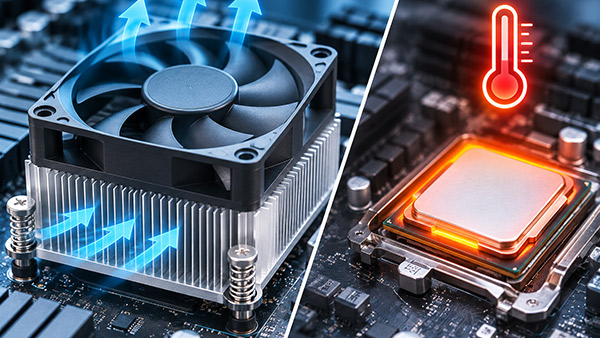
A properly designed CPU heatsink plays an essential role in transferring heat away from the processor and maintaining reliable operating temperatures. Whether used in desktop computers, industrial control systems, embedded electronics, or high-performance servers, effective thermal management is critical to processor performance and long-term system reliability.
Why Does a CPU Need a Heatsink?
A central processing unit (CPU) performs millions or billions of operations every second. During these operations, electrical energy is converted into heat inside the semiconductor components.
As processor workloads increase, heat generation can also increase. Without effective heat dissipation, the CPU temperature may rapidly approach its maximum operating limit.
A CPU heat sink helps prevent this problem by providing a thermal path between the processor and the surrounding environment.
The basic heat transfer process includes four stages:
The CPU generates heat during electrical operation.
Thermal interface material transfers heat from the processor's integrated heat spreader to the heatsink base.
The heatsink conducts and distributes heat through its metal structure and fins.
Natural convection or forced airflow carries heat away from the heatsink into the surrounding environment.
Most conventional CPU heatsinks use aluminum, copper, or a combination of both materials. Aluminum offers a favorable balance of thermal conductivity, weight, and manufacturing cost, making it widely used in extruded aluminum heatsinks and other electronic cooling components.
For industrial equipment manufacturers, selecting the appropriate heatsink is essential for achieving reliable processor cooling within specific space, power, and airflow limitations.
What Happens If You Run a CPU Without a Heatsink?
Running a CPU without proper cooling can cause several thermal problems. The exact behavior depends on the processor model, power consumption, firmware settings, ambient conditions, and built-in protection mechanisms.
1. Rapid Temperature Increase
Without a heatsink, heat cannot be transferred away from the CPU efficiently.
The processor's integrated heat spreader alone typically does not provide sufficient cooling for a conventional desktop or server CPU under normal operating conditions.
As a result, the processor temperature can rise quickly, even during startup or relatively light workloads.
2. CPU Thermal Throttling
Modern processors generally include temperature monitoring and thermal protection technologies.
When a CPU approaches its thermal operating limit, it may automatically reduce operating frequency, voltage, or power consumption to limit heat generation.
This process is known as CPU thermal throttling.
Although thermal throttling helps protect the processor, it can significantly reduce computing performance.
In industrial applications, unexpected performance limitations may interfere with systems requiring consistent processing capability.
3. Automatic System Shutdown
If thermal throttling cannot adequately control processor temperature, the system may automatically shut down as an additional protective measure.
This can cause unexpected interruptions, incomplete processing tasks, or operational downtime.
Thermal shutdown should be considered an emergency protection mechanism rather than a substitute for a properly designed cooling system.
4. Potential Hardware Damage
Modern CPUs incorporate protective features, but these mechanisms do not guarantee that damage is impossible.
Operating without adequate cooling can expose processors and related components to excessive thermal stress.
For this reason, manufacturers generally require an appropriate cooling solution before operating conventional desktop or server processors.
Can a CPU Run for a Few Seconds Without a Heatsink?
Some modern CPUs may successfully power on for a short period without a heatsink. However, the duration before thermal protection activates varies significantly between processor models and system configurations.
There is no universally safe number of seconds for operating a CPU without cooling.
Even a brief startup may cause the processor to reach unsafe temperatures under certain conditions.
Therefore, powering on a conventional CPU without an installed cooling solution is not recommended, including during troubleshooting or initial system assembly.
For equipment manufacturers, thermal testing should be conducted with the intended cooling system correctly installed.
Can a CPU Run Without a Fan but With a Heatsink?
Yes. A CPU can operate without a dedicated cooling fan if its heatsink and the surrounding system are designed to provide sufficient passive cooling.
This approach is commonly called passive CPU cooling.
Unlike active cooling systems, which use fans to move air through heatsink fins, passive cooling relies primarily on natural convection and radiation.
Passive cooling can be appropriate for low-power processors and certain embedded computing systems.
However, successful fanless operation depends on several engineering factors:
CPU power consumption and peak thermal load
Heatsink surface area and thermal resistance
Fin spacing and orientation
Ambient operating temperature
Chassis ventilation and installation position
Available space for heat dissipation
For compact electronic products, a customized aluminum heatsink can be designed to improve passive cooling performance while meeting mechanical integration requirements.
For higher-power processors, active air cooling or liquid cooling may be necessary.
CPU Cooling Methods: Which Solution Is Best?
Different CPU applications require different cooling technologies. Selecting the appropriate solution depends on processor heat generation, space limitations, airflow conditions, and reliability requirements.
| Cooling Method | Main Characteristics | Typical Applications |
|---|---|---|
| Passive Aluminum Heatsink | No dedicated fan; relies on natural convection | Low-power CPUs, embedded electronics |
| extruded aluminum heatsink with Fan | Cost-effective fin structure with forced airflow | Industrial computers, electronic controllers |
| Skived Fin Heatsink | High fin density and large heat transfer area | Compact high-performance electronics |
| Heat Pipe Cooling Module | Transfers heat efficiently to a remote fin assembly | Compact computers, high-power electronic systems |
| Liquid Cold Plate | Transfers heat into a circulating liquid cooling system | Servers, high-power processors, data centers |
No single cooling technology is universally suitable for every CPU.
The best solution must be selected based on actual thermal design requirements and verified under representative operating conditions.
Why Are aluminum heatsinks Widely Used for CPU Cooling?
Aluminum is one of the most commonly used materials in electronic thermal management because it offers several practical advantages.
Good Thermal Conductivity
Aluminum conducts heat effectively from the heatsink base toward the fin surfaces.
Although copper generally provides higher thermal conductivity, aluminum offers an effective balance between cooling performance, weight, and cost.
Lightweight Construction
Compared with copper, aluminum has significantly lower density.
This makes aluminum heatsinks particularly suitable for electronic assemblies where component weight and mechanical loading must be controlled.
Flexible Manufacturing
Aluminum can be processed using several manufacturing methods, including extrusion, CNC machining, skiving, and die casting.
An extruded aluminum heatsink can provide integrated fins and a base within a single profile, reducing the need for complex assembly operations.
Cost-Effective Production
For medium- and high-volume manufacturing, aluminum heat sink extrusion can provide consistent profiles and competitive production costs.
This makes aluminum particularly attractive to OEM equipment manufacturers developing repeatable electronic cooling solutions.
For applications requiring customized thermal structures, KINGKA provides extruded aluminum heatsink manufacturing solutions for industrial and electronic equipment.
How to Choose the Right CPU Heatsink
Selecting a suitable CPU heatsink requires more than comparing physical dimensions or fin quantities.
Engineers and procurement professionals should evaluate the complete thermal environment.
1. Determine CPU Heat Dissipation Requirements
Start by identifying the processor's relevant power and thermal specifications.
Thermal design power (TDP) can serve as an initial reference, but actual sustained and peak CPU power consumption should also be considered.
A heatsink must be capable of removing enough heat under the intended workload and environmental conditions.
2. Evaluate Heatsink Thermal Resistance
Thermal resistance is an important parameter when evaluating CPU cooling performance.
A simplified heatsink-to-ambient thermal resistance relationship is:
RθSA = (Ts − Ta) / Q
Where:
RθSA = Heatsink-to-ambient thermal resistance (°C/W)
Ts = Heatsink reference surface temperature (°C)
Ta = Ambient temperature (°C)
Q = Heat transferred through the heatsink (W)
Lower thermal resistance generally indicates more effective heat dissipation under comparable testing conditions.
However, total CPU junction temperature also depends on package thermal resistance, thermal interface materials, heat spreading, and mounting conditions.
For example, if a heatsink must dissipate 100 W while maintaining a 40°C heatsink-to-ambient temperature difference, the required heatsink-to-ambient thermal resistance is:
RθSA = 40 / 100 = 0.4°C/W
This is a simplified design target rather than a complete CPU temperature calculation.
3. Consider Airflow Conditions
The same heatsink may perform differently under natural convection and forced airflow.
Fin spacing, fin direction, and available airflow should be evaluated together.
For fan-cooled systems, the heatsink design must be compatible with the actual airflow produced by the fan within the assembled equipment.
4. Evaluate Material and Manufacturing Process
Different manufacturing processes support different heatsink geometries.
Extruded aluminum heatsinks are suitable for many standardized and customized cooling applications where cost-effective production and reliable thermal performance are important.
Skived fin heatsinks can provide increased fin density for space-constrained applications requiring larger heat transfer surfaces.
Heat pipes and liquid cold plates may be considered when the heat source location or thermal load makes conventional air cooling difficult.
5. Verify Mechanical Compatibility
A CPU heatsink must also match the equipment's mechanical requirements.
Important considerations include mounting hole positions, contact surface flatness, thermal interface material, assembly pressure, electrical clearance, and available installation space.
For OEM projects, custom machining and mounting features can help improve integration with the final electronic assembly.
Custom CPU Heatsinks for Industrial and OEM Applications
Standard CPU coolers may not satisfy the thermal and mechanical requirements of every electronic system.
Industrial computers, embedded processors, communication equipment, and specialized computing devices may require heatsinks with customized dimensions, fin structures, mounting interfaces, or operating characteristics.
A custom CPU heatsink enables manufacturers to optimize cooling performance around the actual product design rather than relying entirely on standard off-the-shelf components.
KINGKA provides custom thermal management components for industrial and electronic applications, including:
Extruded Aluminum Heatsinks: Custom profiles with integrated fins, CNC machining, and mounting features.
Skived Fin Heatsinks: High-density aluminum or copper fin structures for compact cooling applications.
Heat Sink Assemblies: Customized heatsink structures designed for specific electronic integration requirements.
Liquid Cold Plates: Liquid cooling components for high-power processors and advanced thermal systems.
For applications requiring greater fin density, explore KINGKA's skived fin heatsink solutions.
For customized aluminum cooling components, KINGKA can support engineering discussions based on thermal requirements, drawings, material preferences, and production quantities.
What Information Should OEM Buyers Provide for a Custom CPU Heatsink?
When requesting a quotation from a CPU heat sink manufacturer, providing complete technical information can improve design evaluation and quotation accuracy.
Important project details include:
Processor power: Sustained and peak power dissipation requirements.
Temperature limits: Maximum permitted CPU temperature and expected ambient operating conditions.
Cooling method: Passive convection, forced-air cooling, or liquid cooling.
Mechanical dimensions: Available installation space, mounting points, and contact surface requirements.
Material preferences: Aluminum, copper, or specific material grades.
Manufacturing quantity: Prototype requirements and estimated production volumes.
Technical drawings: CAD models, dimensional drawings, and relevant specifications.
These details help the manufacturer assess suitable materials, fin structures, machining processes, and production methods.
For volume manufacturing, early communication between thermal engineers and heatsink suppliers can reduce unnecessary design revisions and improve manufacturability.
Frequently Asked Questions
Can a CPU run without a heatsink?
A conventional desktop or server CPU may briefly power on without a heatsink, but doing so is unsafe and not recommended. Without sufficient cooling, the processor can overheat rapidly and trigger thermal throttling or shutdown.
Will a CPU be damaged immediately without a heatsink?
Not necessarily. Modern processors often include thermal protection mechanisms, but damage remains possible. The outcome depends on the processor, electrical power, temperature, and protection system. There is no guaranteed safe operating duration without proper cooling.
Can thermal paste replace a heatsink?
No. Thermal paste improves thermal contact between the processor and its heatsink. It does not provide sufficient heat dissipation on its own.
Can I use a CPU without a cooling fan?
Yes, if the processor and heatsink are designed for passive cooling. Low-power CPUs may operate with appropriately sized passive heatsinks, while higher-power processors generally require more effective cooling.
Is an aluminum heatsink good for CPU cooling?
Yes. Aluminum heatsinks provide good thermal conductivity, low weight, flexible manufacturing options, and competitive costs. Their suitability depends on CPU power, heatsink design, and operating conditions.
Is a copper heatsink better than an aluminum heatsink?
Copper generally has higher thermal conductivity, which can improve heat spreading. However, copper is heavier and typically more expensive. The best choice depends on thermal requirements, weight, cost, and available cooling space.
Can a custom extruded heatsink be used for an industrial CPU?
Yes. Custom extruded aluminum heatsinks can be designed for industrial CPU cooling applications, provided their thermal performance, mounting structures, airflow requirements, and operating conditions are properly evaluated.
Conclusion
Can a CPU run without a heatsink? While some processors may operate momentarily without cooling, conventional desktop and server CPUs should never be intentionally operated without an appropriate thermal solution.
A reliable heatsink helps maintain stable processor temperatures, prevent thermal throttling, and support consistent system performance.
For OEM equipment manufacturers, the most effective CPU cooling solution depends on processor power, available space, airflow, material selection, and manufacturing requirements.
Whether an application requires a standard aluminum profile, a custom extruded heatsink, or a high-density skived fin heatsink, selecting the right thermal design is an essential step toward reliable electronic equipment.
Looking for a Custom CPU Heatsink Manufacturer?
KINGKA provides custom aluminum heatsinks, precision-machined thermal components, and cooling solutions for industrial and electronic applications.
Explore our custom heat sink manufacturing capabilities or contact KINGKA to discuss your heatsink requirements and request a quotation.