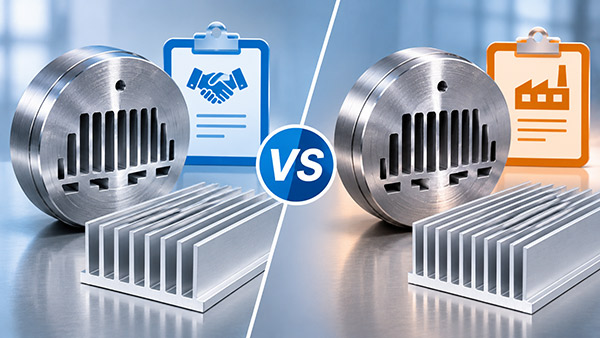
Buyer-Owned vs Supplier-Owned Heat Sink Extrusion Dies: What Should OEM Procurement Teams Negotiate?
KINGKA
Custom extruded aluminum heat sinks often require a dedicated extrusion die.
This tooling can represent an important upfront investment, especially when an OEM expects to purchase the same profile for several years.
However, paying a tooling charge does not automatically establish who legally owns the die or who can control its use.
OEM buyers should clarify the ownership and management arrangements before approving production.
Quick Answer: Buyer-owned extrusion tooling can provide greater contractual control over a custom profile, particularly when the OEM anticipates long-term sourcing or future supplier changes. Supplier-owned tooling may simplify certain initial commercial arrangements. Neither model is inherently better; the agreement should clearly define ownership, use rights, storage, maintenance, replacement, and transfer responsibilities.
Why Does Extrusion Die Ownership Matter?
An aluminum extrusion die creates the cross-sectional geometry of the heat sink profile.
Its design influences fin dimensions, base geometry, integrated mounting features, and manufacturing feasibility.
For a long-running OEM product, the extrusion profile may become an important part of the approved mechanical and thermal design.
If the tooling becomes unavailable, damaged, or disputed, purchasing continuity can be affected.
This makes die ownership a commercial and engineering issue.
Option 1: Buyer-Owned Extrusion Tooling
Under a buyer-owned arrangement, the OEM has ownership rights as defined by the tooling agreement.
The physical die may remain at the manufacturer's facility for production.
Potential advantages include:
Contractual control over tooling use.
Clearer arrangements for long-term product programs.
Potential rights to transfer the die.
Greater visibility over tooling replacement decisions.
However, legal ownership does not guarantee that a particular die can be used successfully at another extrusion factory.
Different equipment, tooling systems, and production processes may create compatibility limitations.
Option 2: Supplier-Owned Extrusion Tooling
Under a supplier-owned arrangement, the manufacturer retains ownership of the die.
The commercial agreement may distribute tooling costs through a separate charge, part pricing, or another negotiated method.
This may simplify administration for some procurement projects.
However, the OEM should understand the implications for future supply continuity and design control.
A supplier-owned die may not be transferable to another manufacturing company.
Buyer-Owned vs Supplier-Owned Tooling
Evaluation Factor
Buyer-Owned Die
Supplier-Owned Die
Ownership
OEM, as contractually defined
Manufacturer
Initial payment
Contract-dependent
Contract-dependent
Tool storage
Agreed with supplier
Usually supplier-managed
Transfer rights
Defined by agreement
Generally restricted
Tool maintenance
Responsibilities negotiated
Responsibilities negotiated
Replacement cost
Contract-dependent
Contract-dependent
Design confidentiality
Requires contractual protection
Requires contractual protection
Does Paying for a New Die Mean the Buyer Owns It?
Not automatically.
A tooling fee may cover engineering, die manufacturing, development, or access to dedicated tooling.
Ownership must be established through the actual commercial agreement.
The contract should also distinguish ownership of the physical die from ownership or permitted use of drawings, CAD files, and related design information.
What Should OEM Buyers Include in a Tooling Agreement?
Before placing a production order, buyers should clarify:
Ownership of the physical extrusion die.
Rights to use the tooling.
Ownership and confidentiality of technical drawings.
Location and conditions of tool storage.
Inspection and maintenance responsibilities.
Procedures for tooling correction.
Responsibility for replacement costs.
Rights and procedures for tool transfer.
Conditions after termination of the supply agreement.
Approval requirements for profile design changes.
These terms should be supported by appropriate purchase agreements and legal review.
Why Does Tooling Condition Affect Product Quality?
Extrusion dies experience wear and may require correction or replacement during their service life.
Changes in die condition can affect profile dimensions and manufacturing consistency.
For a custom heat sink, dimensional changes may influence mounting compatibility, fin geometry, and thermal performance.
The supplier should therefore maintain suitable process controls and inspection methods.
OEM buyers should establish which changes require approval before production continues.
Should Buyers Qualify an Alternative Manufacturing Source?
For long-term or critical equipment programs, second-source planning can reduce dependence on a single manufacturer.
However, supplier qualification requires more than obtaining the original die.
An alternative manufacturer must demonstrate that its extrusion and finishing processes can produce components meeting the approved specification.
Thermal, dimensional, material, and surface requirements may need to be revalidated.
When comparing heat sink manufacturers, buyers should assess technical capability alongside tooling management policies.
Useful questions include:
Who owns the tooling after payment?
Where will the die be stored?
Can the tooling be used for another customer?
What happens if the die becomes damaged?
How are engineering revisions approved?
What documentation is available for recurring orders?
What happens when the supply agreement ends?
Clear answers can help reduce future sourcing disputes.
Frequently Asked Questions
Can an extrusion die be transferred between manufacturers?
Possibly, but compatibility with the receiving manufacturer's equipment and processes must be evaluated.
Is buyer-owned tooling always more expensive?
Not necessarily. Total cost depends on the commercial terms, tooling development, maintenance, replacement, and production volume.
Who pays for die maintenance?
The responsible party should be defined in the tooling or manufacturing agreement.
Can a supplier change the die without customer approval?
That depends on the contract and approved change-control requirements. Changes affecting product specifications should be evaluated before implementation.
Extrusion tooling ownership should be treated as an important part of long-term OEM heat sink procurement.
Buyer-owned and supplier-owned arrangements can both work when responsibilities are clearly defined.
The most suitable approach depends on design control, sourcing strategy, production volume, and future supply requirements.
Purchasing teams can submit drawings, production forecasts, and tooling requirements for project-specific technical and commercial discussions.
Kingka Tech Industrial Limited
We specialize in Heat Sink、Liquid Cold Plate、precision CNC machining and our products are widely used in telecommunication industry, aerospace, automotive, industrial control, power electronics, medical instruments, security electronics, LED lighting and multimedia consumption.