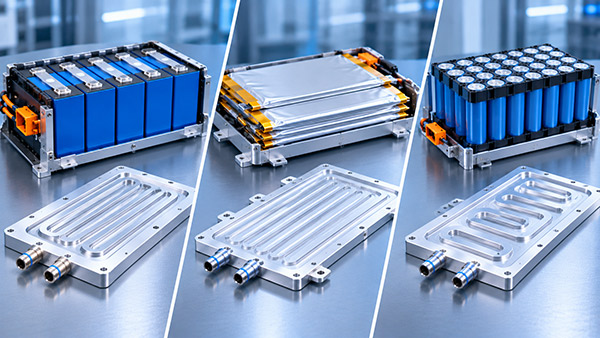
Battery Cooling Plate Selection: Prismatic vs Pouch vs Cylindrical Battery Packs
KINGKA
Battery cooling plate selection depends heavily on battery cell format. Prismatic, pouch, and cylindrical cells have different shapes, contact surfaces, mechanical constraints, and heat-transfer paths.
For OEM battery pack manufacturers, choosing a cooling plate based only on total heat generation can lead to problems with temperature uniformity, assembly tolerances, and manufacturing costs.
Quick Answer: Prismatic and pouch battery packs can often accommodate relatively large cooling contact surfaces, while cylindrical cell assemblies may require specialized cooling paths around grouped cells. The most suitable battery cooling plate depends on cell geometry, heat generation, available contact area, pack structure, and allowable temperature differences.
Why Does Battery Cell Format Affect Cooling Plate Design?
Battery cells generate heat during charging and discharging. That heat must travel through the cell structure and mounting interfaces before reaching the coolant.
Different cell formats produce different thermal and mechanical design constraints.
A flat cooling plate that works well beneath one prismatic module may be unsuitable for a cylindrical cell arrangement with limited contact area.
Therefore, OEM engineers should evaluate the battery cell format before selecting channel geometry, base thickness, or manufacturing technology.
Cooling Plates for Prismatic Battery Cells
Prismatic cells have rigid rectangular housings, which can provide relatively large flat contact regions.
Depending on the pack architecture, cooling may be applied beneath the modules, along their sides, or through other engineered contact surfaces.
An aluminum battery cooling plate can be designed with internal liquid passages that follow the heat distribution of the battery assembly.
Important engineering considerations include:
Cooling surface dimensions.
Contact pressure and thermal interface material.
Flatness of the mounting area.
Cell expansion and mechanical loading.
Coolant flow distribution.
Electrical isolation requirements.
A rigid cell housing does not eliminate the need to account for dimensional variation and expansion throughout the battery's operating life.
Cooling Plates for Pouch Battery Cells
Pouch cells use flexible packaging rather than rigid metal housings.
This makes mechanical support and compression management especially important.
Cooling structures may be positioned against module surfaces or integrated into supporting components, depending on the battery design.
The cooling plate must not introduce unsuitable localized pressure or interfere with the intended cell compression arrangement.
OEM buyers should provide detailed module assembly drawings and identify the permissible mechanical loads.
Thermal performance should be assessed at the battery module level rather than using plate temperature measurements alone.
Cooling Plates for Cylindrical Battery Cells
Cylindrical cells introduce a different challenge because their curved surfaces do not naturally provide the same broad, flat contact area as rectangular cells.
Depending on the assembly, cooling may use a base plate, side-contact structures, or other specialized heat-transfer arrangements.
A simple bottom cooling plate may not deliver the required temperature uniformity in every cylindrical pack.
The design must account for cell spacing, module geometry, contact materials, and the location of coolant passages.
Additional mechanical complexity can also affect assembly cost and serviceability.
Battery Cooling Plate Comparison
Evaluation Factor
Prismatic Cells
Pouch Cells
Cylindrical Cells
Cell geometry
Rigid rectangular
Flexible flat package
Cylindrical
Cooling contact
Flat surfaces available
Depends on support structure
Requires careful contact design
Mechanical concern
Expansion and tolerances
Compression and support
Cell spacing and contact consistency
Plate customization
Module-specific
Compression-compatible
Geometry-specific
Typical challenge
Temperature uniformity
Thermal and mechanical integration
Heat-transfer path optimization
Is Bottom Cooling Always the Best Choice?
No.
Bottom cooling can simplify some battery pack layouts, but its performance depends on the internal thermal characteristics of the cells and the available contact area.
Side cooling or other arrangements may offer advantages for specific cell types.
The correct comparison should consider maximum cell temperature and temperature differences throughout the pack under representative charging, discharging, and environmental conditions.
What Should OEM Buyers Include in Their RFQ?
A useful request for quotation should contain:
Battery cell format and module arrangement.
Overall battery pack or module dimensions.
Expected heat generation during operating cycles.
Maximum allowable cell temperature.
Target temperature uniformity.
Coolant type, inlet temperature, and flow rate.
Allowable pressure drop.
Cooling plate mounting and interface requirements.
Expected prototype and production quantities.
Required pressure, leak, and dimensional tests.
Manufacturers should also understand the equipment's vibration, thermal cycling, and service conditions.
FSW construction: Suitable for selected custom aluminum channel designs when weld paths and plate geometry accommodate friction stir welding.
Brazed construction: Can be considered for integrated channel structures where the joining method and materials meet project requirements.
Embedded tube construction: May be suitable for certain layouts using formed metal tubing within a supporting base.
Manufacturing selection should consider production volume, assembly geometry, joining requirements, and inspection capability.
KINGKA Battery Cooling Plate Manufacturing
KINGKA provides custom liquid cooling plate manufacturing for battery and industrial thermal management applications.
Its Battery Pack Liquid Cooling Plate product range includes aluminum-based constructions and project-specific channel and mounting configurations.
OEM manufacturers can provide battery module drawings, thermal data, coolant conditions, and expected purchasing quantities for feasibility evaluation.
Frequently Asked Questions
Can the same cooling plate be used for prismatic and pouch cells?
Not automatically. The thermal contact and mechanical support requirements may differ substantially.
Is aluminum suitable for battery cooling plates?
Aluminum is commonly considered because of its thermal conductivity, relatively low density, and manufacturing flexibility. The final material selection depends on coolant and application requirements.
Does a battery cooling plate prevent thermal runaway?
No cooling plate can independently guarantee prevention of thermal runaway. Battery safety depends on cell design, battery management, system architecture, protection measures, and validation.
Should buyers evaluate individual cells or the complete battery module?
Both may be relevant, but module-level validation is important because assembly conditions influence temperature distribution.
Prismatic, pouch, and cylindrical battery packs should not automatically use identical cooling plate designs.
OEM buyers should select a battery cooling plate based on cell geometry, mechanical integration, thermal performance, and manufacturing requirements.
We specialize in Heat Sink、Liquid Cold Plate、precision CNC machining and our products are widely used in telecommunication industry, aerospace, automotive, industrial control, power electronics, medical instruments, security electronics, LED lighting and multimedia consumption.